Building a Reputation-Based Email Infrastructure at Scale: How We Solved the Multi-Tenant Email Delivery Crisis
Working on email infrastructure at scale taught me that delivery problems compound quickly in multi-tenant environments. Our platform handles survey distribution, processing over 15 million emails monthly from our US datacenter alone, with six additional datacenters handling global traffic.
The shared email infrastructure that made economic sense was becoming our biggest technical liability. IP blacklisting events were frequent, delivery rates occasionally dropped below 50%, and we had minimal visibility into what was actually happening to emails after they left our servers.
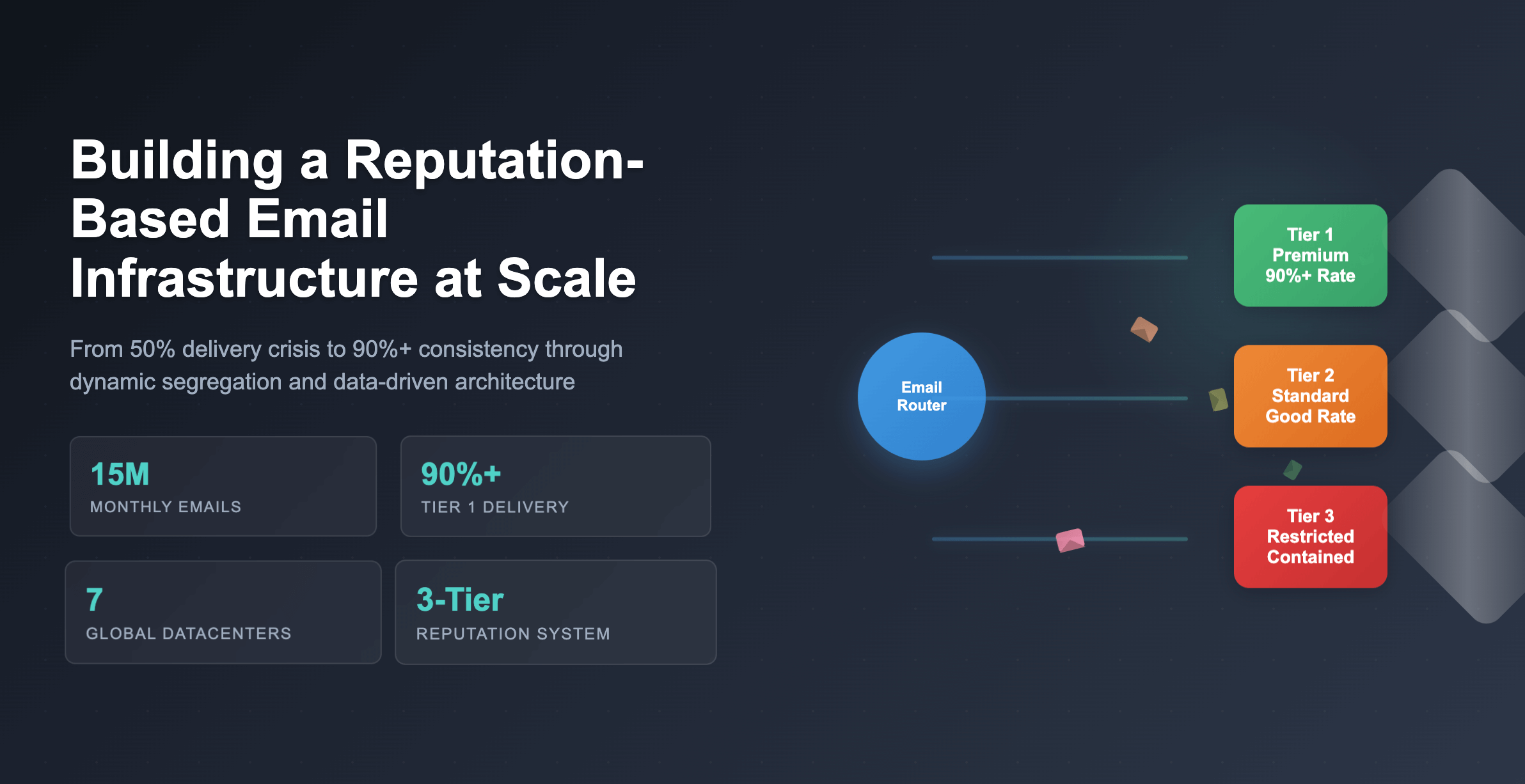
This is how we rebuilt our email system from a reactive, failure-prone infrastructure into a self-managing, reputation-based architecture that now consistently delivers over 90% of emails for our top-tier clients.
Table of Contents
- The Multi-Tenant Nightmare
- Phase 1: Building the Foundation - Comprehensive Tracking System
- Phase 2: Pattern Recognition - The Culprits Revealed
- Phase 3: The Reputation Revolution - Dynamic Segregation
- The Results: From Crisis to Consistency
- Technical Lessons and Ongoing Evolution
- The Ongoing Battle
- Conclusion: Building for Scale and Fairness
The Multi-Tenant Nightmare
Picture this: You’re running a SaaS survey analytics platform where thousands of organizations rely on your email infrastructure to reach their audiences. Your US datacenter alone processes 15 million emails monthly, with six other datacenters handling additional volume worldwide. Everything within a datacenter runs on a shared infrastructure model—cost-effective and seemingly efficient.
Until it isn’t.
The problems started manifesting in a cascade of failures:
1. Constant IP Blacklisting
Our email infrastructure IPs were getting blacklisted regularly by major email service providers. What should have been isolated incidents became a recurring nightmare that affected every single client using our platform.
2. Zero Visibility
We were essentially flying blind. Once an email left our servers, we had no meaningful way to track what happened to it. Did it reach the inbox? Get marked as spam? Bounce due to invalid addresses? We simply didn’t know.
3. Mystery Failures
When emails failed to deliver, we couldn’t pinpoint the exact reasons. Was it a configuration issue? Content problem? Reputation damage? The lack of granular failure tracking made debugging nearly impossible.
4. The Band-Aid Approach
Our “solution” was reactive IP switching—constantly rotating to new IPs whenever blacklisting occurred. This temporary fix actually made things worse, as constantly changing IPs prevented us from building any positive sender reputation.
The multi-tenant architecture that was supposed to be our strength had become our weakness. Bad actors were dragging down the entire system, and good clients were suffering the consequences of others’ poor email practices.
Phase 1: Building the Foundation - Comprehensive Tracking System
The first rule of fixing any system is understanding what’s actually happening. We realized that before we could solve the delivery problem, we needed to build comprehensive visibility into our email pipeline.
Custom Email Tracking Infrastructure
We implemented a sophisticated tracking system built around our existing SMTP servers:
Header-Based Tracing: Every email sent through our system now gets tagged with specific custom headers that allow us to trace any email back to the exact user and organization that triggered it. These headers became our breadcrumbs through the complex email delivery maze.
Log Parsing Engine: We built a robust log parsing system that monitors delivery status for every individual email. This system captures not just whether an email was delivered, but the specific reasons for any failures—whether it’s a soft bounce, hard bounce, spam marking, or reputation-based rejection.
User-Organization Mapping: Every email metric gets tagged back to the originating user and organization, creating a comprehensive database of sending patterns and delivery outcomes across our entire client base.
The Data Revolution
For the first time, we could answer critical questions:
- How many emails is each client sending daily?
- What’s the delivery rate for each organization?
- Which specific clients are experiencing the highest bounce rates?
- What are the most common failure reasons across different user segments?
You can’t optimize what you can’t measure, and we were finally measuring everything.
Phase 2: Pattern Recognition - The Culprits Revealed
With data flowing in, patterns began emerging that explained our infrastructure-wide problems:
The Bad Actor Problem
Our analysis revealed that a small percentage of users were responsible for disproportionate damage to our overall IP reputation:
- High-Volume Spammers: Some clients were sending large volumes of emails that consistently bounced or got marked as spam
- Poor List Hygiene: Organizations using outdated or purchased email lists with high invalid address rates
- Content Issues: Clients sending emails that triggered spam filters due to poor content practices
Configuration Chaos
A significant portion of our delivery issues stemmed from improper email authentication:
- Missing SPF Records: Clients not properly configuring Sender Policy Framework
- Inadequate DKIM: Missing or incorrectly implemented DomainKeys Identified Mail
- DMARC Misconfigurations: Improper Domain-based Message Authentication, Reporting, and Conformance policies
These authentication failures weren’t just affecting the individual clients—they were damaging the reputation of our shared IP pools, causing collateral damage across our entire platform.
The Collective Punishment Reality
The most sobering realization was that email service providers don’t distinguish between clients on shared infrastructure. When one client’s poor practices damaged our IP reputation, everyone suffered. Gmail, Outlook, and other major providers were treating our entire infrastructure as suspect based on the actions of our worst-performing users.
Phase 3: The Reputation Revolution - Dynamic Segregation
Armed with comprehensive data and clear understanding of the problems, we designed a solution: a dynamic, reputation-based email infrastructure that automatically segregates users based on their email practices and delivery performance.
Multi-Tier Reputation System
We created a sophisticated reputation scoring algorithm that evaluates each user and organization across multiple parameters:
Primary Factors
- Authentication Compliance: Proper
SPF,DKIM, andDMARCconfiguration - Delivery Quality: Bounce rates, spam complaints, and engagement metrics
- Sending Patterns: Volume consistency, frequency patterns, and list quality indicators
- Content Quality: Spam score assessments and content best practice adherence
Tier Structure
| Tier | Classification | Criteria |
|---|---|---|
| Tier 1 | Premium | Excellent email practices, proper authentication, high delivery rates |
| Tier 2 | Standard | Good practices but room for improvement |
| Tier 3 | Restricted | Poor email hygiene, high bounce rates, authentication issues |
Dedicated IP Pool Architecture
Each reputation tier gets its own dedicated cluster of IP addresses:
- Tier 1 IPs: Premium IP pools with excellent sender reputation, used exclusively by our best-performing clients
- Tier 2 IPs: Standard IP pools for average performers
- Tier 3 IPs: Isolated IP pools that contain users with poor email practices, preventing them from damaging higher-tier infrastructure
Self-Regulating Ecosystem
The beauty of this system lies in its self-regulating nature:
Automatic Tier Assignment: Users are automatically assigned to tiers based on their real-time performance metrics. There’s no manual intervention required—the system continuously evaluates and reassigns users based on their behavior.
Incentivized Improvement: Clients quickly realize that following email best practices directly impacts their delivery rates. Poor practices result in automatic demotion to lower tiers with worse delivery performance.
Protected Premium Experience: Our best clients enjoy consistently high delivery rates because they’re isolated from the negative impact of poor performers.
Containment Strategy: Bad actors are effectively contained in Tier 3, where their poor practices only affect others with similar behavior patterns.
The Results: From Crisis to Consistency
The transformation has been remarkable:
Delivery Rate Revolution
| Metric | Before | After |
|---|---|---|
| Worst Case | Below 50% during blacklisting | Tier 1: Consistently >90% |
| Stability | Highly volatile | Consistent performance regardless of lower tiers |
| Recovery Time | Days to weeks | Hours (tier-isolated) |
IP Reputation Recovery
- ✅ Reduced Blacklisting: Dramatic reduction in IP blacklisting incidents across all tiers
- ✅ Faster Recovery: When issues do occur, they’re contained to specific tiers, allowing faster resolution
- ✅ Reputation Building: Premium tier IPs continuously build positive sender reputation through consistent good practices
Client Satisfaction Impact
- Predictable Performance: Clients can now predict their email delivery performance based on their practices
- Clear Improvement Path: Organizations understand exactly what they need to do to improve their delivery rates
- Fair Resource Allocation: Good clients no longer subsidize the poor practices of bad actors
Technical Lessons and Ongoing Evolution
This project taught us several critical lessons about building scalable infrastructure:
The Power of Data-Driven Architecture
Every decision in our new system is backed by real-time data. We’re not guessing about email performance—we’re measuring it continuously and adjusting automatically.
Self-Regulating Systems Scale Better
By creating a system that automatically responds to user behavior, we’ve built infrastructure that scales without proportional increases in manual oversight.
Reputation is a Shared Resource
In multi-tenant environments, individual behavior affects collective outcomes. Effective segregation strategies are essential for protecting good actors from bad ones.
Evolution Never Stops
This system took well over a year to fully implement across all three phases, and it continues to evolve today. Email deliverability is an ongoing battle against changing spam detection algorithms, new authentication requirements, and evolving best practices.
We’re constantly refining our reputation algorithms, adjusting tier thresholds, and improving our tracking capabilities. The system we’ve built today is significantly more sophisticated than what we launched in Phase 3, and we expect it to continue evolving.
The Ongoing Battle
Email infrastructure at scale isn’t a problem you solve once—it’s an ongoing battle that requires constant vigilance, continuous improvement, and adaptive strategies. Our reputation-based system has given us the tools to fight this battle effectively, but the landscape continues to evolve.
Major email providers regularly update their spam detection algorithms. New authentication standards emerge. Client behavior patterns shift. Our infrastructure must be flexible enough to adapt to these changes while maintaining the core principle of protecting good actors from the consequences of poor performers.
Conclusion: Building for Scale and Fairness
What started as a crisis—constant IP blacklisting and delivery rates below 50%—became an opportunity to fundamentally rethink how multi-tenant email infrastructure should work. By building comprehensive visibility, implementing data-driven reputation scoring, and creating automatic segregation based on behavior, we’ve created a system that scales fairly and performs consistently.
Key insight: In shared infrastructure environments, individual behavior has collective consequences. The solution isn’t to accept this as inevitable—it’s to build systems smart enough to automatically group users based on behavior and protect good actors from the negative externalities of poor performers.
For Technical Teams Building Similar Infrastructure
- Invest in comprehensive monitoring - You can’t fix what you can’t see
- Use data to drive architectural decisions - Let metrics guide your system design
- Build systems that automatically adapt - Self-regulating systems scale better than manual processes
The result is infrastructure that not only scales technically but scales fairly—ensuring that clients get the level of service their practices deserve.
Our journey from email delivery crisis to reputation-based excellence proves that with the right approach, even the most challenging infrastructure problems can become opportunities for innovation that benefits everyone involved.