Choosing the right question type shapes the quality of your survey data. In research, few decisions matter more than selecting between open-ended vs close-ended questions, since the format directly affects how people respond and how insights are interpreted.
Open-ended questions capture detail, context, and reasoning in respondents’ own words. Close-ended questions help researchers collect structured, comparable data at scale.
Understanding how each works makes it easier to design surveys that are both efficient and meaningful, especially for research teams across the USA working with diverse audiences.
In this article, we will explain what each question type means, how they differ, when to use them, and how combining both leads to stronger insights.
What are open-ended questions?
Open-ended questions allow respondents to answer freely, without predefined response options. Instead of selecting from a list, participants describe their thoughts in their own words.
This format is commonly used when researchers want explanations, opinions, or ideas that may not fit neatly into categories.
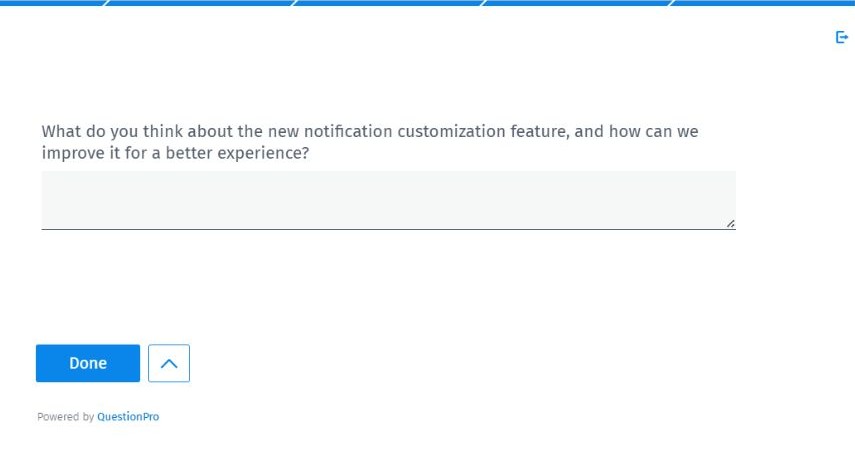
For example, A mobile app launches a new notification customization feature. Early usage data shows mixed engagement, but the team does not yet understand why.
Get the Full Story: Open-Ended Questions: What it is, Examples & Advantages
What are close-ended questions?
Close-ended questions provide a fixed set of answer options. Respondents choose from predefined responses such as yes or no, multiple choice options, or rating scales.
This format produces structured data that is easy to quantify, compare, and visualize across large samples. It is widely used in customer satisfaction surveys, employee feedback programs, and market research studies in the USA.
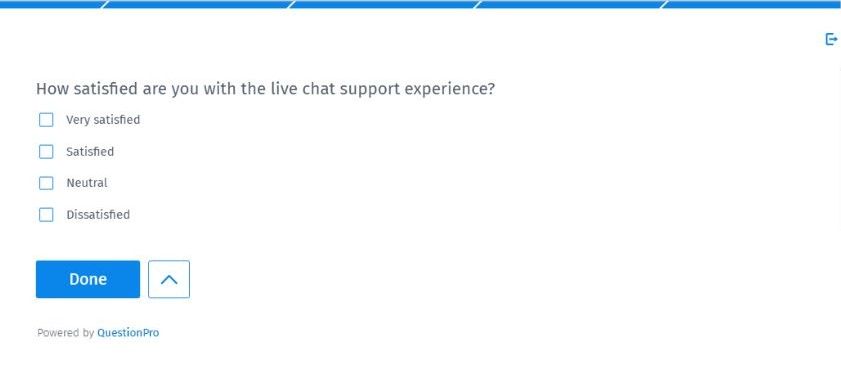
For example, A company introduces live chat support and wants to measure how customers perceive the experience after an interaction. Here you can ask: Here you can ask:
Discover More: Types of Close-Ended Questions with Survey Examples
Key differences between open-ended and close-ended questions
The main difference between open-ended vs close-ended questions lies in how responses are collected and analyzed. Each format supports a different research goal.
| Aspect | Open-ended questions | Close-ended questions |
| Response format | Respondents write their own answers freely | Fixed answer choices such as yes or no, multiple choice, rating scales |
| Type of data | Text-based, unstructured, rich in detail | Structured, numerical, easy to categorize |
| Time required | Takes longer to answer and interpret | Quick to answer and analyze |
| Depth of insight | Provides deeper context and explanations | Offers surface-level insights |
| Flexibility for respondents | High, since people can share anything they want | Limited to the given options |
| Ease of analysis | Requires manual review or text analysis tools | Simple to summarize with charts and statistics |
| Use in large samples | Harder to manage at scale | Works very well for big datasets |
| Risk of bias | Responses depend on how clearly the question is asked | Options may guide responses |
| Discovery of new ideas | High, because respondents can express new thoughts | Low, since choices are predefined |
| Best for | Exploring opinions, understanding motivations, and collecting feedback in detail | Measuring satisfaction, tracking trends, comparing groups |
How to choose between open-ended and close-ended questions
Choosing the right format depends on what you want to learn and how you plan to use the results. The decision often comes down to measurement versus exploration.
When you should use open-ended questions
Open-ended questions are better suited for discovery and explanation. Choose open-ended questions when you want:
- Detailed explanations or personal experiences
- Insights into why people feel a certain way
- New ideas or feedback you may not expect
- Context behind customer decisions
- A deeper understanding of emotions or motivations
Open-ended questions are useful when you want to explore a topic rather than measure it.
When to choose close-ended questions
Use close-ended questions when you want:
- Clear and structured data that you can compare easily
- Quick responses from participants
- Results that can be shown in charts or percentages
- Large sample sizes where consistency matters
- To measure customer satisfaction, preferences, or behaviors
Close-ended questions are ideal when you already know the possible answers and want to understand how many people choose each option.
When it makes sense to use both question types together
Combining open-ended and close-ended questions often produces the strongest results. A common approach is to ask a close-ended question first, followed by an open-ended question that explains the rating or choice.
For example:
- How satisfied are you with our service?
- What is the main reason for your rating?
This pairing shows both what is happening and why it is happening.
Also check: Types of questions and sample question types with examples
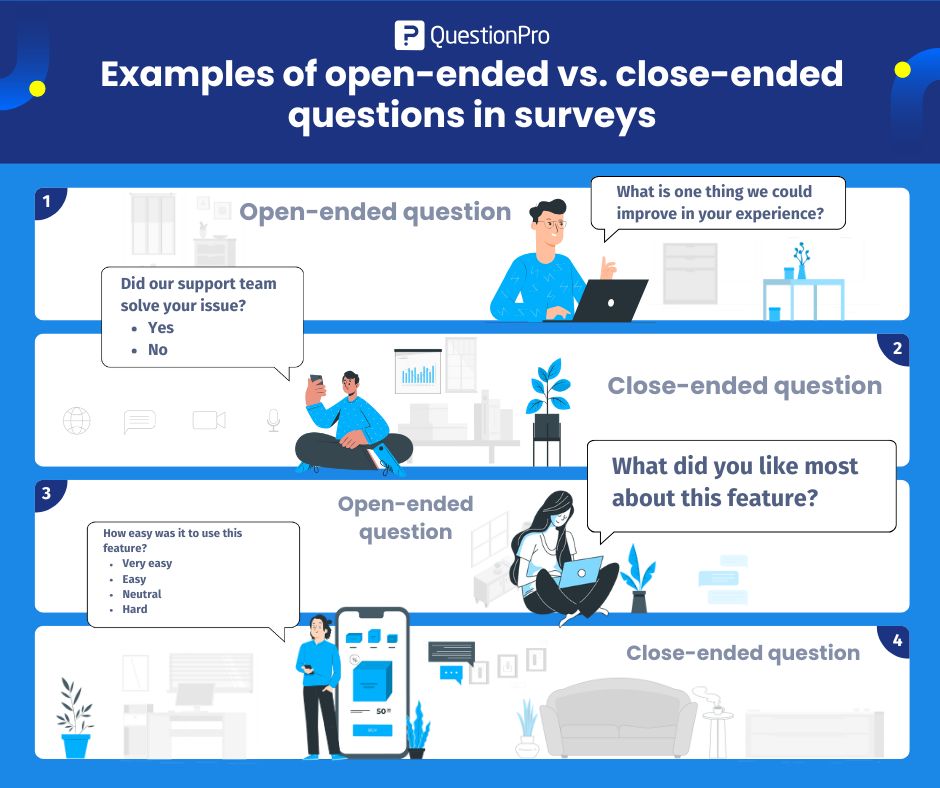
Examples of open-ended vs close-ended questions in surveys
Seeing real examples makes it easier to understand how each question type works in different survey situations. Here are some examples from common research use cases with open-ended vs close-ended questions.
Customer experience survey examples
Customer experience surveys help organizations understand how customers feel about their interactions, support, and overall satisfaction. These questions are often used to identify strengths, uncover pain points, and improve service quality.
Open ended
- What is one thing we could improve in your experience?
- Tell us about any challenge you faced during your interaction.
Close ended
- How satisfied are you with our service?
- Very satisfied
- Satisfied
- Neutral
- Dissatisfied
- Very dissatisfied
- Did our support team solve your issue?
- Yes
- No
Market research survey examples
Market research surveys focus on understanding customer preferences, behaviors, and decision-making factors. They help businesses analyze competition, positioning, and trends within a specific market.
Open ended
- What influences your decision when choosing a brand in this category?
- Describe what you look for when trying a new product.
Close ended
- Which brand do you use most often?
- Brand A
- Brand B
- Brand C
Product feedback survey examples
Product feedback surveys gather deeper insights into usability, features, and overall product performance. These questions help teams refine existing features and guide future product improvements.
Open ended
- What did you like most about this feature?
- What changes would make this feature more useful for you?
Close ended
- How easy was it to use this feature?
- Very easy
- Easy
- Neutral
- Hard
- Very hard
Why question design matters in US-based research
In the USA, survey results often shape business strategy, public policy decisions, and customer experience investments. When question design is unclear or poorly structured, results can become misleading, even when data is collected from large samples.
The impact of question format is widely recognized by research institutions. Organizations such as the Pew Research Center emphasize that clarity and structure are essential to collecting reliable, unbiased survey data. Their methodology standards show that subtle differences in wording or response options can influence responses.
Well-designed questions help ensure that:
- Respondents interpret questions consistently, reducing confusion and misreporting
- Survey results reflect true opinions rather than being shaped by leading or restrictive wording.
- Findings can be used with confidence to guide decisions across marketing, research, and policy teams.
- Data remains comparable over time, which is especially important for longitudinal studies in the US.
Getting question design right is not just a technical detail. It directly affects how trustworthy your insights are and how confidently teams can act on them.
Conclusion
Open-ended and close-ended questions each bring valuable strengths to a survey. Open-ended questions give you rich context and personal insights in the respondent’s own words, while close-ended questions help you collect clear, structured data that is easy to compare across large groups.
When you understand how each format works, you can design surveys that are both efficient and meaningful. The best results often come from using a mix of both, giving you measurable trends along with the explanations behind them.
QuestionPro supports this blended approach by offering an easy platform to create, distribute, and analyze surveys with any question type. Whether you need quick quantitative data or deeper qualitative insights, QuestionPro gives you the tools to understand your audience and make confident decisions.
Frequently Asked Questions (FAQs)
Answer: The main difference is how respondents answer. Open-ended questions allow respondents to answer freely in their own words, while close-ended questions provide predefined options.
Answer: Close-ended questions work better for large samples because they are quicker to answer and easier to analyze using charts, percentages, and statistics.
Answer: Yes, open-ended questions require more effort to analyze because detailed responses are text-based and unstructured. They often need manual review or text analysis tools.
Answer: Close-ended questions are ideal for measuring satisfaction because they allow easy comparison through ratings and scales.
Answer: QuestionPro allows you to create surveys using both close-ended and open-ended questions and provides tools to analyze quantitative data and interpret qualitative feedback effectively.