Capital One NPS in 2025 sits well above the average score for US banks. That gap matters if you run a financial services brand, because Capital One competes in one of the most benchmarked categories in customer experience.
In this article, we’ll break down Capital One’s current score, what drives it, and how it stacks up against other major card issuers. We’ll also cover how to calculate and improve your own NPS using the same method.
What is Capital One’s NPS in 2025?
Capital One’s NPS in 2025 is 53, based on a QuestionPro benchmark survey of 1,000 US customers conducted in Q1 2025. That score sits well above the 41 average QuestionPro reports for US banking.
The breakdown behind that score comes from three response groups.
● Detractors: 12
● Passives: 23
● Promoters: 65
| Response group | Share of respondents |
|---|---|
| Promoters (score 9 to 10) | 65% |
| Passives (score 7 to 8) | 23% |
| Detractors (score 0 to 6) | 12% |
Subtracting the detractor share from the promoter share gives the final score: 65% minus 12% equals 53. QuestionPro updates its NPS benchmarks every quarter, so the exact split can shift slightly as new responses come in.
What is NPS and how is it calculated?
Net Promoter Score is a single-question metric that predicts customer loyalty and the likelihood that a customer will recommend a brand to others. It comes from asking customers to rate, on a scale of 0 to 10, how likely they are to recommend a company.
Each respondent falls into one of three groups based on that rating. Ratings of 9 or 10 make someone a promoter. Customers who answer 7 or 8 are passives. Anyone rating 0 through 6 is a detractor.
The formula is simple:
NPS = % Promoters − % Detractors
Passives are counted toward the total number of respondents but don’t factor directly into the subtraction. The resulting score always falls between negative 100 and positive 100, with anything above 0 generally considered positive and scores above 50, like Capital One’s, considered excellent.
What’s driving Capital One’s NPS score in 2025?
Three factors explain most of Capital One’s advantage over the typical bank score.
- Cash back and rewards structure
Capital One’s reward cards, including the Venture and Quicksilver lines, tie cash back and travel points directly to everyday spending with no rotating categories to track. Customers who understand their rewards without extra effort tend to rate their experience higher. - No-fee checking and savings products
Capital One’s 360 checking and savings accounts carry no monthly maintenance fees, and the bank has dropped overdraft fees. Removing a common source of customer frustration tends to lift loyalty scores across the full relationship, not just on the credit card side. - Digital account management
Capital One has invested heavily in its mobile app for account servicing, dispute resolution, and card controls. A smooth digital experience reduces the friction that often creates detractors in financial services.
How does Capital One’s NPS compare to other credit card issuers?
Capital One’s NPS beats both Bank of America and the US banking average, though satisfaction rankings tell a slightly different story.
| Brand | 2025 benchmark | What it measures |
|---|---|---|
| Capital One | NPS of 53 | Likelihood to recommend |
| Bank of America | NPS of 46 | Likelihood to recommend |
| US banking average | NPS of 41 | Likelihood to recommend |
| Capital One (J.D. Power) | Third among major card issuers | Overall card satisfaction |
This lines up with the J.D. Power U.S. Credit Card Satisfaction Study, which ranks Capital One third among major credit card issuers, about 31 points behind American Express on its 1,000-point satisfaction index. NPS and J.D. Power’s index measure different things. NPS tracks willingness to recommend, while J.D. Power tracks overall satisfaction across service touchpoints. A brand can lead on one and trail on the other.
For a closer look at how a traditional bank performs on the same metric, read Bank of America’s NPS and customer perception in 2025. For a view of a global bank with a larger branch footprint, see JPMorgan Chase’s NPS score for 2025.
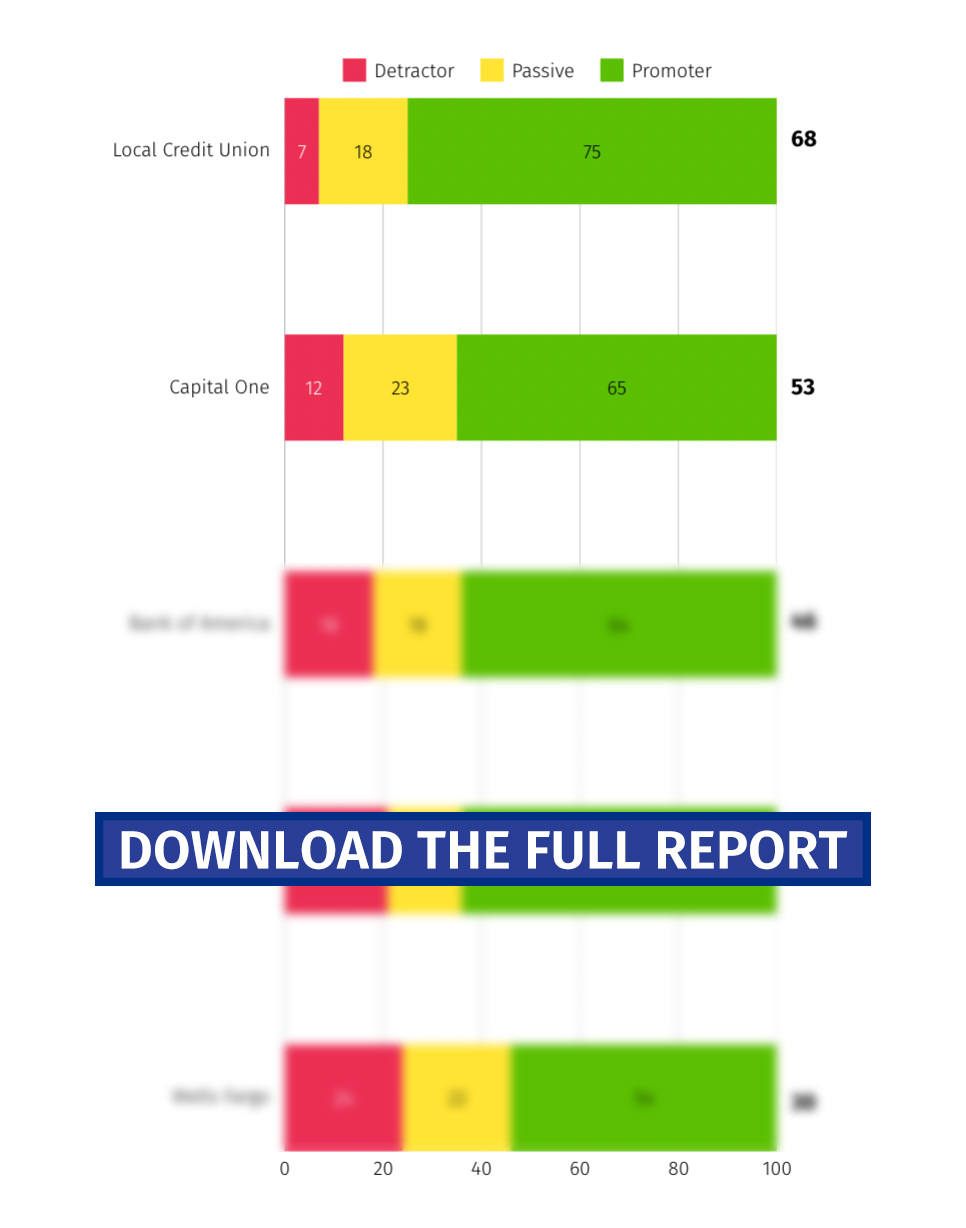
These results represent Q1 2025, and QuestionPro updates them quarterly to track industry shifts and trends.
To keep up with the latest NPS benchmarks across industries, download our latest report. It includes insights on major brands and trends shaping customer satisfaction.
How can you measure and improve your own NPS?
Benchmarking against Capital One only helps if you can measure your own score the same way. Here’s how to do it.
- Build the survey: Create a one-question NPS survey in QuestionPro Customer Experience, using the standard 0-to-10 recommendation scale.
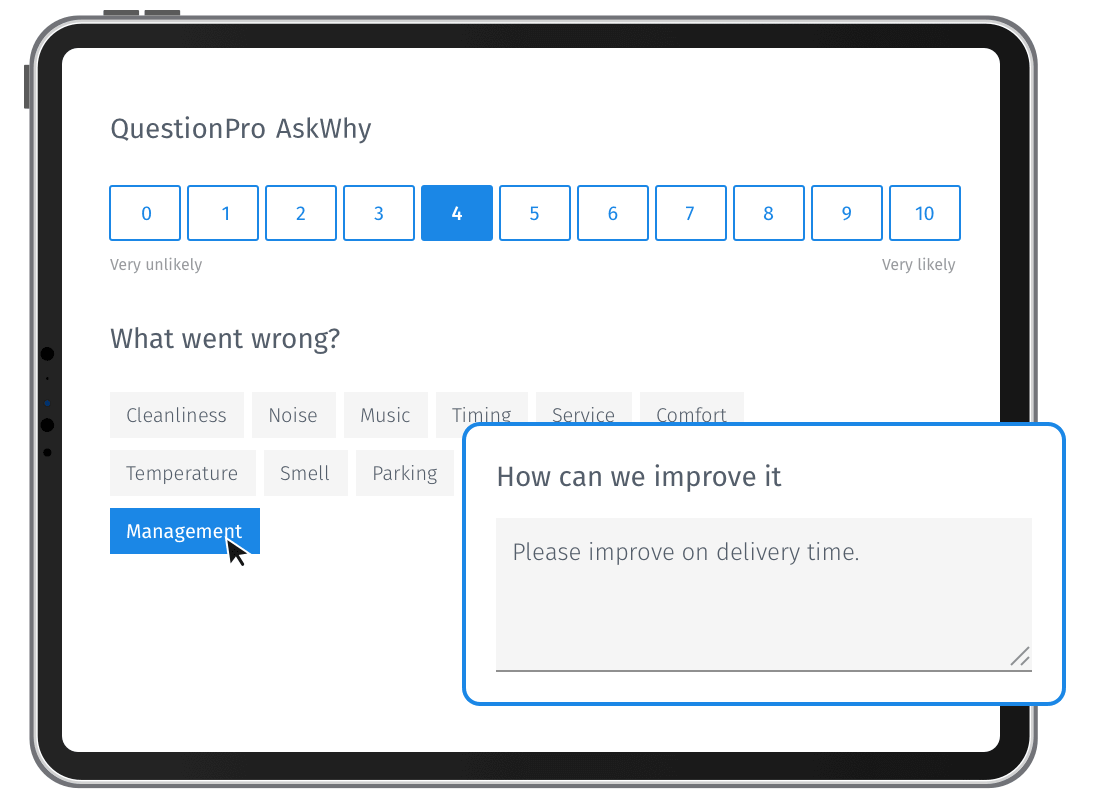
- Add a follow-up question: Attach an AskWhy question right after the rating so detractors and promoters can explain their score in their own words.
- Distribute it through the right channel: Send the survey by email, SMS, or in-app prompt right after a service interaction, such as a card dispute or account opening, while the experience is still fresh.
- Calculate the score: Subtract your detractor percentage from your promoter percentage using the same formula Capital One’s score is built on. An online NPS calculator speeds this up.
- Act on the lowest-rated touchpoints first: Use the AskWhy responses to find the specific moments pulling your score down, then fix those before chasing incremental gains elsewhere.
QuestionPro’s Survey Software supports this entire workflow from a single platform, from survey design through response analysis.
What mistakes should you avoid when benchmarking NPS?
A few common errors make NPS comparisons misleading.
- Comparing across industries: A 53 in credit cards doesn’t mean the same thing as a 53 in airlines or retail. Compare only within financial services or against your own prior scores.
- Relying on a small sample: A result based on fewer than a few hundred responses can swing wildly between survey waves. Capital One’s score above is based on 1,000 respondents for this reason.
- Treating one survey wave as final: NPS moves over time. QuestionPro re-runs this benchmark quarterly rather than publishing a single annual number.
- Skipping the follow-up question: A score without a reason attached tells you that something changed, not what to fix.
For deeper insights, try our AskWhy feature. It adds an open-ended follow-up question to gather context on scores.
What Capital One’s score means for your customer experience strategy
Capital One’s 2025 score shows that removing friction, simplifying rewards, and investing in a reliable app can move NPS well above the industry average, even in a category as competitive as credit cards. The same principles apply outside banking: fewer points of friction and faster resolution tend to raise loyalty scores in any industry. Use Capital One’s number as a reference point, not a target to match exactly, since your own customer base and prior scores are the more useful benchmark over time.
Frequently Asked Questions (FAQs)
Yes. A score of 53 is well above the 41 US banking average and reflects strong loyalty among cardholders. American Express still leads J.D. Power’s 2025 credit card satisfaction ranking, with Capital One placing third overall.
QuestionPro’s benchmark updates quarterly, so Capital One’s score can shift by a few points between waves. Sample composition, product changes, and economic conditions affecting US cardholders all influence the movement.
Not necessarily. NPS measures willingness to recommend, not complaint volume. A customer can file a dispute and still rate the overall relationship highly if the bank resolves the issue quickly and fairly.
Yes. Smaller institutions often score higher because of close branch relationships and faster decisions. They can’t match Capital One’s digital investment or rewards scale, but personal service can still win promoters.
Start by beating the 41 US banking average QuestionPro reports. Anything above 50, like Capital One’s current score, places a brand among the stronger performers in US retail banking today.
Capital One isn’t the only company in the banking and credit unions industry with valuable lessons for those looking to improve their customer service and experience. Below, we recommend a few articles where you can learn how other major brands manage to maintain a high NPS and a loyal customer base — you’ll surely find some useful insights along the way.