
When companies compare Adobe Customer Journey Analytics vs QuestionPro Customer Journey Analytics, they are usually deciding between two very different approaches. One is built for enterprise-scale digital data ecosystems. The other focuses on connecting customer feedback with behavioral insights in a practical, CX-driven way.
If you operate a business with high customer expectations and low switching costs, this choice directly affects retention, personalization, and ROI.
What is Adobe Customer Journey Analytics?
Adobe Customer Journey Analytics (CJA) is a component of Adobe Experience Platform. It allows organizations to analyze cross-channel customer behavior using large datasets pulled from websites, apps, CRM systems, and other digital properties.
It is a behavioral analytics system designed for enterprises that already rely on Adobe’s ecosystem.
Key characteristics:
- Built on Adobe Experience Platform
- Designed for massive omnichannel data
- Strong focus on digital behavior tracking
- Requires structured data engineering
It is commonly used by large US enterprises with advanced analytics teams and existing Adobe infrastructure.
What is QuestionPro Customer Journey Analytics?
QuestionPro Customer Journey Analytics is a platform that connects survey feedback, NPS, operational metrics, and behavioral signals into a single journey view.
Unlike Adobe’s behavioral-first architecture, QuestionPro integrates voice-of-customer programs directly into journey analysis.
If you want a structured overview of how customer path analysis works in general, this guide on customer journey analytics explains the core framework step by step.
QuestionPro is often chosen by:
- Mid-market US companies
- CX and research teams
- Organizations without large data engineering departments
The platform emphasizes clarity, speed to deployment, and direct insight activation.
“Read the complete guide on how to use customer journey analytics, from defining journey boundaries to acting on insights and measuring impact.”
Adobe vs QuestionPro Customer Journey Analytics: Core differences
Below is a structured comparison that highlights the strategic differences between the two platforms.
| Area | Adobe CJA | QuestionPro CJA |
| Target Audience | Large enterprises | SMB to mid-market and enterprise |
| Technical Complexity | High | Moderate |
| Implementation | Requires technical integration across the Adobe stack | Faster deployment with CX-focused integrations |
| Primary Strength | Advanced digital behavioral analytics | Feedback-driven journey intelligence |
| Ecosystem Dependency | Strongly tied to Adobe Experience Cloud | Flexible, independent platform |
| CX Integration | Requires configuration | Native integration with NPS, surveys, and CX programs |
How does data integration work in both platforms?
Data integration is where the real difference between these two platforms becomes visible. Journey analytics only works if data from multiple touchpoints connects accurately to a single customer profile. The way each platform handles that process reflects its design philosophy.
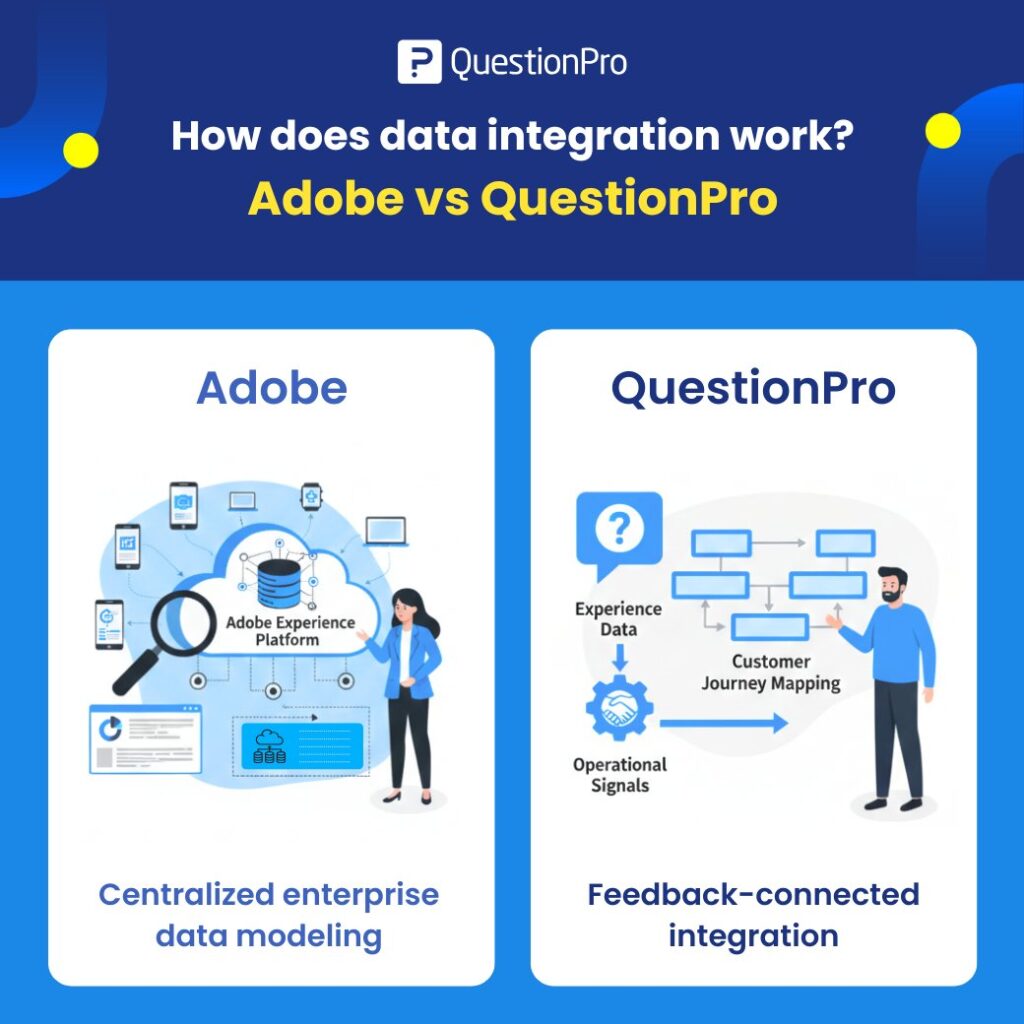
Adobe: Centralized enterprise data modeling
Adobe CJA ingests data into Adobe Experience Platform. It stitches identities across devices and channels and allows advanced calculated metrics.
Because Adobe is built for bigger business environments, integration usually requires:
- Structured data pipelines from CRM, web, mobile, and offline systems
- Tag management systems for digital tracking
- Engineering and analytics support
- Ongoing configuration within Adobe Experience Platform
This makes it powerful, but it is also resource-intensive. Setup time, governance rules, and internal training are typically part of the rollout process.
QuestionPro: Feedback-connected integration
QuestionPro approaches integration differently. Instead of starting with a large behavioral data lake, it connects experience data and operational signals directly into journey mapping.
The platform integrates:
- Survey responses
- NPS and CSAT scores
- CRM data
- Behavioral events
- Transactional records
Identity stitching still occurs, but the emphasis is on connecting what customers say with what they do.
For example:
- A drop in NPS can be traced to a specific touchpoint.
- Churn risk can be tied to both satisfaction scores and usage behavior.
- Journey friction can be linked to survey feedback themes.
Implementation is generally lighter because it does not require a full enterprise data platform. Many mid-market US companies can deploy interaction mapping without building complex engineering pipelines.
This makes it faster to operationalize insights, especially for CX teams who need visibility without deep technical overhead.
Which platform is easier to use?
Ease of use is not just about interface design. It depends on your team’s technical depth, reporting needs, and how quickly insights must translate into action.
The Adobe solution is built for analysts who are comfortable working with structured datasets, calculated metrics, and attribution models. Users can customize dimensions, build advanced reports, and analyze cross-channel paths at scale. Without experience in Adobe tools, teams often require training.
In enterprise environments with dedicated analytics teams, this is manageable. In leaner organizations, it can slow adoption.
QuestionPro CJA is structured differently. It is designed for:
- CX leaders
- Market research teams
- Product managers
The focus is on visual journey mapping, identifying friction points, and connecting satisfaction metrics to specific touchpoints. Instead of building complex calculated metrics from scratch, users can view patterns, segment audiences, and trigger actions with less technical setup.
For many US organizations that operate in fast-moving markets, insight speed matters as much as analytical depth. If your team needs to review journey performance, identify churn risks, and act within days rather than weeks, a lighter interface with clearer workflows can make a significant difference.
How do these platforms support customer experience programs?
CX programs depend on consistent feedback collection, structured analysis, and visible action loops. In the US market, where customer expectations are high and switching costs are low, loyalty is strongly influenced by how well companies respond to real experiences.
According to the American Customer Satisfaction Index, customer experience remains a top driver of loyalty in US markets. Adobe supports CX programs primarily through behavioral signals and digital interaction analysis.
QuestionPro takes a different route. It connects customer experience programs directly to measurable journey performance.
The platform integrates:
- NPS tracking
- Closed-loop feedback
- Survey insights
- Operational improvement workflows
This means CX leaders can see not only where friction occurs, but also how customers describe that friction and which teams must resolve it.
For organizations where structured feedback programs are central to strategy, this close connection between satisfaction metrics and journey visibility can help reduce the gap between insight and action, particularly in feedback-driven CX environments.
Which platform is better for companies?
The right choice depends less on feature lists and more on operational fit.
When evaluating Adobe and QuestionPro, focus on what actually matters inside your organization:
- Do you need advanced cross-channel behavioral modeling at scale?
- Do you have internal data engineering resources?
- Is your CX strategy driven primarily by digital behavior or by structured customer feedback?
- How quickly do insights need to translate into operational change?
For US businesses that prioritize:
- Direct integration of NPS and survey metrics
- Clear journey visualization without complex setup
- Lower technical complexity and faster rollout
QuestionPro may align well with day-to-day CX execution for organizations that prioritize feedback integration and faster deployment. It enables teams to connect satisfaction data to touchpoints without requiring extensive analytics infrastructure.
For larger enterprises already invested in Adobe Experience Cloud, especially those managing complex digital ecosystems with dedicated analytics teams, Adobe may provide deeper control over cross-channel behavioral data.
Ultimately, the best journey analytics platform is the one that fits your analytics maturity, technical capacity, and strategic priorities. Choose based on how your team works, not just on platform scale.
Final thoughts
If your organization already runs on Adobe Experience Platform and manages complex digital data environments, Adobe may align naturally with your infrastructure.
If your priority is connecting customer input to touchpoint performance without heavy engineering overhead, QuestionPro may offer a more direct path to action for teams focused on operational improvements.
When evaluating Adobe customer journey analytics vs QuestionPro, the right decision often depends on your existing tech stack, analytics maturity, and how tightly journey insights need to connect with customer feedback programs.
The right choice depends on three factors:
- How complex your data environment is
- How much technical support you have internally
- Whether behavioral tracking or customer input drives your strategy
Choose the platform that fits how your team actually works, not just how powerful the software looks on paper.
Frequently Asked Questions (FAQs)
Answer: Adobe is optimized for organizations that prioritize cross-channel digital behavior tracking across large datasets. QuestionPro focuses on combining behavioral data with structured customer feedback programs.
Answer: In practice, yes. It is optimized for organizations with advanced technical teams and existing Adobe infrastructure, which are typically large enterprises in the USA.
Answer: They can, but implementation costs and technical requirements may outweigh the benefits unless they already use Adobe Experience Platform.
Answer: Yes. QuestionPro integrates NPS, CSAT, and survey data directly into journey mapping, allowing teams to connect satisfaction scores to specific touchpoints.
Answer: If retention strategy relies heavily on customer feedback and structured CX programs, QuestionPro provides a more direct connection between insight and action. If the retention strategy focuses on digital behavioral optimization at scale, Adobe may be more suitable.