Customer journey mapping has become an essential practice for organizations looking to improve customer experience, align teams, and drive business growth. Yet despite its importance, many organizations still face a common challenge: every new journey map starts from scratch.
Teams spend hours recreating the same journey structures, redefining stages, and rebuilding frameworks that already exist elsewhere in the organization. Over time, this approach leads to inconsistency, inefficiency, and confusion.
The solution? Journey Frameworks.
Journey Frameworks enable organizations to create reusable journey map templates that help teams launch journey maps faster, maintain consistency, and scale customer journey mapping programs across the business.
In this article, we’ll explore why starting from scratch is slowing down your journey management efforts and how Journey Frameworks can help you build a more scalable, governed, and efficient customer experience program.
The Hidden Cost of Starting Every Journey Map from Scratch
Most organizations don’t realize how much time and effort is wasted rebuilding journey maps.
A customer onboarding journey created by the Product team may look completely different from one created by the Customer Success team. Regional teams may follow different journey mapping methodologies, and consultants may introduce their own frameworks.
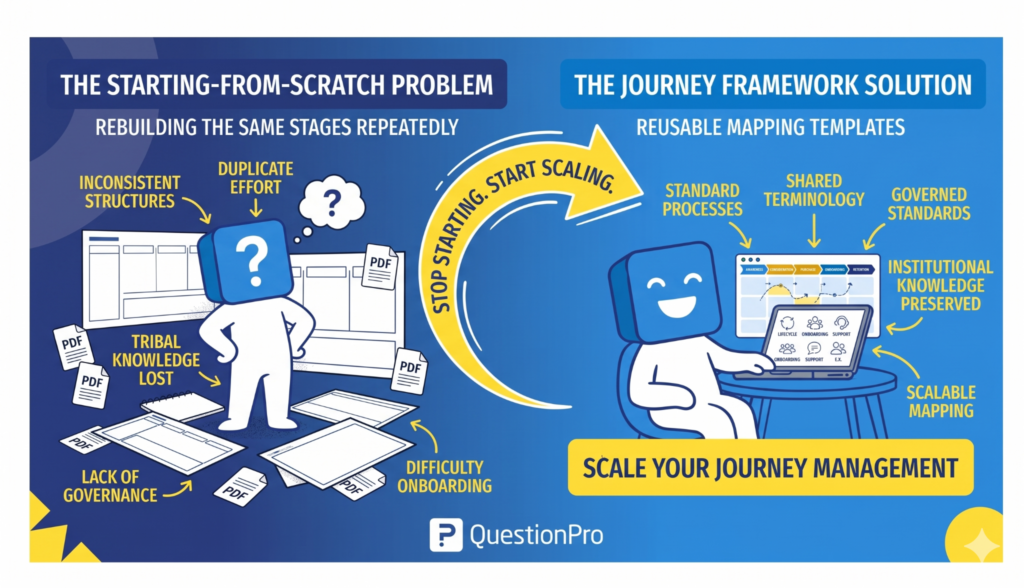
As a result, organizations often encounter:
- Inconsistent journey structures across teams
- Duplicate effort when creating similar journey maps
- Difficulty onboarding new team members
- Lack of standardization and governance
- Multiple versions of similar customer journeys
- Challenges comparing journeys across departments
Over time, journey mapping becomes fragmented instead of becoming a strategic asset.
When every team starts with a blank canvas, organizations lose the opportunity to build a repeatable customer experience methodology.
What Are Journey Frameworks?
Journey Frameworks are reusable journey map templates that provide predefined structures, phases, and touchpoints for creating customer journeys.
Instead of building every journey from scratch, teams can start with a proven framework and customize it based on their specific goals.
Think of a Journey Framework as a blueprint.
Just as architects use blueprints to ensure consistency across building projects, CX teams can use frameworks to ensure consistency across journey mapping initiatives.
Frameworks can include:
- Customer lifecycle journeys
- Product onboarding journeys
- Customer support journeys
- Employee experience journeys
- Service delivery journeys
- Industry-specific journey templates
- Organization-approved journey mapping standards
By starting with a framework, teams can focus on insights and improvements rather than spending time recreating structure.
Why Journey Frameworks Matter for Customer Experience Teams
1. Accelerate Journey Creation
One of the biggest barriers to journey mapping adoption is the time required to build a map.
Without frameworks, teams often spend hours:
- Defining stages
- Creating touchpoints
- Establishing journey structures
- Aligning on formats
Journey Frameworks eliminate this repetitive work.
Instead of starting from a blank page, teams can select an existing framework and begin adding customer insights immediately.
This allows organizations to create journey maps faster while reducing administrative effort.
2. Standardize Journey Mapping Across Teams
As journey mapping programs grow, consistency becomes increasingly important.
Different teams often use different formats, terminology, and methodologies, making collaboration difficult.
Journey Frameworks provide a standardized foundation that every team can follow.
Benefits include:
- Consistent journey structures
- Shared terminology
- Easier collaboration across departments
- Better alignment between CX, Product, Operations, and Leadership teams
Standardization helps organizations establish journey mapping as a repeatable business process rather than an isolated exercise.
3. Preserve Organizational Knowledge
Many organizations create exceptional journey maps that generate valuable insights.
Unfortunately, these maps often remain tied to a single project or team.
When employees leave or projects end, that knowledge can be lost.
Journey Frameworks help organizations preserve institutional knowledge by turning successful journey maps into reusable templates.
Instead of relying on tribal knowledge, organizations can build a centralized repository of proven journey structures and best practices.
This creates continuity and enables future teams to benefit from previous work.
4. Improve Journey Governance
For enterprise organizations, journey governance is critical.
Without governance, journey maps can become inconsistent, outdated, and difficult to manage.
Journey Frameworks support governance by enabling organizations to:
- Create approved journey standards
- Ensure teams follow established methodologies
- Reduce duplicate journey creation
- Maintain consistency across regions and business units
Rather than reviewing every new journey individually, organizations can establish approved frameworks that serve as the foundation for future work.
This approach improves quality while reducing oversight effort.
5. Scale Customer Journey Mapping Programs
Many journey mapping initiatives start successfully but struggle to scale.
As more teams begin creating journey maps, inconsistencies emerge and coordination becomes more difficult.
Journey Frameworks provide the foundation for scalable journey management.
Whether an organization is creating 10 journey maps or 1,000, frameworks ensure every journey starts from a proven structure.
This enables organizations to expand journey mapping across:
- Business units
- Geographic regions
- Product lines
- Customer segments
- Service teams
without sacrificing quality or consistency.
Building Your Framework Library
Organizations that see the most success with Journey Frameworks often build a centralized framework library.
A framework library serves as a repository of approved journey templates that teams can access whenever they create new journey maps.
Best practices include:
- Creating frameworks for common journey types
- Using clear naming conventions
- Documenting framework purposes and use cases
- Reviewing frameworks periodically
- Establishing governance ownership
Over time, this library becomes a strategic asset that accelerates journey creation and promotes organizational consistency.
The Future of Customer Journey Mapping
Customer journey mapping is evolving from a workshop activity into a continuous business discipline.
Organizations are no longer looking for tools that simply help them draw journey maps. They need solutions that help them scale, govern, and operationalize customer experience management.
Journey Frameworks play a critical role in this transformation.
By enabling organizations to reuse proven structures, standardize methodologies, and preserve best practices, frameworks turn journey mapping into a scalable and repeatable process.
The result is faster journey creation, stronger governance, and better alignment across teams.
Stop Rebuilding. Start Scaling.
If your teams are still creating every journey map from scratch, you’re likely spending more time on setup than on customer insights.
Journey Frameworks help organizations move beyond one-off journey mapping exercises by creating a foundation for scalable customer experience management.
Instead of rebuilding the same structures repeatedly, teams can start with proven frameworks, focus on understanding customer needs, and drive meaningful improvements across the customer journey.
The question is no longer how quickly you can create a journey map.
It’s how effectively you can scale journey mapping across your organization.
And that starts with a framework.