Introduction
Imagine contacting customer support to reset your password. Instead of receiving a quick solution, you’re transferred between multiple agents, asked to repeat your information several times, and eventually spend twenty minutes solving what should have taken two.
Even if your issue is ultimately resolved, the experience leaves you frustrated.
This is exactly what the Customer Effort Score (CES) is designed to measure.
While businesses have traditionally focused on Customer Satisfaction (CSAT) and Net Promoter Score (NPS), these metrics don’t always reveal how difficult it was for customers to complete an interaction. A customer may be satisfied with the final outcome but still feel that the process required too much effort.
Customer Effort Score fills this gap by helping organizations understand how easy or difficult it is for customers to accomplish their goals.
In this article, we’ll explore what CES is, why it matters, how it works, and how organizations can use it to improve customer experiences.
What Is Customer Effort Score (CES)?
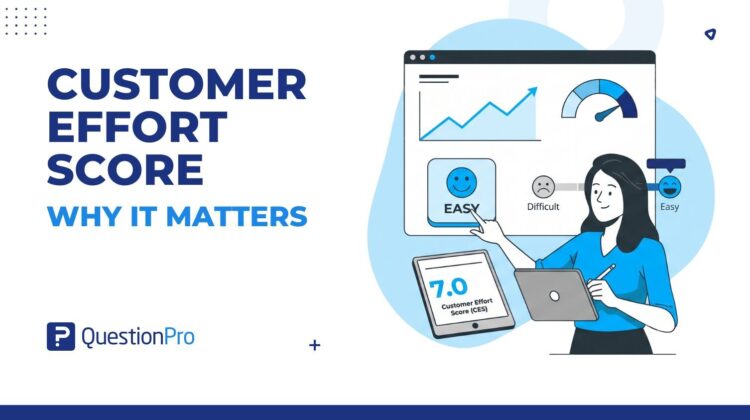
Customer Effort Score (CES) is a customer experience metric that measures the amount of effort customers must exert to complete a task or interaction with your business.
Rather than asking customers whether they are satisfied or likely to recommend your company, CES focuses on a simple question:
“How easy was it to complete your task today?”
Customers typically respond using a rating scale that ranges from Very Difficult to Very Easy, allowing organizations to quantify the effort involved in a particular interaction.
The lower the effort, the better the customer experience.
Research has consistently shown that customers value effortless experiences more than memorable ones. When customers can accomplish their goals quickly and without unnecessary friction, they are more likely to remain loyal and continue doing business with the organization.
Why Customer Effort Matters
Every customer interaction involves some level of effort.
Whether customers are:
- Making an online purchase
- Contacting customer support
- Completing account registration
- Using a mobile app
- Finding information on a website
- Submitting a claim
- Renewing a subscription
they expect the process to be simple.
When interactions become difficult, customers experience frustration that often leads to:
- Lower customer loyalty
- Increased churn
- Higher support costs
- Reduced conversion rates
- Negative brand perception
Measuring customer effort helps organizations identify these friction points before they become larger business problems.
How CES Works
QuestionPro enables organizations to measure customer effort using a dedicated Customer Effort Score (CES) Question Type.
Organizations can add the CES question to post-purchase surveys, customer support surveys, onboarding surveys, product feedback programs, and other Voice of Customer initiatives.
A typical CES question asks customers to rate how easy it was to complete their interaction using a standardized effort scale.
Once responses are collected, organizations can monitor results through the CES Dashboard Widget, which can be added to the Customer Experience Dashboard.
This allows CX teams to:
- Track customer effort trends over time
- Compare CES alongside NPS and CSAT
- Monitor customer experience health from a single dashboard
- Share insights with leadership and stakeholders
Why Businesses Should Measure Customer Effort
1. Identify Customer Friction
CES highlights the steps in the customer journey where customers struggle the most.
Instead of guessing where problems exist, organizations receive direct feedback from customers.
2. Improve Customer Retention
Reducing customer effort has a direct impact on loyalty.
When customers can resolve issues quickly and accomplish tasks easily, they are more likely to continue using your products or services.
3. Optimize Digital Experiences
Many customer journeys now happen online.
CES helps identify usability issues across websites, customer portals, mobile apps, and self-service experiences.
4. Reduce Support Costs
If customers consistently report high effort during support interactions, organizations can simplify processes, improve knowledge bases, and reduce repeat contacts.
Lower effort often translates into fewer support requests and faster resolution times.
5. Make Better Product Decisions
Product teams can use CES to understand whether new features simplify or complicate the customer experience.
Instead of relying solely on feature adoption, they gain insight into the ease of using those features.
Common Use Cases for CES
Customer Effort Score is valuable across many customer touchpoints, including:
- Post-support surveys
- Product onboarding
- Checkout experiences
- Account registration
- Customer service interactions
- Self-service portals
- Website usability
- Mobile applications
- Subscription renewals
- Claims and service requests
Organizations can deploy CES anywhere they want to understand how easy it is for customers to complete a task.
Best Practices for Using CES
To get the most value from Customer Effort Score:
Measure immediately after the interaction.
The closer the survey is to the customer experience, the more accurate the feedback.
Include an open-ended follow-up question.
Ask customers why they selected their rating to uncover specific friction points.
Monitor trends over time.
A single score provides limited insight. Tracking changes helps organizations evaluate the impact of improvements.
Combine CES with NPS and CSAT.
Customer effort is one part of the overall customer experience. Monitoring all three metrics provides a more complete picture.
Act on the insights.
Collecting feedback is only valuable if organizations use it to simplify customer journeys and remove unnecessary friction.
Measuring CES in QuestionPro
QuestionPro makes it easy to measure and monitor customer effort.
Organizations can:
- Add the Customer Effort Score Question Type to any CX survey.
- Customize the question to fit specific customer journeys.
- Analyze responses alongside other Voice of Customer metrics.
- Add the CES Dashboard Widget to the Customer Experience Dashboard to monitor trends and performance in real time.
- Compare CES with NPS and CSAT from a unified reporting environment.
This combination of data collection and dashboard visualization helps organizations continuously improve customer experiences.
Conclusion
Customers don’t just remember whether their issue was resolved—they remember how easy or difficult it was to get there.
Customer Effort Score provides organizations with a powerful way to identify friction, simplify customer journeys, and improve loyalty.
By combining the Customer Effort Score Question Type with the CES Dashboard Widget in QuestionPro, organizations can collect actionable feedback, monitor effort over time, and make data-driven decisions that create smoother, more effortless customer experiences.
Reducing customer effort isn’t just good for customers, it’s good for business.