Customer experience teams today are surrounded by data. Surveys, support tickets, product feedback, CRM notes, behavioral analytics—everything exists somewhere. Yet despite this abundance, most organizations still struggle to answer a simple question with confidence:
“How is this customer actually doing?”
The problem isn’t lack of data. It’s fragmentation.
Information is spread across tools, teams, and systems that were never designed to talk to each other. As a result, CX decision-making often happens in silos—based on partial signals rather than a complete view of the customer.
This is where the Customer 360 Dashboard changes the game.
It shifts organizations from fragmented feedback to unified intelligence—turning disconnected signals into a single, actionable customer view.
The Problem: CX Data Lives in Silos
Most organizations collect customer feedback through multiple channels:
- Post-purchase or transactional surveys (NPS, CSAT, CES)
- Support tickets and complaint logs
- Product usage and behavioral analytics
- CRM notes and account updates
- Social or indirect feedback channels
Individually, each dataset is useful. But together, they rarely come together in a meaningful way.
This leads to common challenges:
1. No single view of the customer
Teams often rely on different systems to understand the same customer. CX sees survey data, Support sees tickets, Product sees usage—but no one sees everything together.
2. Delayed insight discovery
By the time patterns are manually stitched together, the customer may already be at risk or have churned.
3. Inconsistent decision-making
Without a unified view, decisions are based on partial truths—leading to misaligned priorities across CX, Product, and Operations teams.
4. Reactive rather than proactive CX
Teams respond to issues after they escalate instead of identifying early warning signals.
The Shift: From Data Points to Customer Intelligence
The Customer 360 approach fundamentally changes how organizations interpret CX data.
Instead of looking at isolated signals, it connects them into a unified customer narrative.
A single customer is no longer just:
- A low NPS response
or - A support ticket
or - A drop in engagement
They become a complete profile of interactions, experiences, and risks.
This shift enables teams to move from:
“What did customers say in this survey?”
to
“What is happening to this customer across all touchpoints?”
That difference is what turns reporting into intelligence.
What Customer 360 Actually Does
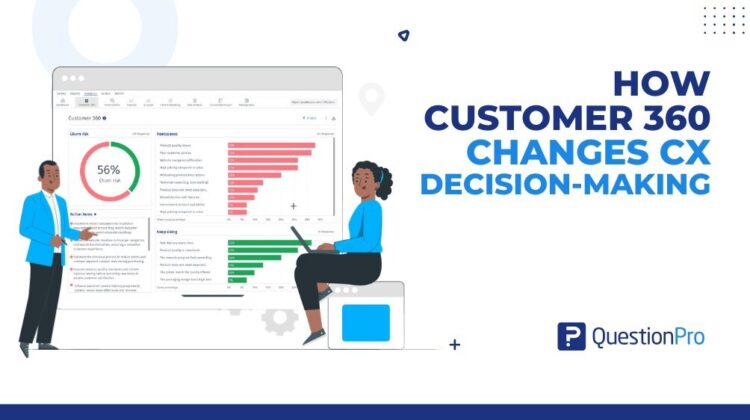
The Customer 360 Dashboard brings all customer signals into one place, creating a unified view at the customer or account level.
It allows teams to:
- Consolidate feedback from multiple sources
- Track customer experience over time
- Identify churn risk early
- Understand patterns across interactions
- Connect feedback to real customer accounts
Instead of jumping between tools, teams get a single source of truth for each customer.
To access it:
- Go to Workspace
- Navigate to Analytics
- Select Customer 360 Dashboard
- View churn risk data and customer insights
This simplicity hides a powerful shift underneath: intelligence is no longer scattered—it is centralized.
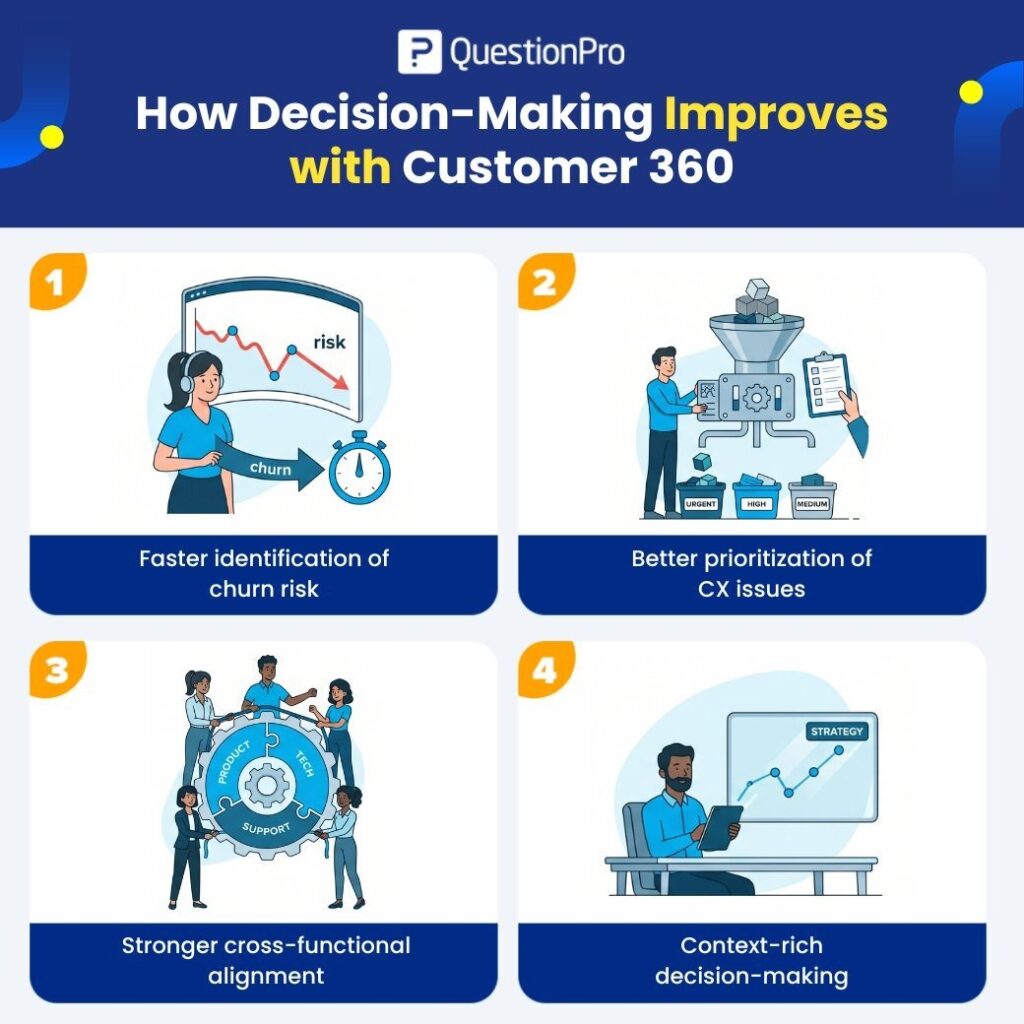
How Decision-Making Improves with Customer 360
Once customer data is unified, CX decision-making becomes significantly more effective.
1. Faster identification of churn risk
Instead of waiting for a customer to churn or escalate complaints, teams can see early warning signals in one place.
A drop in satisfaction combined with repeated negative feedback becomes visible immediately when data is unified.
2. Better prioritization of CX issues
Not all problems impact customers equally. Customer 360 helps teams identify which issues are affecting high-value or at-risk customers, so they can prioritize what actually matters.
3. Stronger cross-functional alignment
CX, Product, Support, and Operations teams all see the same customer reality. This reduces debates over “whose data is correct” and shifts focus toward action.
4. Context-rich decision-making
Instead of reacting to a single datapoint, teams understand the full story behind it.
For example:
- A low survey score is no longer just a metric
- It becomes part of a larger pattern of poor experience across multiple touchpoints
Why Fragmentation Hurts CX Performance
To understand the value of Customer 360, it helps to see what happens without it.
Fragmentation creates blind spots such as:
- Customers appearing satisfied in surveys but actively struggling in support interactions
- High-value accounts silently disengaging without triggering alerts
- Product issues being reported in tickets but not reflected in CX dashboards
- Teams optimizing for metrics instead of real customer outcomes
These gaps lead to misinformed decisions and missed opportunities.
In many cases, organizations are not lacking insight—they are simply unable to connect the dots.
The Role of Customer 360 in Modern CX Strategy
Customer 360 is not just a dashboard—it is a foundational layer for modern CX programs.
It supports:
- Voice of Customer (VOC) programs by consolidating feedback
- Customer Success strategies by identifying risk early
- Product decisions by linking feedback to actual users/accounts
- Executive reporting by providing a unified customer health view
It becomes the bridge between raw data and actionable strategy.
From Reactive to Predictive CX
One of the most powerful outcomes of Customer 360 is the shift toward proactive experience management.
Instead of reacting after a customer leaves or complains, teams can:
- Monitor churn risk patterns
- Identify declining engagement trends
- Act before dissatisfaction becomes churn
With upcoming enhancements like predictive churn trends, this shift becomes even more powerful—moving from “what is happening” to “what will happen next.”
The Bigger Picture: One Customer, One Truth
At its core, Customer 360 solves a simple but critical problem:
There should not be multiple versions of customer truth across an organization.
There should be:
- One customer
- One unified view
- One shared understanding
When everyone works from the same intelligence layer, CX stops being reactive reporting and becomes a coordinated growth driver.
Final Thought
Customer experience is no longer about collecting more data—it is about connecting the data you already have.
Organizations that continue to operate in silos will always struggle with delayed insights and fragmented decision-making.
Those that move to a unified customer intelligence model with Customer 360 will gain something far more valuable:
Clarity. Speed. And the ability to act before problems become churn.