Why support teams shouldn’t be forced to work from the same ticket layout
Every support team works differently.
A technical support engineer investigating escalations needs quick access to SLA deadlines, product details, and issue categories. A customer success manager may care more about survey responses, customer health, and account information. A quality assurance lead might prioritize ticket status and resolution trends.
Yet in many support platforms, everyone is expected to work from exactly the same ticket list.
The result isn’t just a less personalized experience. It creates unnecessary friction that slows agents down every single day.
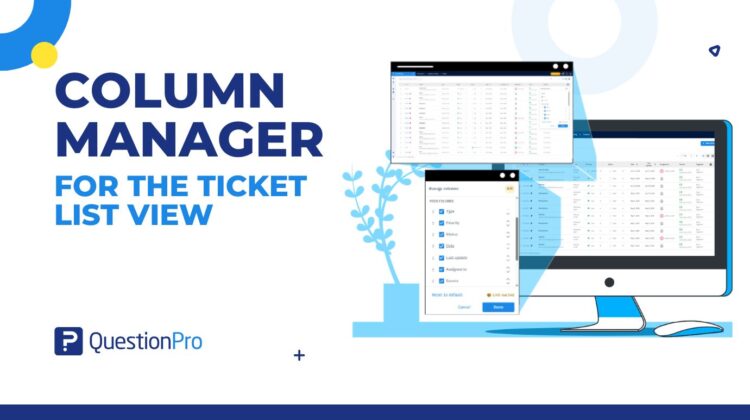
That’s why we’ve introduced Column Manager for the Ticket List.
It gives every user the ability to configure their ticket workspace around the information they actually need.
The Problem with Fixed Ticket Lists
As customer support operations grow, so does the amount of information attached to every ticket.
Organizations introduce:
- Priority levels
- SLA deadlines
- Product categories
- Survey responses
- Custom fields
- Team-specific attributes
Every new field adds valuable context.
It also adds another column.
Eventually, the ticket list becomes crowded with information that only some users need.
Support agents spend more time scanning across columns to find relevant information.
Managers request different layouts for different teams.
Administrators receive repeated requests to add, remove, or reorder columns.
The ticket list becomes a compromise that works perfectly for no one.
One Workspace Doesn’t Fit Every Workflow
Different support teams solve different problems.
A billing support team doesn’t need the same ticket information as a product support team.
Customer success teams review different indicators than escalation specialists.
Even within the same department, individuals often prioritize different information depending on their responsibilities.
Instead of forcing every user into a single layout, Column Manager lets each person create a workspace that reflects how they actually work.
The underlying ticket data stays the same.
Only the presentation changes.
Meet Column Manager
Column Manager allows users to personalize the Ticket List by selecting which columns are visible and arranging them in the order that best supports their workflow.
From a single configuration panel, users can:
- Show or hide optional columns
- Reorder columns using drag-and-drop
- Search available system and custom fields
- Configure their preferred ticket view
- Save those preferences for future sessions
Essential identity columns such as Ticket ID and Contact remain permanently visible, ensuring every ticket can always be identified while still allowing extensive personalization.
The result is a cleaner, more focused workspace that adapts to the needs of each individual user.
Reduce Clutter Without Losing Information
One of the biggest challenges in mature support environments is balancing visibility with usability.
Adding more fields improves data capture.
Displaying every field all the time reduces usability.
Column Manager solves this by separating available information from visible information.
Support teams still capture all the information they need.
Users simply decide which pieces of that information deserve permanent space in their own ticket list.
This creates a workspace that’s easier to navigate while preserving the richness of the underlying data.
Built for Organizations That Continue to Grow
Support operations rarely stay static.
New workflows emerge.
New products introduce new ticket attributes.
Custom fields expand as businesses evolve.
Column Manager is designed to scale alongside those changes by supporting both system-defined fields and custom fields within the same configuration experience.
As ticket data grows, users can continue refining their workspace without waiting for platform changes or requesting custom configurations.
Less Administration, More Flexibility
Support administrators frequently receive requests that have little to do with business rules and everything to do with personal preference.
“Can we move this column?”
“Can we hide this field?”
“Can we see SLA time next to ticket status?”
While individually small, these requests add operational overhead and reduce agility.
Column Manager shifts those decisions directly to end users.
Instead of relying on administrators to tailor the interface for every team, users can personalize their own workspace whenever their needs change.
This reduces configuration requests while giving teams greater flexibility in how they manage their daily work.
Different Feedback Sources, Different Workspaces
Support teams often work across multiple feedback sources, each with its own operational priorities.
Column Manager maintains independent configurations for different feedback sources, allowing users to optimize each workspace separately rather than forcing a single layout across every ticket type.
A Better Ticket List Is a Better Workspace
Support teams don’t need more information.
They need the right information at the right time.
Column Manager transforms the ticket list from a static table into a personalized operational workspace that adapts to the way every individual works.
Instead of asking every team to fit the interface, the interface now fits the team.
And when agents spend less time navigating their workspace, they can spend more time delivering exceptional customer support.