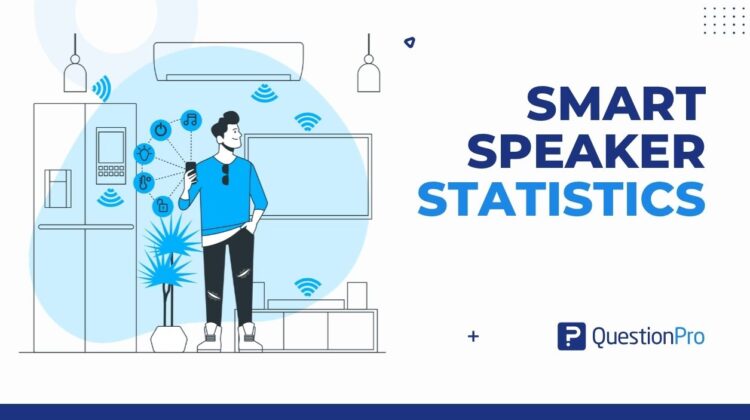
Smart speaker statistics for 2026 tell a very different story than the excited predictions from 2017. Back then, brands guessed at how many households would adopt devices like Amazon Echo, Google Home, and the still unreleased Apple HomePod.
Today, the guessing is over. Ownership has climbed steadily, one brand has pulled ahead, and daily habits around voice technology have settled into a clear pattern. Privacy concerns still exist, but they now sit next to genuine daily use rather than blocking it outright.
In this blog, we’ll break down the latest smart speaker statistics, connect them to the wider smart home market, and cover how researchers can measure this kind of shift with confidence.
What is a smart speaker?
A smart speaker is a Wi-Fi-connected speaker with a built-in voice assistant, such as Amazon Alexa or Google Assistant, that responds to spoken commands.
The category gets confused with a few adjacent terms. Here is how they differ:
- Smart speaker: An audio-only device controlled entirely by voice, with no screen.
- Smart display: The same voice assistant technology, plus a screen for visual answers like recipes or video calls.
- Voice assistant: The software itself, such as Alexa or Siri, which can also run on a phone or car system without a dedicated speaker.
- Smart home: The broader network of connected devices, including thermostats, lighting, and security cameras, that a smart speaker can control.
Getting these terms right matters for research too. A survey that lumps “smart home” and “smart speaker” into one question tends to produce muddled results. QuestionPro’s guide to quantitative research vs. qualitative research covers how to frame this kind of question before a study goes into the field.
How many Americans own a smart speaker in 2026?
Ownership has grown steadily since smart speakers reached the mass market, though the pace has slowed compared to the early years.
| Year | US ownership (age 12+) |
|---|---|
| 2017 | 7% |
| 2019 | 23% |
| 2021 | 33% |
| 2023 | 36% |
| 2026 | 39% |
Source: Edison Research, The Infinite Dial 2026
That 39% works out to roughly 112 million Americans age 12 and older living in a household with a smart speaker, per the same report. Growth has flattened compared to the early years, when ownership nearly doubled every twelve months.
This kind of plateau is common in consumer technology. Early adopters buy fast, then the remaining market grows in smaller increments tied to price drops and new use cases rather than novelty alone.
Which brand leads the US smart speaker market?
Amazon still controls most of the US installed base, though the gap with Google has narrowed compared to the category’s early years.
Industry estimates for 2026 put the split at roughly 62% Amazon Alexa, 26.5% Google Nest, and 11.5% Apple HomePod, based on data compiled by VoxBooster’s smart speaker statistics report. Amazon’s lead traces back to Echo’s early launch and its tight integration with Amazon shopping and Fire TV.
Google has closed part of the gap through deeper integration with Android phones and Google Home routines. Apple entered the category later with HomePod and still holds the smallest share, though its audio quality keeps it relevant with existing iPhone households that value sound over price.
How is generative AI changing smart speakers in 2026?
Generative AI is the biggest change to hit smart speakers since launch, replacing scripted replies with something closer to real conversation.
About 76% of current owners say they want a more conversational assistant rather than a device limited to music and timers, according to the same VoxBooster 2026 data. Amazon answered that demand first. The company completed a nationwide rollout of its Alexa+ assistant to all US Prime members in February 2026, as reported by MacRumors. Google has moved in a similar direction with a Gemini-based assistant built into newer Nest devices.
The shift is not free for everyone. Roughly 24% of owners say they would pay a monthly subscription, in the 5 to 10 dollar range, for the more advanced conversational features. That willingness to pay marks a real change after a decade of smart speakers being treated as a one-time purchase with no ongoing cost.
What do people actually use their smart speakers for?
Voice assistants get used for a narrow set of tasks far more than any others.
| Activity | Share of owners who do this regularly |
|---|---|
| Play music, radio, or podcasts | 86% |
| Check weather or traffic | 72% |
| Control smart home devices | 54% |
| Make a purchase by voice | 22% |
Source: VoxBooster, Smart Speaker Usage Statistics 2026
Voice commerce remains the smallest use case by far. That matches years of consumer research showing people trust voice assistants for quick tasks but still prefer a screen for anything involving payment details.
Why some consumers still won’t buy one
Not every household is convinced, and the reasons have stayed fairly consistent since the category launched.
Reasons people avoid smart speakers:
- Concern that the microphone is always listening
- Worry about hackers accessing personal data
- A sense that the device is not worth the cost
- No clear use case at home
Reasons owners keep buying more:
- Convenience for hands-free tasks
- Integration with other smart home devices
- Falling hardware prices
- Growing comfort with voice technology generally
About 64% of non-owners cite microphone and privacy fears as their main objection, according to VoxBooster’s 2026 smart speaker data. That figure has barely moved in years, which suggests privacy is a durable barrier rather than a passing concern.
This kind of consumer wariness about data is not unique to smart speakers. It shows up across most consumer research today, a pattern covered in QuestionPro’s broader look at market research industry statistics.
How smart speakers fit into the wider smart home
A smart speaker is often the entry point into a larger smart home setup, not the whole system by itself.
Roughly 45% of US households with internet access now own at least one smart home device, according to Today’s Homeowner’s 2026 smart home data, which cites Parks Associates research. That broader smart home statistic sits above smart speaker ownership alone, since many households add cameras, thermostats, or video doorbells without ever buying a dedicated speaker.
Real households use their speaker as a control hub. A homeowner might ask Alexa to dim the living room lights, tell Google Assistant to lower the thermostat before bed, or check a doorbell camera through a smart display. Retailers have built voice skills for tasks like reordering groceries or requesting a rideshare, following a pattern that Domino’s and Uber set years ago. Brands that track this well often fold device ownership signals into a broader customer intelligence program, pairing it with purchase history to personalize outreach.
How researchers measure this kind of shift accurately
Tracking smart speaker and smart home adoption sounds simple, but a few mistakes show up often in this space.
The most common one is treating “smart home” and “smart speaker” as interchangeable inside a single survey question, which inflates or deflates ownership numbers depending on how a respondent interprets the term. A second mistake is relying on one wave of data instead of a tracking study, since adoption in this category shifts every year:
- Define the device category clearly before writing the questionnaire
- Repeat the same question across multiple waves for trend data
- Weight the sample against known population figures, not just convenience data
Getting it right starts with a clearly worded questionnaire, a representative sample, and tools built for the job. QuestionPro’s market research software handles the survey design and analysis side, while QuestionPro Audience supplies a pre-screened US consumer panel when a team needs respondents beyond its own customer list.
The bigger signal behind the numbers
Smart speaker adoption has moved past the hype phase from 2017. It now sits inside a slower, more permanent story about how people bring connected devices into daily routines, one weather check and one dimmed light at a time.
The businesses and researchers who track that story well are the ones asking specific questions, following the data across multiple years, and pairing it with a sample that reflects the market. That discipline matters more than any single ownership percentage, and it echoes the larger shifts described in QuestionPro’s roundup of market research trends shaping how brands turn everyday adoption data into strategy.
Frequently Asked Questions (FAQs)
Entry-level models from Amazon and Google typically start around 25 to 50 dollars. Premium options with better audio, such as the Apple HomePod or Sonos Era, run from 100 to 300 dollars, depending on speaker size and features.
A smart speaker only responds through audio, while a smart display adds a touchscreen for visual results like weather graphics, video calls, or recipe steps. Both run the same underlying voice assistant software.
Most models process audio locally and only send data to the cloud after detecting a wake word like “Alexa” or “Hey Google.” Manufacturers publish privacy controls that let owners review, delete, or disable stored voice recordings.
Among current owners, 44% have three or more smart speakers in the home, according to VoxBooster’s 2026 data. Multi-room setups have become common as prices dropped and households added speakers to bedrooms and kitchens.
Cross-check self-reported ownership against a syndicated study like Edison Research’s Infinite Dial before publishing internal numbers. Running the same question across multiple survey waves, against a broad and pre-screened consumer panel, helps confirm that a sample is not skewed toward early adopters.