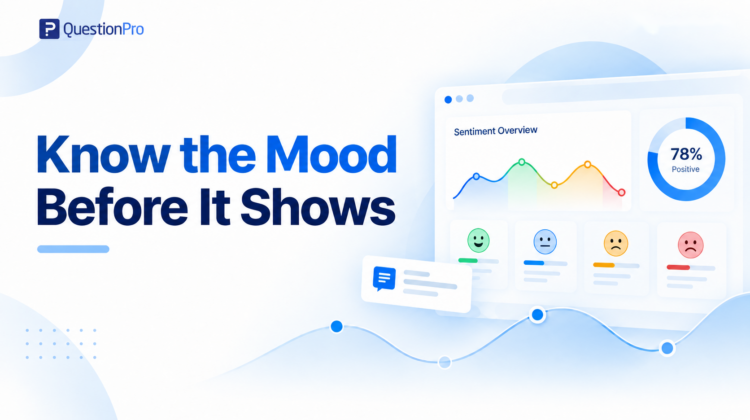
A poll tells you what people chose. Sentiment tells you how they felt while choosing it — and the difference matters more than most presenters realize. Two audiences can select the same answer to a poll for completely different reasons: one group is enthusiastic, the other is resigned. A standard poll result cannot tell them apart. Real-time sentiment tracking, layered on top of live audience response, is what closes that gap.
This matters most in settings where the room’s emotional temperature is itself the useful data — a product announcement, a change-management town hall, or a conference keynote testing a new message. The result isn’t just “what did they think” but “how did the room feel while we said it,” captured at the moment it happened rather than reconstructed afterward from memory.
Quick takeaways
- Sentiment data captures how an audience felt, not just what they chose — a distinction a standard poll can’t make.
- The value is in the moment it’s captured; sentiment reconstructed after the fact from memory is far less reliable.
- This works best layered onto an existing live session, not as a standalone survey instrument.
Beyond the poll result — reading the room as data
Experienced presenters already do a version of this instinctively — they watch faces, listen for murmurs, and adjust their delivery based on a read of the room that they can’t fully articulate afterward. Real-time sentiment tracking formalizes that instinct into something measurable: open-text reactions, quick mood check-ins, or reaction-based polling that captures tone rather than just choice, aggregated and visualized as the session unfolds.
How this fits into a live session
The mechanics are simple by design. Instead of (or alongside) a multiple-choice poll, the audience is prompted with an open, low-friction reaction — a one-word response, an emoji-style reaction, or a quick agree/disagree pulse — and the aggregate is visualized live. Because the input is lightweight, response rates stay high even in large rooms, which matters: sentiment data is only as useful as its coverage.
What presenters do differently when they can see mood in real time
The practical value shows up in the adjustment, not just the measurement. A presenter who sees the room’s sentiment dip during a specific section can address it immediately — pause, ask a clarifying question, or acknowledge the concern directly — rather than finding out three weeks later in a post-event survey that this exact section landed badly. That immediacy is the entire advantage over traditional feedback collection.
Where this fits in an events or L&D stack
Sentiment tracking is not a replacement for structured surveys or in-depth qualitative research — it’s a lightweight layer for live moments where speed matters more than depth. Teams already running live polling with LivePolls are best positioned to add this layer, since the audience is already primed to respond in the moment rather than needing a separate tool or link.
For change-heavy communications specifically — a reorg announcement, a policy shift, a major product pivot — combining sentiment tracking with a follow-up structured survey gives both halves of the picture: the immediate emotional read, and the considered feedback that comes once people have had time to process it.
Frequently asked questions
Is real-time sentiment tracking the same as a poll?
No. A poll captures a choice; sentiment tracking captures the emotional tone behind responses, typically through lightweight open reactions rather than multiple-choice selection.
Does sentiment tracking replace post-event surveys?
No — it complements them. Sentiment tracking captures the in-the-moment reaction; a follow-up survey captures the considered view once the audience has had time to reflect.
QUESTIONPRO LIVEPOLLS — FREE TO START
See how your audience is really feeling, live, during the session.