• Skip to main content
  • Skip to primary sidebar
  • Skip to footer
QuestionPro

QuestionPro

questionpro logo
  • Products
    survey software iconSurvey softwareEasy to use and accessible for everyone. Design, send and analyze online surveys.research edition iconResearch SuiteA suite of enterprise-grade research tools for market research professionals.CX iconCustomer ExperienceExperiences change the world. Deliver the best with our CX management software.WF iconEmployee ExperienceCreate the best employee experience and act on real-time data from end to end.
  • Solutions
    IndustriesGamingAutomotiveSports and eventsEducationGovernment
    Travel & HospitalityFinancial ServicesHealthcareCannabisTechnology
    Use CaseAskWhyCommunitiesAudienceContactless surveysMobile
    LivePollsMember ExperienceGDPRPositive People Science360 Feedback Surveys
  • Resources
    BlogeBooksSurvey TemplatesCase StudiesTrainingHelp center
  • Features
  • Pricing
Language
  • English
  • Español (Spanish)
  • Português (Portuguese (Brazil))
  • Nederlands (Dutch)
  • العربية (Arabic)
  • Français (French)
  • Italiano (Italian)
  • 日本語 (Japanese)
  • Türkçe (Turkish)
  • Svenska (Swedish)
  • Hebrew IL (Hebrew)
  • ไทย (Thai)
  • Deutsch (German)
  • Portuguese de Portugal (Portuguese (Portugal))
  • Español / España (Spanish / Spain)
Call Us
+1 800 531 0228 +1 (647) 956-1242 +55 9448 6154 +49 030 9173 9255 +44 01344 921310 +81-3-6869-1954 +61 (02) 6190 6592 +971 529 852 540
Log In Log In
SIGN UP FREE

Home Surveys Academic Research

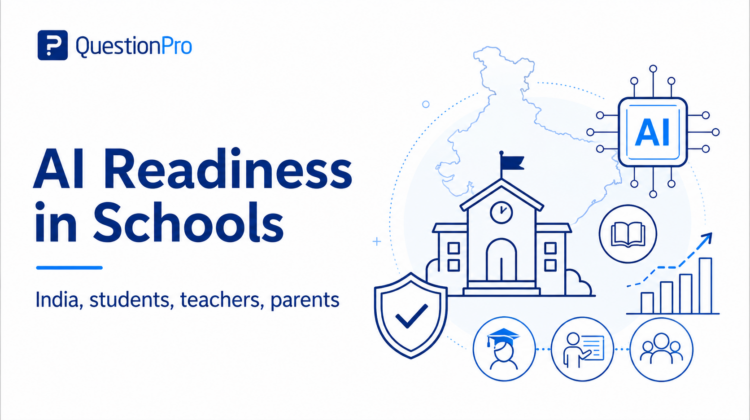
AI Literacy in Indian Schools: Measuring Readiness Across Students, Teachers and Parents

AI literacy is moving into mainstream school education in India. In January 2026, CBSE encouraged schools to participate in the national YUVA AI for All foundational course, and the 2026-27 curriculum framework includes Computational Thinking and Artificial Intelligence for Classes III to VIII.

For schools, introducing the curriculum is only one part of readiness. Students, teachers and parents may start from very different levels of confidence, access and understanding.

A short readiness programme can help schools identify those differences before training and classroom activity begin.

Measure three audiences separately

Audience What to measure Why it matters
Students Concept awareness, safe use, confidence, access Learning design
Teachers Pedagogy, assessment, tool confidence, safeguarding Professional development
Parents Awareness, concerns, home access, expectations Trust and home support

Do not combine these into one generic AI survey. The questions and decisions are different for each group.

Create a baseline before training

A pre-training baseline makes professional development more efficient. Teachers who need basic tool literacy should not receive the same session as teachers already experimenting with AI-assisted lesson planning.

  • Ask about current use, not just confidence.
  • Include scenario-based questions about safe and ethical use.
  • Measure access to devices and connectivity.
  • Ask students when they think AI use should be disclosed.
  • Give parents a simple way to submit concerns or questions.

Track readiness by grade and school

For school groups and larger CBSE networks, readiness will vary by grade, teacher role and campus. A shared instrument allows central teams to compare patterns while principals see only their own school.

QuestionPro Academic supports multi-admin survey programmes, and QuestionPro BI can provide school-level dashboard views from a common data source.

Re-measure after classroom implementation

A readiness survey should not be a one-time launch activity. Re-measure after a term to see whether students understand responsible use, teachers feel more capable and parent concerns have changed.

Pair perception data with participation data from AI learning activities so the school can distinguish confidence from actual engagement.

Use the results to shape policy

School AI policy works better when it reflects real classroom conditions. If students report unclear expectations, teachers report inconsistent assessment rules or parents report concerns about privacy, those findings should feed policy updates and communication.

The strongest AI literacy programme combines curriculum, capability building and a recurring feedback loop.

Turn readiness data into a training map

Group teachers by need rather than job title alone. Some may need foundational AI literacy, others may need assessment design, subject-specific classroom examples or safeguarding guidance. Use baseline responses to create training pathways and re-measure the same capabilities afterwards.

For students, readiness can inform where schools need more emphasis on verification, disclosure, privacy or critical evaluation. For parents, it can identify where orientation materials should explain the educational purpose of AI rather than focusing only on risk.

Keep equity in the readiness model

AI literacy can widen existing gaps if access to devices, connectivity or support differs sharply between students. Include questions about where students access technology, whether they share devices and whether they can practise outside school.

Report access separately from confidence. A student may understand AI concepts well but have limited opportunity to use tools, while another may use AI frequently without strong critical literacy.


Build a simple AI literacy maturity model

Schools can translate survey results into four maturity levels. At the foundational level, students and teachers recognise basic AI concepts and risks. At the guided-use level, they can use approved tools with clear rules. At the critical-use level, learners evaluate output, verify information and disclose use appropriately. At the creation level, they understand how AI systems can be designed, tested or applied to real problems.

Map each survey item to one level and report the distribution rather than a single average score. This helps schools see whether a cohort has broad foundational understanding but weak critical evaluation, which requires a different teaching response from low awareness overall.

Repeat the maturity assessment after a term and use the change to evaluate whether curriculum and teacher training are producing the intended capability.

Sources and further reading

  • CBSE National AI Literacy Campaign circular
  • CBSE Computational Thinking and AI curriculum

Getting started

For education teams building a governed feedback and reporting programme, explore QuestionPro Academic, QuestionPro survey capabilities and QuestionPro BI.

Frequently asked questions

What is AI literacy for school students?

AI literacy includes understanding basic AI concepts, recognising appropriate and inappropriate uses, evaluating AI output critically and using tools safely and responsibly.

Why should schools survey parents about AI?

Parents influence home technology use and may have concerns about privacy, safety and academic integrity. Measuring those views helps schools communicate expectations clearly.

What should a teacher AI readiness survey measure?

Measure current use, confidence, classroom applications, assessment practice, safety knowledge and the types of professional development teachers need.

How often should schools measure AI readiness?

Run a baseline before major training or curriculum rollout, then repeat after a term or semester to identify progress and remaining gaps.

Measure AI readiness across students, teachers and parents before scaling your programme.
Measure readiness
SHARE THIS ARTICLE:

About the author
Vaidehi Palsokar
Academic Marketing Manager
View all posts by Vaidehi Palsokar

Primary Sidebar

Gain insights with 80+ features for free

Create, Send and Analyze Your Online Survey in under 5 mins!

Create a Free Account

RELATED ARTICLES

HubSpot - QuestionPro Integration

Closing the Loop on Course Evaluations: Data to Action

Jul 08,2026

HubSpot - QuestionPro Integration

Employee Engagement App: Top 11 For Workforce Improvement 

Apr 10,2024

HubSpot - QuestionPro Integration

Customer Reviews: Why They Matter and How to Get More

Sep 19,2024

BROWSE BY CATEGORY

Footer

MORE LIKE THIS

Chronic Absenteeism in US Schools: How Student and Family Feedback Improves Attendance Strategy

Sep 2, 2026

School Attendance Communication in England: Using Parent Voice to Reduce Persistent Absence

Sep 2, 2026

AI Literacy in Indian Schools: Measuring Readiness Across Students, Teachers and Parents

Sep 2, 2026

Nonprofit Trust and AI Transparency: A 2026 Guide for US and Canadian Organizations

Sep 2, 2026

Other categories

questionpro-logo-nw
Help center Live Chat SIGN UP FREE
  • Sample questions
  • Sample reports
  • Survey logic
  • Branding
  • Integrations
  • Professional services
  • Security
  • Survey Software
  • Customer Experience
  • Workforce
  • Communities
  • Audience
  • Polls Explore the QuestionPro Poll Software - The World's leading Online Poll Maker & Creator. Create online polls, distribute them using email and multiple other options and start analyzing poll results.
  • Research Edition
  • LivePolls
  • InsightsHub
  • Blog
  • Articles
  • eBooks
  • Survey Templates
  • Case Studies
  • Training
  • Webinars
  • All Plans
  • Nonprofit
  • Academic
  • Qualtrics Alternative Explore the list of features that QuestionPro has compared to Qualtrics and learn how you can get more, for less.
  • SurveyMonkey Alternative
  • VisionCritical Alternative
  • Medallia Alternative
  • Likert Scale Complete Likert Scale Questions, Examples and Surveys for 5, 7 and 9 point scales. Learn everything about Likert Scale with corresponding example for each question and survey demonstrations.
  • Conjoint Analysis
  • Net Promoter Score (NPS) Learn everything about Net Promoter Score (NPS) and the Net Promoter Question. Get a clear view on the universal Net Promoter Score Formula, how to undertake Net Promoter Score Calculation followed by a simple Net Promoter Score Example.
  • Offline Surveys
  • Customer Satisfaction Surveys
  • Employee Survey Software Employee survey software & tool to create, send and analyze employee surveys. Get real-time analysis for employee satisfaction, engagement, work culture and map your employee experience from onboarding to exit!
  • Market Research Survey Software Real-time, automated and advanced market research survey software & tool to create surveys, collect data and analyze results for actionable market insights.
  • GDPR & EU Compliance
  • Employee Experience
  • Customer Journey
  • Synthetic Data
  • About us
  • Executive Team
  • In the news
  • Testimonials
  • Advisory Board
  • Careers
  • Brand
  • Media Kit
  • Contact Us

QuestionPro in your language

  • English
  • Español (Spanish)
  • Português (Portuguese (Brazil))
  • Nederlands (Dutch)
  • العربية (Arabic)
  • Français (French)
  • Italiano (Italian)
  • 日本語 (Japanese)
  • Türkçe (Turkish)
  • Svenska (Swedish)
  • Hebrew IL (Hebrew)
  • ไทย (Thai)
  • Deutsch (German)
  • Portuguese de Portugal (Portuguese (Portugal))
  • Español / España (Spanish / Spain)

Awards & certificates

  • survey-leader-asia-leader-2023
  • survey-leader-asiapacific-leader-2023
  • survey-leader-enterprise-leader-2023
  • survey-leader-europe-leader-2023
  • survey-leader-latinamerica-leader-2023
  • survey-leader-leader-2023
  • survey-leader-middleeast-leader-2023
  • survey-leader-mid-market-leader-2023
  • survey-leader-small-business-leader-2023
  • survey-leader-unitedkingdom-leader-2023
  • survey-momentumleader-leader-2023
  • bbb-acredited
The Experience Journal

Find innovative ideas about Experience Management from the experts

  • © 2022 QuestionPro Survey Software | +1 (800) 531 0228
  • Sitemap
  • Privacy Statement
  • Terms of Use