Surveys are one of the most common ways to collect feedback.
They are fast, structured, easy to distribute, and useful when you need responses from a large number of people. If you want to measure satisfaction, compare preferences, track NPS, validate demand, or quantify a known pattern, surveys are hard to beat.
But surveys have a weakness.
They often tell you what people think, but not enough about why they think that way.
A customer may select “too expensive” as a churn reason. A user may rate onboarding as 4 out of 10. A buyer may say a message is “unclear.” A participant may leave a one-line open-ended response like “It was confusing.”
Those answers are useful, but they usually need follow-up.
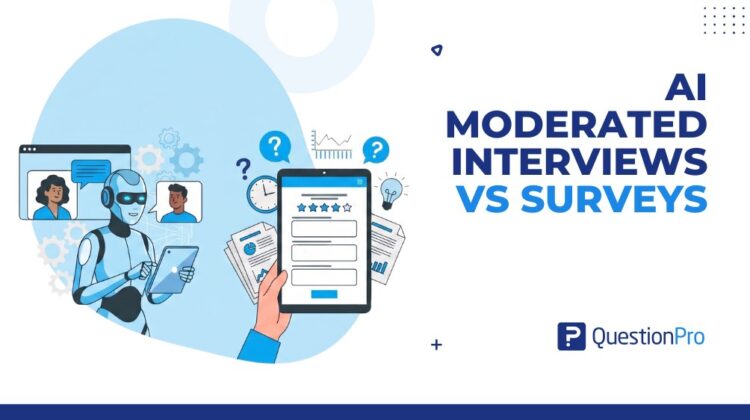
That is where AI moderated interviews are different.
AI moderated interviews give teams a way to collect qualitative feedback at scale. Instead of asking only fixed survey questions, an AI moderator can ask open-ended questions, listen to the participant’s response, and ask follow-up questions when the answer is vague, short, surprising, or important.
The right choice is not always AI interviews or surveys.
Surveys are better for measurement. AI moderated interviews are better for understanding. The strongest research workflows often use both.
What Are Surveys?
A survey is a structured research method where participants answer a set of predefined questions.
Survey questions may include:
- Multiple choice questions
- Rating scales
- Ranking questions
- Matrix questions
- NPS questions
- CSAT questions
- Open-ended text questions
- Demographic or screening questions
Surveys are useful because they create structured data. That makes them easier to analyze across large samples.
For example, a product team can survey 1,000 users and learn that:
- 42% found onboarding easy
- 31% found it somewhat difficult
- 17% did not complete onboarding
- 10% were unsure what to do next
That type of data is useful for measurement, prioritization, segmentation, and trend tracking.
But if the team wants to understand why users struggled, the survey may not be enough.
What Are AI Moderated Interviews?
An AI moderated interview is a qualitative research conversation where an AI interviewer asks questions, listens to participant responses, asks follow-up questions, and helps organize the results into transcripts, summaries, themes, and quotes.
In an AI moderated interview, the researcher still controls the study. The researcher defines the goal, creates the interview guide, sets probing instructions, recruits participants, and reviews the findings.
The AI helps conduct the conversation.
For example, instead of asking:
“How easy was onboarding?”
An AI moderated interview might ask:
“Can you walk me through what happened the first time you tried to set up the product?”
If the participant replies:
“It was confusing.”
The AI can ask:
“Which step in the setup process made you unsure what to do next?”
That follow-up is the key difference.
Surveys collect answers. AI moderated interviews collect context.
Read more: AI Moderated Interviews: What They Are, How They Work, and When to Use Them in Research
AI Moderated Interviews vs Surveys: Quick Comparison
| Factor | AI Moderated Interviews | Surveys |
|---|---|---|
| Best for | Understanding why people think, behave, buy, leave, or struggle | Measuring known patterns across a large audience |
| Question format | Open-ended, conversational, adaptive | Fixed, structured, mostly predefined |
| Follow-up questions | Yes, based on participant responses | Usually no, unless using branching logic |
| Depth | High | Low to medium |
| Scale | Medium to high | Very high |
| Speed | Fast, especially compared with human interviews | Very fast |
| Analysis | Thematic, qualitative, quote-based, transcript-based | Quantitative, statistical, chart-based |
| Best output | Themes, stories, objections, quotes, explanations | Scores, percentages, rankings, trends, segments |
| Participant effort | Higher than a survey | Lower than an interview |
| Researcher control | High, through interview guide and probing rules | High, through question design and survey logic |
| Risk | Poor guide can create shallow interviews | Poor questions can create misleading numbers |
The Core Difference: Understanding vs Measurement
The simplest way to compare AI moderated interviews and surveys is this:
Surveys help you measure what is happening. AI moderated interviews help you understand why it is happening.
For example, a survey can tell you:
- 38% of users found onboarding difficult
- 54% of customers think pricing is unclear
- 27% of trial users did not understand the product’s value
- 45% of buyers preferred a competitor
An AI moderated interview can help explain:
- Which part of onboarding was difficult
- What made pricing unclear
- What value users expected but did not see
- Why buyers preferred the competitor
- What language customers use to describe the problem
- What almost convinced them to buy
- What made them hesitate
Surveys are better when you already know what you want to measure.
AI moderated interviews are better when you need to discover the reasons behind the numbers.
Where Surveys Work Better
Surveys are still essential. AI moderated interviews do not replace them.
Use surveys when you need structured, comparable data from a larger audience.
1. When you need statistically useful measurement
Surveys are better when you need to measure a pattern across many people.
Examples:
- What percentage of customers are satisfied?
- Which feature is most requested?
- How likely are users to recommend the product?
- Which pricing plan is preferred?
- Which brand message performs best?
- How does satisfaction differ by customer segment?
If the goal is to quantify a known question, surveys are usually the better method.
2. When the question is simple
Some research questions do not need a full interview.
For example:
- Which plan are you using?
- How often do you use this feature?
- How satisfied are you with support?
- Which of these concepts do you prefer?
- How likely are you to buy in the next 30 days?
These are structured questions. A survey is more efficient.
3. When you need fast feedback from a very large audience
Surveys are easy to distribute to hundreds or thousands of people.
They are useful for:
- Customer satisfaction tracking
- NPS programs
- Brand tracking
- Product feedback at scale
- Employee pulse checks
- Market research panels
- Post-event feedback
- Post-purchase feedback
AI moderated interviews can scale more than human interviews, but surveys are still better for very large samples.
4. When you need charts and comparisons
Surveys produce data that can be easily visualized.
You can compare:
- Segments
- Time periods
- Regions
- Plans
- Personas
- Cohorts
- Satisfaction levels
- Purchase intent
- Preference scores
This is useful when stakeholders need clear numbers for decision-making.
5. When participant effort must be very low
Surveys are usually easier for participants.
A short survey may take 2 to 5 minutes. An AI moderated interview may take 10 to 30 minutes, depending on the study.
If you need a quick response from busy participants, a survey may be the better option.
Where AI Moderated Interviews Work Better
AI moderated interviews are better when fixed survey questions are not enough.
Use them when you need depth, examples, reasoning, and follow-up questions.
1. When you need to understand the “why”
A survey can tell you that a user was dissatisfied.
An AI moderated interview can help you understand why.
For example, instead of only asking:
“How satisfied were you with onboarding?”
An AI moderated interview can ask:
“Can you walk me through your onboarding experience from the moment you signed up?”
Then, if the participant says onboarding was confusing, the AI can ask:
“What was the first step where you felt unsure what to do next?”
That produces richer feedback than a rating scale alone.
2. When open-ended survey responses are too shallow
Open-ended survey questions often produce short answers.
Examples:
- “Too expensive.”
- “Hard to use.”
- “Not relevant.”
- “Confusing.”
- “Missing features.”
- “Bad support.”
These answers are signals, but they are incomplete.
An AI moderated interview can probe deeper:
- What felt expensive compared with alternatives?
- Which part was hard to use?
- What would have made it more relevant?
- What specifically was confusing?
- Which missing feature mattered most?
- What happened during the support experience?
This is where AI interviews create value.
3. When you do not know the answer options yet
Surveys work best when you already know the possible answer choices.
But early in research, you may not know what options to include.
For example, if you are researching why users churn, you may assume the reasons are:
- Price
- Missing features
- Poor onboarding
- Better competitor
- Lack of support
But customers may reveal different reasons:
- Internal team change
- Lack of executive buy-in
- Confusing setup ownership
- Weak implementation process
- Unclear ROI
- Procurement friction
- No urgency after purchase
AI moderated interviews can help discover the answer options before you build a survey.
4. When you need participant stories
Stories are useful because they reveal context.
A survey might tell you:
“User rated onboarding 4 out of 10.”
An interview might reveal:
“The user signed up after seeing a LinkedIn ad, expected a self-serve setup, got stuck on invite permissions, waited for an admin, forgot to come back, and then chose a simpler competitor.”
That story is much more actionable.
It tells the team where the user came from, what they expected, where the experience failed, and what happened next.
5. When you need language from customers
Surveys often force participants into your language.
AI moderated interviews let participants explain things in their own words.
This is valuable for:
- Messaging
- Positioning
- Landing pages
- Sales enablement
- Product naming
- Feature descriptions
- Customer objection handling
For example, your team may describe a product as “workflow automation,” but customers may call it “a way to stop manually chasing updates.”
That language can improve marketing and product communication.
6. When follow-up questions matter
The biggest difference between AI moderated interviews and surveys is follow-up.
Surveys can use branching logic, but they usually cannot have a natural conversation.
AI moderated interviews can ask:
- Can you give an example?
- What happened next?
- What made that difficult?
- What did you expect instead?
- What were you comparing it to?
- Why did that matter to you?
- What would have changed your decision?
These questions help teams move from feedback to insight.
Example: Survey vs AI Moderated Interview
Imagine a SaaS company wants to understand why trial users are not activating.
Survey approach
The survey might ask:
Question: Why did you not complete setup?
Options:
- I did not have time
- It was too confusing
- I did not see enough value
- It was too expensive
- I needed help from my team
- Other
The survey may show:
- 36% said setup was confusing
- 24% said they did not have time
- 18% said they did not see enough value
- 12% said they needed help from their team
- 10% selected other
This is useful. It shows the scale of each problem.
But it still leaves questions.
What was confusing? Why did they not have time? What value were they expecting? Which team member did they need? What does “other” mean?
AI moderated interview approach
An AI moderated interview might ask:
Opening question:
“What were you hoping to accomplish when you first signed up?”
Follow-up:
“You mentioned setup was confusing. Which step made you unsure what to do next?”
Follow-up:
“What did you expect to happen at that step?”
Follow-up:
“Did you try to solve the issue yourself, ask someone for help, or stop there?”
Follow-up:
“What would have made you more likely to complete setup?”
Now the team may learn:
- Users expected setup to be self-serve
- The invite flow required admin permissions
- The product did not explain who needed to complete setup
- Users did not understand the value before inviting teammates
- Some users compared the product with a simpler competitor
- The activation email did not bring users back at the right moment
This is deeper and more actionable.
Best workflow
The strongest workflow is often:
- Use AI moderated interviews to discover the real reasons users do not activate.
- Use a survey to measure how common each reason is across the full user base.
- Use follow-up AI interviews to explore the most important segment in more depth.
This gives you both understanding and measurement.
When to Use Surveys
Use surveys when your research question is structured and you need data from a larger audience.
Good survey use cases include:
NPS and customer satisfaction
Surveys are ideal for tracking customer sentiment over time.
Use them for:
- NPS
- CSAT
- CES
- Support satisfaction
- Post-purchase feedback
- Renewal health checks
Preference testing
Surveys work well when participants need to choose between defined options.
Use them for:
- Feature prioritization
- Pricing plan preference
- Message preference
- Concept ranking
- Brand perception tracking
- Product attribute importance
Segmentation
Surveys are useful when you need to classify or compare groups.
Use them for:
- Persona research
- Market segmentation
- Usage behavior
- Customer maturity
- Industry differences
- Role-based differences
Quantifying known issues
Once you already know the main themes, surveys help you measure how widespread each issue is.
For example:
- How many users find onboarding confusing?
- Which onboarding step causes the most friction?
- How common is pricing confusion?
- Which competitor is most often considered?
Quick feedback
If the research question is simple and the participant burden should be low, use a survey.
For example:
- “How would you rate your support experience?”
- “Which of these features matters most?”
- “How likely are you to attend this event?”
- “Which message is clearest?”
When to Use AI Moderated Interviews
Use AI moderated interviews when you need depth, context, and follow-up.
Good AI moderated interview use cases include:
Product feedback
Use AI moderated interviews to understand how users experience a feature or product.
Example questions:
- What were you trying to accomplish?
- What felt easy?
- What felt difficult?
- Where did the product not match your expectations?
- What would make this more useful?
Churn research
Use AI moderated interviews to understand why customers leave or trial users fail to activate.
Example questions:
- What were you hoping the product would help you do?
- Where did it fall short?
- What alternatives did you consider?
- What would have made you more likely to continue?
Concept testing
Use AI moderated interviews to understand reactions to a new idea, feature, campaign, or product concept.
Example questions:
- What is your first reaction?
- What problem do you think this solves?
- What feels unclear?
- What would make this more compelling?
Message testing
Use AI moderated interviews to understand whether your positioning is clear, credible, and relevant.
Example questions:
- What do you think this message means?
- Who do you think this is for?
- What feels believable?
- What feels exaggerated or confusing?
Win/loss research
Use AI moderated interviews to understand buyer decisions.
Example questions:
- What problem were you trying to solve?
- Which alternatives did you consider?
- What mattered most in your decision?
- Why did you choose one option over another?
Customer discovery
Use AI moderated interviews to explore pain points, existing workflows, and unmet needs.
Example questions:
- Can you walk me through how you solve this problem today?
- What is frustrating about the current process?
- What have you tried before?
- What would an ideal solution look like?
When to Combine AI Moderated Interviews and Surveys
The strongest research teams do not treat AI moderated interviews and surveys as competitors.
They use them together.
Workflow 1: Interviews first, survey second
Use this when you do not yet know the answer options.
Step 1: Run AI moderated interviews to discover themes.
Step 2: Build a survey using those themes as answer choices.
Step 3: Send the survey to a larger audience to measure how common each theme is.
This is useful for:
- Churn research
- Product discovery
- Customer onboarding research
- Message development
- Brand perception
- Market research
Workflow 2: Survey first, interviews second
Use this when you already have quantitative data but need explanation.
Step 1: Run a survey to identify patterns.
Step 2: Select interesting segments.
Step 3: Run AI moderated interviews with those participants to understand the reasons behind the data.
This is useful when you want to understand:
- Why detractors gave low NPS scores
- Why one segment prefers a competitor
- Why users in one region have lower adoption
- Why trial users are not activating
- Why a message performs well with one persona but not another
Workflow 3: Survey for screening, AI interview for depth
Use a survey to identify the right participants, then invite selected respondents into an AI moderated interview.
For example:
- Survey users about onboarding difficulty
- Identify users who rated onboarding poorly
- Invite them to an AI moderated interview
- Ask them to walk through what happened
This creates a focused qualitative study with better participant targeting.
Workflow 4: AI interviews for depth, surveys for tracking
Use AI moderated interviews to understand a problem deeply. Then use surveys to track whether the problem improves over time.
For example:
- AI interviews reveal that pricing confusion is a major barrier
- The team redesigns the pricing page
- A survey tracks whether pricing clarity improves over the next quarter
This connects qualitative insight with measurable outcomes.
Common Mistakes to Avoid
Mistake 1: Using surveys when you need a conversation
If participants are likely to give short or vague answers, a survey may not be enough.
For example, asking “Why did you churn?” in a survey may produce surface-level answers. AI moderated interviews are better when you need to probe.
Mistake 2: Using AI interviews when you only need a number
If you simply need to know which of five options people prefer, a survey is faster and easier.
Do not use AI moderated interviews for every research question.
Mistake 3: Writing survey answer choices too early
Teams often create survey options based on internal assumptions.
For example, they may assume customers churn because of price, but interviews may reveal that the real problem is unclear value, poor handoff, or lack of internal ownership.
Use AI moderated interviews first when you are not sure what the real answer choices are.
Mistake 4: Treating open-ended survey responses as deep qualitative data
Open-ended survey responses can be useful, but they are usually not the same as interview data.
A one-sentence response rarely gives the full story.
Mistake 5: Treating AI interview summaries as final truth
AI moderated interviews can generate useful summaries and themes, but researchers should still review transcripts, check quotes, and interpret findings carefully.
AI can speed up analysis. It should not replace judgment.
Decision Framework: AI Moderated Interviews or Surveys?
Use this framework to choose the right method.
Choose surveys when:
- You need structured data
- You need a large sample size
- You want to compare segments
- You already know the answer options
- You need scores, rankings, percentages, or trends
- The question is simple
- Participant effort must be low
- You need repeated tracking over time
Choose AI moderated interviews when:
- You need to understand why something is happening
- You need examples and stories
- You want participants to explain things in their own words
- You do not yet know the answer options
- Open-ended survey responses would be too shallow
- Follow-up questions matter
- You need richer qualitative feedback without scheduling live interviews
- You want transcripts, quotes, themes, and summaries
Use both when:
- You need both depth and measurement
- You want to discover themes and then quantify them
- You have survey data but need explanation
- You want to screen participants before deeper research
- You want qualitative insight and trend tracking
- You want to connect customer stories with numbers
How ListenAI Helps Teams Go Beyond Surveys
ListenAI helps teams collect deeper qualitative feedback through AI moderated interviews.
Instead of relying only on rating scales and short open-ended survey responses, teams can use ListenAI to create an interview guide, share a participant link, ask adaptive follow-up questions, and analyze responses through transcripts, summaries, themes, quotes, and participant-level insights.
This helps teams understand not just what participants selected, but why they felt that way.
For research teams, product teams, CX teams, marketing teams, and founders, ListenAI can be used alongside surveys to build a stronger research workflow:
- Use AI moderated interviews to discover themes
- Use surveys to measure those themes
- Use AI interviews again to go deeper into important segments
The goal is not to replace surveys.
The goal is to use the right method for the right research question.
FAQ
Are AI moderated interviews better than surveys?
Not always. AI moderated interviews are better for depth, context, and follow-up questions. Surveys are better for structured measurement, large samples, and tracking trends.
When should I use AI moderated interviews instead of surveys?
Use AI moderated interviews when you need to understand why participants think, behave, buy, leave, or struggle. They are especially useful when open-ended survey responses would be too shallow.
When should I use surveys instead of AI moderated interviews?
Use surveys when you need numbers, percentages, rankings, segment comparisons, or repeated tracking over time. Surveys are better when the question is structured and the answer choices are already known.
Can AI moderated interviews replace surveys?
No. AI moderated interviews and surveys serve different purposes. AI interviews help explain behavior and uncover themes. Surveys help measure how common those themes are.
How are AI moderated interviews different from open-ended survey questions?
Open-ended survey questions collect written responses, but they usually do not ask follow-up questions. AI moderated interviews can probe vague answers and ask participants for examples, context, and clarification.
Should I run surveys before or after AI moderated interviews?
It depends on the research goal. If you do not know the themes yet, run AI moderated interviews first. If you already have survey results and need to explain them, run AI moderated interviews afterward.
Are AI moderated interviews qualitative or quantitative?
AI moderated interviews are primarily qualitative. They collect stories, explanations, quotes, themes, and context. Some platforms may summarize patterns across participants, but the core method is qualitative.
What is the best use case for combining surveys and AI moderated interviews?
One strong workflow is to run AI moderated interviews to discover the real reasons behind a behavior, then run a survey to measure how common each reason is across a larger audience.
Final Takeaway
AI moderated interviews and surveys are not competing methods. They answer different research questions.
Surveys are best when you need to measure known patterns across a large audience.
AI moderated interviews are best when you need to understand the reasons behind those patterns.
Use surveys when you need numbers.
Use AI moderated interviews when you need stories, examples, objections, context, and follow-up questions.
Use both when you want a complete research workflow: qualitative depth to discover what matters, and quantitative measurement to understand how much it matters.
For most teams, the strongest research strategy is not replacing surveys with AI interviews. It is knowing when a survey is enough, when a conversation is needed, and how to combine both to make better decisions.