Most academic research teams have a data problem they do not talk about openly. The surveys run. The responses come in. The platform stores the data. And then someone downloads a CSV, pastes it into an AI tool, and tries to reconstruct context that was lost the moment the file left the platform.
That is not an edge case. It is the standard workflow for thousands of research teams right now.
The Model Context Protocol (MCP) addresses that structural problem directly. Not by adding another survey feature, but by creating a live connection between the survey tool and the AI so analysis happens inside the research environment, not outside it.
What Is MCP?
MCP is an open standard introduced by Anthropic in late 2024. Before it existed, connecting an AI to any external platform required custom integration work, bespoke code for every model-tool pairing, rebuilt from scratch whenever the AI landscape shifted. For research institutions without engineering teams, that cost was prohibitive. The export-paste-summarise workaround became the default.
MCP replaces that fragmented approach with a single protocol. Any platform that builds an MCP server becomes accessible to any AI that implements an MCP client without custom development, without model-specific connectors.
The protocol defines three core elements: tools (functions the AI can call, such as creating a survey or retrieving responses), resources (data sources the AI can read), and prompts (reusable instruction templates). That lean specification is why adoption accelerated so quickly. As of early 2026, MCP had reached 97 million monthly SDK downloads, with OpenAI, Microsoft, AWS, and Google DeepMind all supporting the standard. It is production-grade infrastructure, not an experiment.
What Changes for Academic Research Teams
The most immediate change is the removal of the export loop. With an MCP connection, the AI queries the survey platform directly, applying filters, pulling segmented response sets, and reading longitudinal data across waves without the researcher acting as a manual relay between the two systems.
Three workflow shifts are worth naming specifically.
Survey creation from a description. A researcher types: “Build a 15-item questionnaire on postgraduate researcher well-being, a 5-point Likert scale, with two open-ended follow-up items.” The AI calls the platform’s creation tool, and a live survey appears, structured intact, ready to distribute. No form builder navigation required.
Live data queries during analysis. Rather than running an analysis after a wave closes, a researcher can query response data mid-session: “How do the open-ended responses from final-year students differ from first-year respondents on the workload pressure question?” The AI queries the platform, applies the segmentation, and returns a synthesised finding within the same conversation. It changes when analysis happens, which changes how often researchers test their assumptions against actual data.
Longitudinal synthesis across waves. This is where the value is most significant for academic research. Multi-wave studies accumulate data across separate files and reports that rarely get read together in full. An AI with MCP access can compare response patterns across cohort years, flag shifts in specific subgroups, or surface variance in a tracked metric working from the live dataset, not a manually assembled summary. The audit trail is cleaner, and the conclusions are grounded in the actual data rather than an export chain.

Start building research-ready surveys today with QuestionPro
Data Governance: The Questions Research Teams Need to Ask.
Connecting AI to participant survey data raises legitimate questions. Here is how a well-implemented MCP integration handles them.
The AI does not store participant data in persistent memory. It reads data within the active conversation context, uses it, and the connection closes without writing anything to the AI provider’s systems. The survey platform remains the authoritative data store throughout.
PII redaction operates before data reaches the AI’s context. Names, contact details, and other direct identifiers are stripped or tokenized before processing. The AI works with the research signal themes, distributions, and patterns without handling raw participant identifiers.
Role-based permissions transfer automatically through the MCP connection. A researcher with view-only access to a study cannot modify it through an AI agent. The connection changes the interface. It does not change the permissions.
For institutions operating under GDPR, FERPA, or TEQSA frameworks, any deployment involving human participant data should be reviewed against institutional ethics protocols before going into production. The architecture supports compliance; it does not replace the governance review.
How Does QuestionPro’s MCP Integration Work?
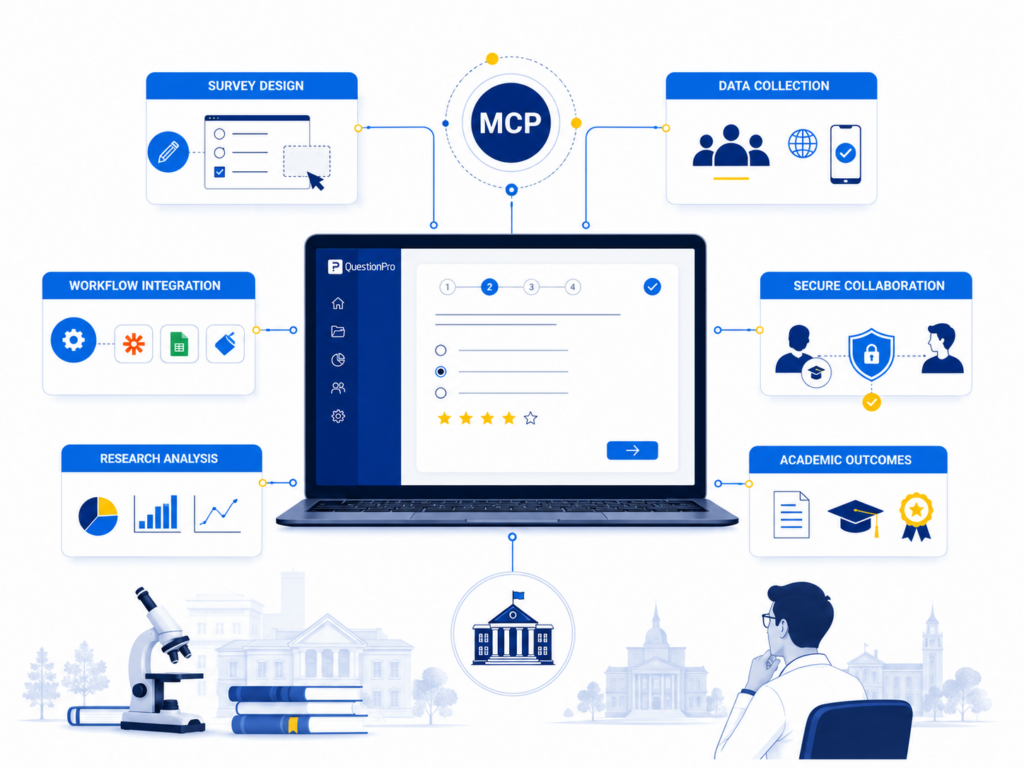
QuestionPro’s academic research platform includes an MCP server that exposes survey creation, response retrieval, and analytics to any compatible AI client. Claude, ChatGPT, and other MCP-compatible agents connect to a QuestionPro account and interact with the full platform through natural language without exporting data, without switching tools, and without losing the structural context that makes survey data useful.
For teams already using QuestionPro’s Research Suite, the MCP layer sits on top of the infrastructure already in place. No new data environment, no migration.
Setup for local AI clients takes minutes: register the server endpoint and API credentials in the client’s configuration file, restart, and the tools will be available in every subsequent conversation. Before connecting to production data, run a read-only test query on a non-sensitive dataset first. Confirming that permission scoping behaves as expected is not optional when participant data is involved.
Where are the limits?
AI agents can build surveys from descriptions, but complex branching logic common in validated academic instruments needs human review before deployment. Treat AI-generated structures as a well-informed first draft.
At a very large scale, context window limits constrain how much raw response data an AI can process in a single query. Native platform analytics handles volume better; the AI interprets the outputs.
Prompt quality determines analytical quality. An AI with access to excellent data will return vague analysis if the question is vague. Research expertise is still the differentiating factor.
The Shift That Matters
The problem in academic research data workflows has never been running the surveys. It has been the distance between the data and the analysis, the manual work at every stage, that delays insight and erodes context. stage,
MCP closes that distance. For research teams managing longitudinal studies, multi-cohort comparisons, or simply trying to spend less time on data preparation, that is a meaningful operational shift.
To see how it fits your research infrastructure, explore the QuestionPro Research Suite or speak with the team for a live walkthrough.