You log into your research platform to launch a survey, and a “create a poll” button sits right next to it. In the poll vs survey decision, picking the wrong tool wastes time, or worse, hands you data that cannot answer your real question.
A poll and a survey both collect opinions, but they are built for different jobs. One gives you a fast, single-question read on a group. The other digs into the reasoning behind that read.
This guide breaks down the real differences, shows where each tool fits, and walks through the mistakes that trip up even experienced researchers.
What is the difference between a poll and a survey?
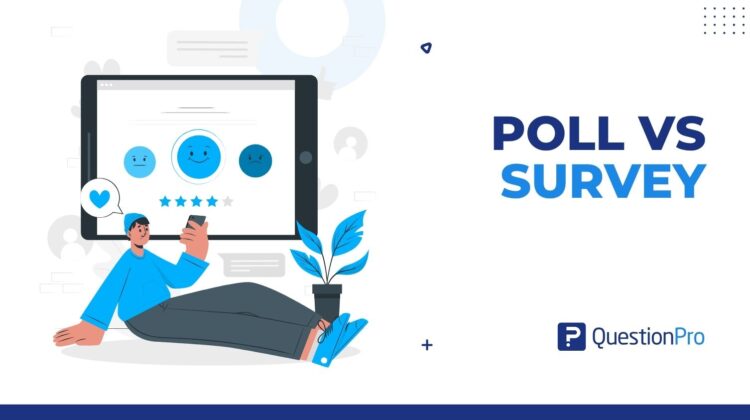
A poll is a single question with a small set of closed-ended answers, built to capture an instant read on opinion. A survey is a structured set of multiple questions, often mixing closed-ended and open-ended formats, built to explain the reasoning behind that opinion.
The two tools share a purpose, gathering input from people, but they differ in scope, speed, and depth. Here is how they compare side by side.
| Factor | Poll | Survey |
|---|---|---|
| Number of questions | One | Multiple |
| Question type | Closed-ended (yes/no, multiple choice) | Mix of closed-ended and open-ended |
| Time to complete | Seconds | A few minutes or more |
| Results | Available instantly | Require time for analysis |
| Respondent detail | Usually anonymous | Can include demographics and contact info |
| Best for | A quick pulse check | Decisions backed by data |
Most poll options rely on closed-ended questions because the answers need to be countable the moment they arrive. A survey can use the same question type, then add room for people to explain themselves in their own words.
When should you use a poll instead of a survey?
The right choice comes down to how fast you need an answer and how many questions you actually have. Match the tool to the job, and the decision gets simple.
Reach for a poll when:
- You need results in minutes, not days
- You only have one question to ask
- The answer options fit into a handful of choices
- You want to spark engagement or start a conversation
- Respondent identity does not matter to the outcome
Reach for a survey when:
- You are making a decision that affects the business
- You need to understand the “why” behind an opinion, not just the “what”
- The topic needs open-ended questions to capture nuance
- You need to filter or qualify specific respondents
- You plan to track the same metric over time
Real-world examples of polls and surveys
Seeing the two side by side in practice makes the difference easier to remember than any definition on its own.
- A retail brand testing a headline.
Before sending a full email campaign, a marketing team runs a one-question poll asking subscribers which subject line they prefer. The winner ships within the hour, and the loser is forgotten. - A SaaS company reviewing product-market fit.
Instead of a poll, the same company runs a twelve-question survey asking free-trial users about pricing sensitivity, feature gaps, and switching costs. That data feeds a roadmap decision, not a same-day call. - A newsroom covering election night.
A quick poll asks viewers which candidate they expect to win, purely for engagement. It is not market research and was never designed to predict the outcome. - An HR team checking morale after a reorganization.
A single pulse question, “How supported do you feel this week?” on a five-point scale, gives leadership a same-day signal. A deeper annual engagement survey follows later to explain what is actually driving that number.
Common mistakes when choosing between a poll and a survey
Most poll vs survey mistakes are not really about picking the wrong tool. They come from asking that tool to do a job it was never built for.
- Using a poll to make a big decision: A single question from an unverified, anonymous audience is not a stable base for a budget or product call.
- Turning a survey into a poll with extra steps: Stacking ten closed-ended questions with no open-ended follow-up gives you data without any context for it.
- Ignoring sample size: A poll with forty responses can be a fun snapshot. Treating it as representative of an entire customer base is a stretch.
- Skipping a pilot test: Confusing wording sinks both formats, but it costs more in a long survey where respondents quit halfway through.
- Forgetting the follow-up: A poll that sparks interest but never leads to a deeper survey wastes the opening it created.
Poll vs Survey vs Questionnaire: What’s the difference?
Poll and survey are not the only terms that get mixed up. Questionnaire and metrics like Net Promoter Score add to the confusion, so it helps to place all of them side by side.
| Term | What it means | Example |
|---|---|---|
| Poll | One question, instant results | “Which logo do you prefer?” |
| Survey | Multiple questions, structured analysis | A ten-question customer satisfaction study |
| Questionnaire | The list of questions itself, with no built-in analysis | A paper form used inside a larger survey |
| NPS question | A single scored question, tracked inside a survey | “How likely are you to recommend us?” |
An NPS question looks like a poll because it only asks one thing, but it functions as a tracked metric inside a larger survey program, which puts it in a category of its own. Even researchers who study public opinion for a living, like the Pew Research Center, note that market research and public opinion polling are usually told apart by subject matter more than by format.
How to measure and act on poll and survey results
Once results start coming in, a poll and a survey call for different levels of analysis. Here is a simple process for each.
- Check volume before you read into a poll.
A handful of responses is fine for a quick temperature check, but treat the result as directional, not definitive. - Cross-tabulate survey data by segment.
Break results out by role, tenure, or customer type to see if the overall number is hiding a smaller, more urgent story. - Watch for response bias in both formats.
People who feel strongly are more likely to answer than people who feel neutral, so a loud minority can skew either tool. - Set a cadence for repeat polls.
A one-off poll is a snapshot. Running the same question weekly through a tool like QuestionPro’s Live Polls turns it into a trend line worth watching. - Route survey findings into a decision, not a slide.
If nobody acts on the result, the survey was not worth the time it took respondents to finish it.
Choosing the right tool for the moment
Poll vs survey is not really a competition. A poll earns its place when speed matters more than depth, giving you a read you can act on before the moment passes. A survey earns its place when you are staking a real decision on the data and need the reasons behind the numbers, not just the headline result.
The best researchers keep both tools within reach and switch between them without much thought, the same way a carpenter reaches for a hammer or a level based on the job in front of them, not out of habit.
Frequently Asked Questions (FAQs)
Yes. Many surveys open with a poll-style question, such as a single rating or yes-no item, before moving into open-ended follow-ups. That first question sets context, and the rest of the survey builds on it.
Polls do not need a statistically representative sample since they measure a quick reaction. Surveys used for real decisions typically need enough responses across key segments to be confident the results reflect your broader audience.
Reliability depends on sample size and question wording, not the format itself. A poorly worded survey question can mislead just as easily as an unrepresentative poll, so design quality matters more than which tool you choose.
Yes, and it often should. A poll that surfaces a surprising result, like a product preference nobody expected, is a strong signal to follow up with a full survey that asks respondents why they feel that way.
No. Polls work just as well for internal team checks, event feedback, or quick product decisions. Politics gets the headlines, but business teams use single-question polls constantly for fast, low-stakes reads.