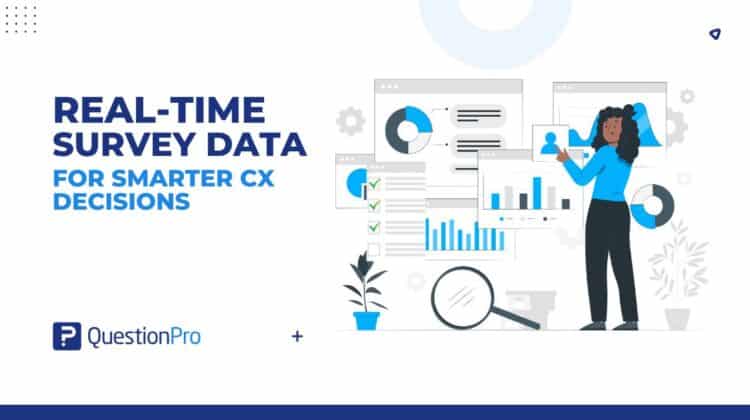
Real-time survey data is feedback that becomes visible the moment someone submits it, not days or weeks later. Instead of waiting for a survey to close, teams watch scores, comments, and trends update as responses arrive.
For US businesses working in fast-moving markets, that speed changes what feedback is good for. A support team can catch a bad call before the next ten calls happen the same way. A product team can see a confusing onboarding step drop satisfaction within hours of a launch, not a quarter later.
In this guide, we’ll cover what real-time survey data actually means, how it differs from a live dashboard or near-real-time reporting, and how to build a program around it without drowning in noise.
What is real-time survey data?
Real-time survey data is survey responses that get captured, processed, and displayed immediately after a person submits them, with no manual delay between collection and visibility.
The moment a respondent hits submit, the answer appears in a dashboard, report, or alert. Nobody has to close the survey, export a file, or run a report first.
Three things separate real-time data from a “live-looking” dashboard that only refreshes on a schedule:
- Responses appear within seconds or minutes, not after a batch update
- Filtering and segmentation happen on the current data set, not a cached snapshot
- Alerts can fire automatically when a score crosses a set threshold
Real-time does not mean statistically final. A handful of early responses is a signal, not proof. Businesses that treat every early spike as confirmed fact tend to overcorrect on noise instead of on a real pattern.
Real-time, live, and near-real-time: what’s the difference?
These three terms get used interchangeably, and that causes confusion when teams compare tools or set expectations internally.
| Term | What it means | Typical delay |
|---|---|---|
| Real-time | Data appears the instant it’s submitted | Seconds |
| Live | Often used loosely for real-time, but sometimes means a dashboard that auto-refreshes on a short timer | Seconds to a few minutes |
| Near-real-time | Data is processed in small batches rather than instantly | Minutes to an hour |
The distinction matters most when a business is evaluating survey software. A platform that calls itself “live” but batches updates every 15 minutes will not catch a support call gone wrong fast enough to intervene during the same shift.
How does real-time survey feedback collection work?
Real-time feedback collection is triggered by an action, not a calendar. A purchase, a support call, a delivery, or a login can all set off a survey the instant that moment happens.
The sequence usually looks like this:
- A customer or employee completes a key action. This could be a checkout, a support ticket closing, an onboarding step, or a service appointment.
- A short survey fires immediately. It’s delivered by email, SMS, in-app prompt, or an on-site QR code while the moment is still fresh.
- The response is processed the instant it’s submitted. There’s no wait for a survey to close or a batch job to run.
- Metrics update on a live dashboard. Scores, sentiment, and open-text comments refresh automatically as new responses land.
Behind the scenes, three technical pieces make this reliable instead of just fast:
- Identity matching ties each response to the right customer, order, or interaction
- Timestamps preserve exactly when the feedback was given
- Validation filters out incomplete, duplicate, or low-quality responses before they hit the dashboard
Without that validation layer, speed just means bad data arrives faster. Survey analysis done well still applies rigor to real-time responses, it just applies it continuously instead of after the fact.
What types of surveys work best for real-time feedback?
Real-time feedback works best when a survey is short, tied to one specific moment, and easy to answer in under a minute. Long, exploratory surveys are built for reflection, not instant reaction, so they rarely benefit from real-time display.
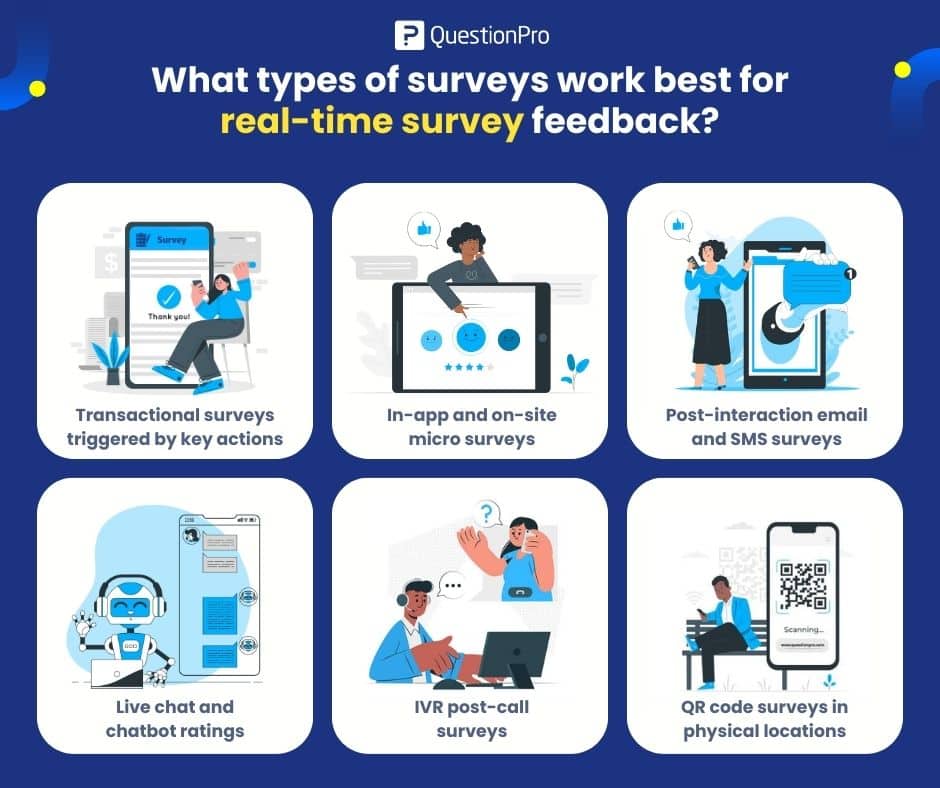
The formats that consistently perform well include:
- Transactional surveys sent right after checkout, delivery, or a support call, usually measuring CSAT or Customer Effort Score with one to three questions
- In-app or on-site micro surveys, like a one-question pop-up after a feature is used
- Post-interaction SMS or email surveys sent within minutes of the interaction ending, not hours later
- Live chat and chatbot ratings captured the moment a conversation closes
- IVR post-call surveys that ask about the call while memory is still accurate
- QR code surveys used in stores, at events, or on-site, where a customer scans and answers on their phone
Each of these works because the question arrives close enough to the experience that the answer reflects what actually happened, not a reconstructed memory of it.
How is real-time survey analysis different from traditional analysis?
Traditional survey analysis starts after the field period closes. Real-time survey analysis happens continuously while responses are still coming in.
The practical difference shows up in what teams look for. Traditional analysis explains what already happened, with confidence intervals and complete samples. Real-time analysis looks for directional signals, consistent patterns across segments, and recurring themes in open comments, while accepting that the picture will keep updating.
That shift changes the job. A traditional report tells a team what to study next quarter. A real-time dashboard tells a team what to check today.
How does real-time survey data improve customer experience decisions?
Real-time survey data improves CX decisions by showing exactly where an experience is breaking down while there’s still time to fix it, instead of after the damage is already done.
A few concrete examples make this tangible:
- A retailer notices Customer Effort Score drop right after a new checkout flow ships, and rolls back the change within a day instead of a quarter later
- A SaaS company sees onboarding satisfaction fall for one plan tier and adjusts the welcome email before churn shows up in the numbers
- A hotel chain spots a cluster of low ratings tied to one property and dispatches a regional manager the same week
In each case, the value isn’t the speed by itself. It’s catching a small, specific problem before it spreads to a larger group of customer segments. Waiting for a quarterly report to reveal the same issue means the damage has already compounded.
How to build a real-time survey feedback program
A real-time feedback program is not about collecting data faster for its own sake. It’s a system that connects live signals to decisions a team is actually ready to act on.
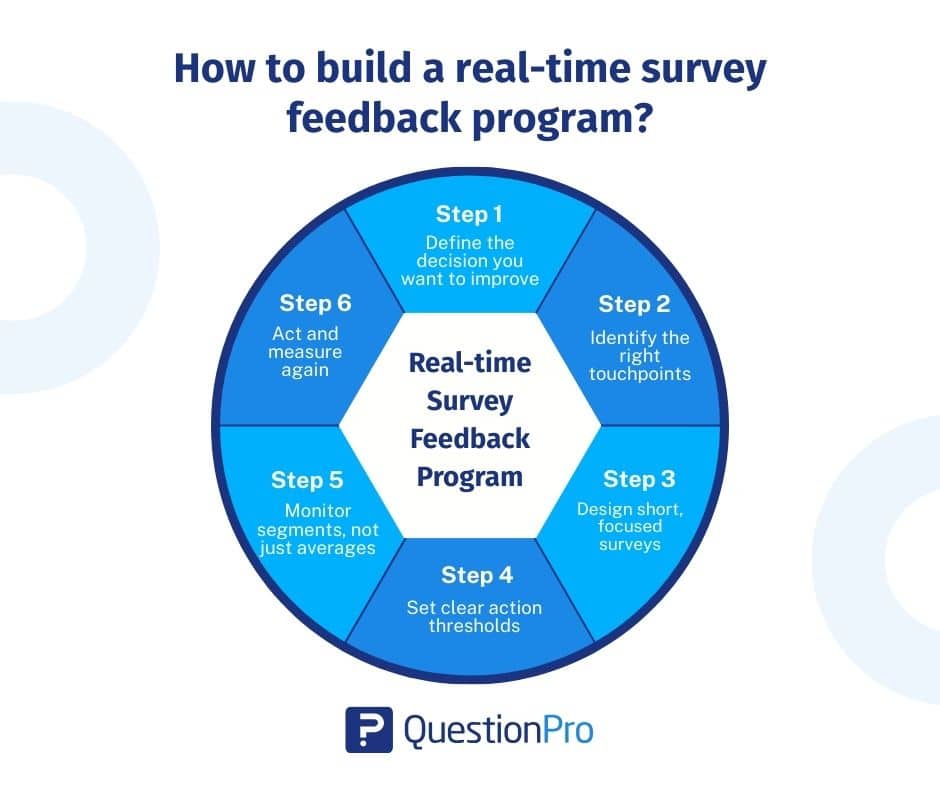
- Pick one decision to improve first. Reducing early churn, cutting support effort, or improving delivery satisfaction are all specific enough to design around.
- Choose touchpoints that reflect the real experience, not ones that are convenient to survey.
- Keep surveys to one to three questions. Anything longer defeats the purpose of instant feedback.
- Set action thresholds in advance. Decide what score or comment pattern triggers a follow-up before the data starts arriving.
- Watch segments, not just the overall average. A flat average can hide a serious problem in one region or channel.
- Act, then watch the same metric again to confirm whether the change actually worked.
Skipping the first step is the most common failure. Teams that collect real-time data without a target decision end up with a dashboard nobody checks.
Common mistakes to avoid with real-time survey data
Speed creates its own set of risks that a traditional, slower research cycle doesn’t have.
- Acting on tiny sample sizes.
Five negative responses out of five isn’t a trend yet, especially on a low-traffic day.
- Ignoring segment differences.
A stable overall score can mask a real problem in one channel or region.
- Surveying too often.
Triggering a survey after every micro-interaction leads to fatigue and falling response rates over time.
- Treating every dip as a crisis.
Normal day-to-day variation exists even in healthy programs.
- Skipping the open-text comments.
Scores show that something changed. Comments usually explain why.
Most of these mistakes come from treating real-time data with the same instinctive trust people give a stock ticker. A single score moving up or down is a prompt to look closer, not a finished conclusion.
How do you measure whether a real-time feedback program is working?
The clearest sign a real-time program is working is that it changes decisions, not just dashboards. If scores update live but nobody’s actions change because of them, the program isn’t delivering value yet.
Two numbers tell that story quickly. The first is the gap between a negative response and a follow-up action, which should shrink as a program matures. The second is whether issues flagged in real time get resolved before they ever show up in a monthly or quarterly report.
Response rate trends matter here too, since fatigue from over-surveying shows up first as a slow decline in completion, long before anyone complains directly. Average response rates for structured employee feedback programs run around 76%, typically ranging between 60% and 92%, according to industry benchmark data compiled by ContactMonkey. A program drifting well below that range is often a sign of survey fatigue, not disengagement.
How QuestionPro supports real-time survey data
QuestionPro makes feedback visible the moment a response is submitted and connects it directly to tools teams can act on, not just a dashboard to watch.
That support shows up in a few practical ways:
- Event-based triggers launch surveys automatically by email, SMS, in-app prompt, web embed, or QR code, right when an experience happens
- Live dashboards update scores, trends, and open comments as responses arrive, without a manual refresh
- Segmentation and alerts flag sudden CSAT drops or negative spikes by channel, region, or customer type as data comes in
- QuestionPro AI helps teams build and launch a survey quickly after a product change or campaign, which matters when timing is the whole point
None of this replaces judgment. It just removes the delay between a customer’s experience and a team’s ability to see it.
Real-time signals still need a bigger picture
Real-time survey data is best understood as an early warning system, not a replacement for deeper research. It tells a team where to look. It rarely tells the whole story on its own.
The strongest CX programs pair real-time signals with structured voice of the customer programs and periodic deep-dive research. Real-time data flags what deserves attention today. Ongoing research explains the patterns behind it and guides longer-term strategy.
Used that way, real-time feedback stops being a stream of noise and becomes one input in a much more complete decision system.
Real-time survey data works best as a habit, not a one-time setup. The businesses that get the most out of it treat every score as a prompt to ask a better question, not a final answer on its own.
Frequently Asked Questions (FAQs)
Not inherently. Most modern survey platforms include real-time dashboards as a standard feature rather than a paid add-on. Costs usually come from higher survey volume or advanced alerting, not the real-time display itself.
Yes, though sample sizes are smaller, so patterns take longer to confirm. Small businesses benefit most by focusing on one or two triggered surveys, like post-purchase or post-support, rather than trying to monitor everything at once.
Most platforms display responses within seconds to a couple of minutes of submission. True instant delivery depends on the survey channel, since SMS and email have small transmission delays that in-app surveys don’t have.
The statistical rules don’t change, but the interpretation timeline does. Teams should still wait for a reasonable volume of responses before treating an early trend as confirmed, even though the data is visible immediately.
Overreacting to short-term noise. Without segment analysis and a baseline for normal variation, teams can chase false signals and miss the slower, more meaningful patterns that longer research cycles are built to catch.