Relationship surveys are structured tools that help explain how people experience relationships over time. Whether the relationship is personal, professional, or commercial, these surveys help capture trust, communication quality, emotional connection, and satisfaction in a way that can be analyzed and acted on.
A relationship survey track how trust, communication, and emotional connection evolve within an ongoing relationship.
In the USA, this surveys are widely used in academic research, workplace culture programs, customer experience initiatives, and mental health studies. What makes them valuable is not the scale or the software behind them, but how clearly they translate human experiences into usable insight.
In this blog, we’ll explain what relationship surveys are, the main types, how to design them well, and when they actually work.
What are relationship surveys?
Relationship surveys are questionnaires designed to assess how people perceive and feel about a relationship. The relationship might be between partners, coworkers, managers, and teams, or customers and brands.
At their core, these surveys focus on patterns, not moments. They look at how trust is built or damaged, how communication works under pressure, and whether people feel valued and understood.
What relationship surveys measure
Healthy relationships need more than assumptions. Most relationship surveys measure some combination of:
- Trust and reliability: How safe and dependable the relationship feels
- Communication clarity: How openly concerns and expectations are shared
- Emotional connection: Feelings of closeness, value, and understanding
- Perceived fairness and respect: Balance, recognition, and mutual regard
- Satisfaction and long-term intent: Willingness to continue the relationship
Unlike transactional surveys, which capture feedback after a single event, relationship surveys focus on how perceptions develop and change over time.
When you should use relationship surveys
Relationship surveys are most effective when relationship quality directly influences retention, performance, or long-term outcomes. These surveys are most useful when outcomes depend on long-term behavior rather than one-time actions.
You should use them when:
- You want to understand why loyalty changes over time
- You need early warning signs of disengagement or conflict
- You want to compare perception gaps between groups
- You are tracking improvement after an intervention
In the USA, many organizations run these surveys quarterly or biannually, especially in HR and CX programs where relationship quality directly affects retention.
Types of relationship surveys and what they reveal
Relationship surveys are used across different contexts to understand how people experience ongoing relationships. While the setting may change, the goal stays the same: to uncover trust, communication quality, emotional connection, and long-term stability. Below are the main types of relationship surveys, each focusing on a specific kind of relationship and the insights it provides.
How personal relationship surveys assess emotional bonds
Personal relationship surveys focus on intimate or close relationships, most often romantic partnerships, but sometimes family relationships as well. The goal is to understand emotional alignment, communication habits, and overall relationship health.
These surveys are common in psychological research, couples therapy, and wellness platforms.
They often focus on:
- Emotional closeness and affection
- Trust and reliability
- Conflict handling and repair
- Shared values and future alignment
To measure these areas, surveys typically use Likert-scale agreement statements (where respondents rate how strongly they agree or disagree). These questions are usually phrased neutrally to avoid blame, such as:
- I feel emotionally supported by my partner
- We handle disagreements in a respectful way
- I feel secure about our future together
When done well, these surveys act as a mirror, not a verdict. They help individuals reflect rather than assign fault.
Why workplace relationship surveys matter for culture
Workplace relationship surveys measure how employees experience relationships at work. This includes relationships with managers, peers, and leadership.
In US companies, these surveys are often part of engagement or culture initiatives, but their real value lies in diagnosing trust gaps early.
Workplace relationship surveys measure key areas, such as:
- Manager trust and fairness
- Team collaboration and respect
- Psychological safety
- Communication clarity
These surveys are closely linked to employee relationship feedback and team collaboration surveys, especially in distributed or hybrid teams.
Poor workplace relationships often show up as turnover, silence, or burnout long before formal complaints. Relationship surveys surface issues that people are hesitant to say out loud. That’s why organizations rely on them.
How customer relationship surveys go beyond transactions
Customer relationship surveys focus on how customers feel about a company over time, not just after a purchase or support ticket.
They are widely used in CX programs across the USA to understand loyalty, trust, and emotional connection.
These surveys help answer questions like:
- Do customers feel understood by the brand?
- Is trust growing or eroding?
- What keeps customers coming back, beyond price?
To capture these insights, surveys commonly use a mix of rating-scale questions and loyalty-intention items, such as likelihood to recommend or stay.
They often complement customer loyalty surveys by adding emotional context to behavioral data.
Common signals measured
- Confidence in the company
- Perceived consistency
- Willingness to stay or recommend
They are especially valuable in subscription-based or service-driven industries where relationships drive revenue.
How brand relationship surveys measure trust and perception
Brand relationship surveys look at how people relate to a brand as an identity, not just as a product provider.
In the US market, where brand choice is often emotional, these surveys help explain why people prefer one brand over another even when features are similar.
Brand relationship surveys focus on how customers perceive the brand’s character, values, and reliability over time.
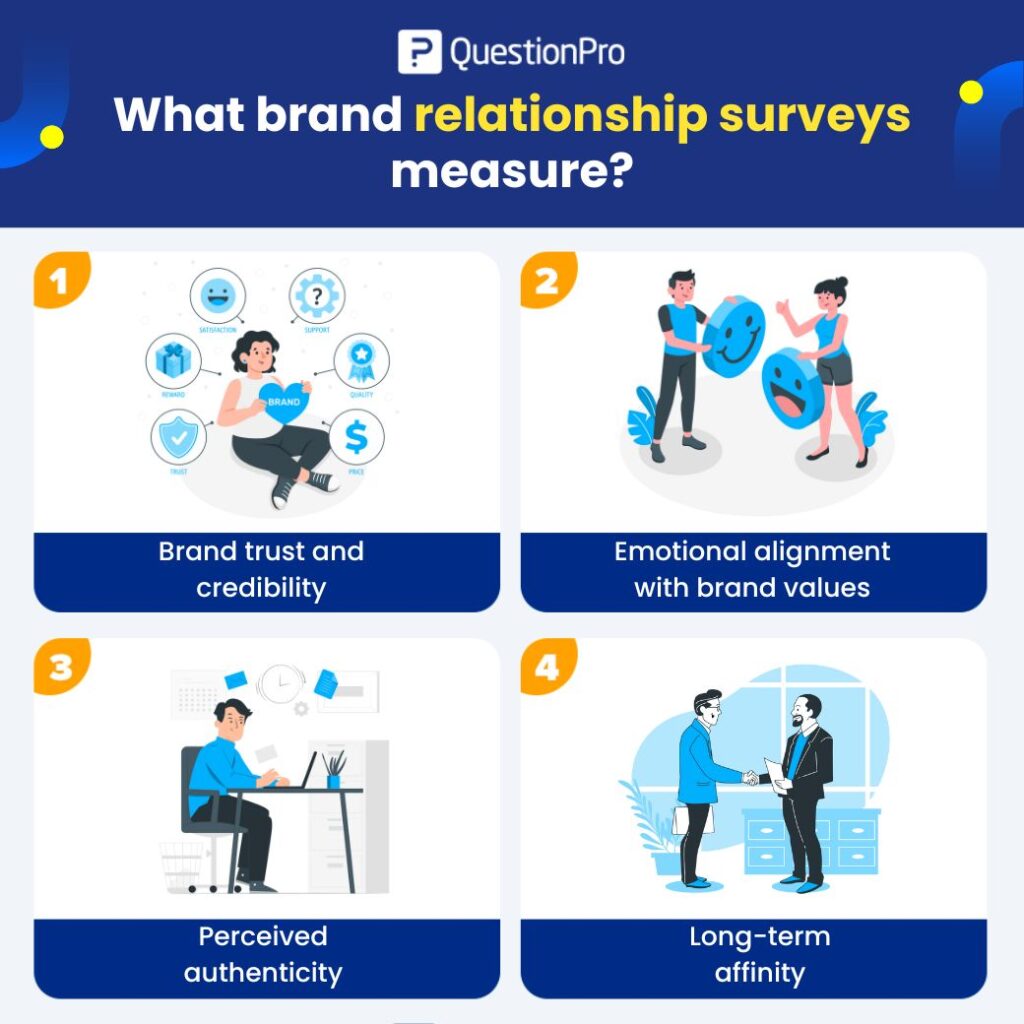
They often measure:
- Brand trust and credibility
- Emotional alignment with brand values
- Perceived authenticity
- Long-term affinity
This is closely tied to brand trust measurement, especially in regulated or high-stakes industries like finance and healthcare. Brand relationships influence forgiveness. Customers are more likely to stay loyal after a mistake if trust already exists.
What makes relationship satisfaction surveys different
Relationship satisfaction surveys measure overall contentment with a relationship rather than specific behaviors.
They are often used as a benchmark metric, especially in research and therapy settings.
They are typically used:
- As a baseline before deeper diagnostics
- To track change over time
- To compare groups or segments
These surveys work best when paired with more detailed follow-up questions that explain the score.
What types of relationship survey questions work best
Good relationship survey questions are clear, neutral, and specific. Poorly written questions introduce bias or defensiveness.
Principles that matter in question design include:
- Avoid assumptions about intent
- Focus on experiences, not character
- Keep language simple and concrete
- Avoid leading or loaded wording
For example, asking “I feel listened to during discussions” works better than “My partner is a good listener.” This is where strong survey design becomes critical. Question wording, order, and scale choice all influence how honest people feel comfortable being. A solid reference on survey question design can be found here: Survey Design – Writing Great Questions for Online Surveys
How to conduct a relationship assessment without bias
A relationship assessment should feel safe to complete. If respondents fear judgment or consequences, results will be skewed.
Practical steps to reduce bias include:
- Use anonymous or confidential formats
- Balance positive and negative statements
- Avoid emotionally loaded terms
In US workplace settings, anonymity is especially important to get honest feedback from employees about managers or leadership.
How relationship surveys create deeper understanding over time
Beyond surface-level satisfaction, relationship surveys help explain why relationships strengthen, weaken, or stay stable. By measuring emotional connection, trust, communication, and changes over time, these surveys reveal patterns that are easy to miss in one-off feedback.
How emotional connection measurement adds depth
Emotional connection measurement goes beyond satisfaction. It looks at how strongly people feel bonded, valued, and understood.
This dimension is often what separates stable relationships from fragile ones.
Why emotional signals matter?
Two relationships can score similarly on satisfaction but differ greatly in emotional depth. Emotional connection predicts resilience during stress or conflict.
This applies equally to personal relationships and customer or brand relationships.
How trust and communication surveys reveal weak points
Trust and communication surveys focus on how information flows and how reliable people perceive one another to be.
They use a mix of Likert-scale agreement statements, frequency-based questions, and perception rating scales to surface gaps that are often hidden in day-to-day interactions.
Common areas they highlight include:
- Fear of speaking openly
- Misaligned expectations
- Inconsistent follow-through
In teams, these issues often explain performance problems better than skill gaps, because they point to breakdowns in trust and clarity rather than capability.
How to turn relationship data into long-term insights
Relationship surveys are not one-off tools. Their real power comes from repetition and comparison.
What long-term tracking reveals:
- Patterns, not reactions: Spotting consistent behaviors and perceptions over time
- Early warning signs: Identifying emerging issues before they escalate
- Impact of interventions: Measuring whether changes or programs improve relationships
These long-term relationship insights help organizations and individuals move from reactive fixes to sustained improvement.
Common mistakes to avoid with relationship surveys
Even well-intentioned surveys can fail if poorly handled. Avoiding the following mistakes helps protect trust and ensures the feedback you collect is accurate and useful.
- Surveys that are too long
- Questions that mix multiple ideas
- Collecting data without follow-up
In the USA, survey fatigue is real. Short, focused surveys tend to perform better and earn more honest responses.
When relationship surveys actually work
Relationship surveys actually work when they are treated as tools for understanding, not judgment. Their value depends less on the questions themselves and more on how thoughtfully the process is handled before and after responses are collected.
They work best when people trust the survey’s intent and feel confident that their feedback will be used responsibly. Clear communication about why the survey is being run and how the results will be applied encourages more honest and meaningful responses.
A relationship survey is most effective when they lead to visible action. Sharing key findings, acknowledging concerns, and making improvements based on feedback show that responses matter. Without follow-through, even well-designed surveys can undermine trust rather than strengthen it.
Consistency also plays a critical role. Running relationship surveys at regular intervals allows patterns to emerge and helps track change over time. This long-term view turns individual responses into insights that support healthier relationships, stronger communication, and more informed decisions.
When trust, clarity, and action come together, a relationship survey becomes a reliable way to understand how relationships truly feel and how they can improve over time.
Frequently Asked Questions (FAQs)
Answer: Yes, when they are well-designed and based on validated constructs. Many are grounded in decades of behavioral and psychological research used widely in the USA.
Answer: Most organizations run them quarterly or biannually. Personal relationship surveys are often used at key moments or milestones rather than on a fixed schedule.
Answer: They can indicate risk by tracking declining trust, satisfaction, or emotional connection, but they do not predict outcomes with certainty.
Answer: Yes. In fact, small teams often benefit more because issues surface faster and can be addressed directly.
Answer: Yes, especially when questions feel relevant and respectful. Customers are often more willing to share feelings than companies expect.