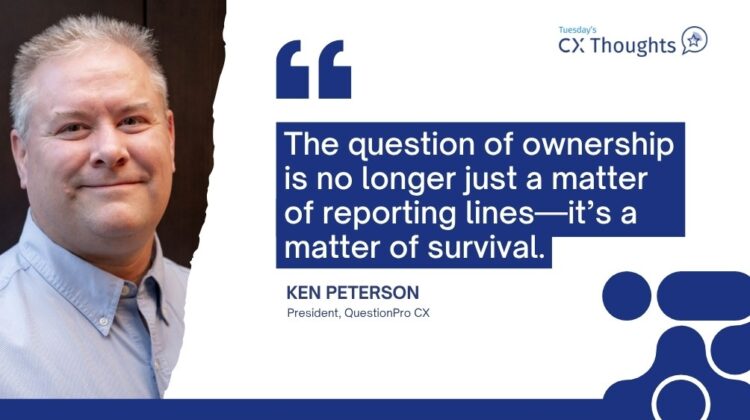
TCXT is a section of our blog where our Director of QuestionPro Customer Experience reflects and shares his thoughts on everyday moments and their relationship to customer experience. Ken Peterson shares his thoughts on how everyday moments shape customer experience. Read on to discover his perspective.
Want to hear Ken Peterson’s thoughts directly? Watch the video summary here:
For years, Customer Experience has been the “nomad” of the corporate world. It wanders from Marketing to Operations, stops briefly in HR, and occasionally settles into its own dedicated department. But as we move into an era demanding Experience Transformation, the question of ownership is no longer just a matter of reporting lines—it’s a matter of survival. According to our recent 2025 benchmarks trends report, customer tolerance is at a collective low, and the operational strain of siloed data is causing any perception gains to evaporate overnight.
To build a resilient brand, you must decide where CX lives. Here is a cursory dive into the pros and cons of what I see as the four primary contenders for CX ownership.
1. The Operations Model: CX as a Functional Core
In this model, CX is treated as a set of Standard Operating Procedures. It focuses on the mechanics of the journey—reducing friction, improving delivery times, and optimizing the supply chain.
- The Pros:
- Immediate Actionability: Operations teams have the power to change workflows quickly. If data shows a bottleneck in the delivery process, an Operations-led CX team can redesign the logistics “journey” without waiting for cross-departmental approval.
- Root Cause Resolution: This department is best in taking action with the Outer Loop—fixing systemic issues that cause recurring customer pain.
- The Cons:
- Lack of Emotional Resonance: Operations often prioritize efficiency over empathy. A journey might be efficient on paper but feel cold or robotic to the customer. As someone that used to work in operations, it can be easy to look at metrics over emotion.
- Short-Termism: There is a risk of focusing solely on tactical fixes (the CLF Inner Loop) rather than long-term brand strategy.
2. The Human Resources Model: The Culture-First Approach
This approach stems from the CX = EX philosophy: you cannot deliver a 5-star customer experience with a 1-star employee experience. Here, Customer Experience is managed by the people who manage the people.
- The Pros:
- Silo-Busting: HR is one of the few departments that touches every corner of the organization. They can align the contact center, market research, and sales under a single cultural banner.
- Empowered Front Lines: When the Customer Experience lives in HR, training, and recruitment are aligned with the customer-centricity model. Employees aren’t just told to be “customer-centric”; they are hired and rewarded for it.
- The Cons:
- Data Literacy Gap: HR teams may lack the technical expertise to manage complex CX tech stacks, AI-linked dashboards, or advanced journey mapping software.
- Distance from the Transaction: HR is often several steps removed from the actual point of sale or digital product interaction, making it harder to track real-time ROI.
3. The Standalone CX Department: The Central Intelligence Hub
Creating a dedicated CX department treats Experience as a specialized craft, much like Finance or Legal. This department acts as the source of truth and advocacy for the entire company.
- The Pros:
- Unbiased Advocacy: A standalone team doesn’t have a “departmental agenda.” They don’t care about marketing’s lead-generation numbers or operations’ cost-cutting goals; they only care about the customer journey.
- Strategic Governance: This model will allow for dedicated “Experience Intelligence” for both understanding journeys and taking actions. They can manage sophisticated journey maps that integrate indirect data, inferred data, and real-time Voice of the Customer signals.
- The Cons:
- The “Influence” Problem: Without a direct seat at the executive table, a standalone CX department can become a reporting shop—generating beautiful NPS metrics, dashboards and insights that no one actually acts upon.
- Internal Friction: Other departments may view a standalone Customer Experience team as a “policing” group overseeing their work, leading to defensiveness rather than collaboration.
4. The Product & Tech Model: CX as a Digital Asset
In a world where the app is the brand, many companies are moving CX into the Product or IT department. This focuses on the digital application journey and tech-enabled touchpoints.
- The Pros:
- Real-Time Action Intercepts: Tech-led CX can trigger feedback loops the moment a customer encounters a bug or a friction point in a digital journey.
- Data Integration: They are best positioned to merge CX sentiment data with behavioral data (clicks, dwell time, drop-offs) stored in the company’s data warehouse to create a 360-degree view of the user.
- The Cons:
- Digital Bias: This model has a team that often ignores the offline world. If your brand has physical stores or human support agents, a tech-heavy Customer Experience approach may create a disjointed experience that lacks empathy.
- Feature Over-Focus: Product teams may prioritize “cool” new features over fixing basic, low-tech customer frustrations.
So, where should it live?
Data suggests that the most successful organizations are moving toward a Hybrid Governance Model. While CX might have a home in a standalone department for the sake of data integrity and strategy, the action must be decentralized. Operations must own the friction reduction, HR must own the cultural alignment, and Product must own the digital journey.
As we saw in the Q4 2025 QuestionPro Benchmarks “universal reset,” brands that siloed their CX functions were the first to see their loyalty scores collapse under economic pressure. The brands that survived were those that treated CX not as a department, but as a shared operational philosophy. The question for 2026 isn’t “Who owns CX?” but rather “How can our Customer Experience program empower every owner in the building?”
Measure the experience you are delivering to your customers
Understanding customer satisfaction levels and their perception is essential to evaluating the impact of our efforts across every aspect of our business. Our main goal remains the same: providing a great experience.
If you’re also interested in gaining deeper insights into your customer base, QuestionPro Customer Experience offers the necessary tools to help you achieve this. Schedule a demo now—we’ll be happy to guide you through the platform and learn about the challenges in reaching your goals.