Why Traditional Survey Distribution Is Failing
Organizations invest significant effort in collecting customer feedback. They design surveys, define customer segments, and create detailed reporting dashboards. Yet one challenge continues to limit the value of these efforts:
Customers simply don’t complete surveys.
Email invitations often go unopened. Survey links are ignored. Customers abandon feedback forms before providing responses.
One of the biggest reasons for low response rates is friction.
The traditional feedback process usually looks like this:
- A customer completes an action.
- They receive an email later.
- They click a survey link.
- They are redirected to another page.
- They decide whether the survey is worth their time.
At every step, organizations lose respondents.
Embedded feedback changes this entire experience.
The Hidden Cost of Low Response Rates
Low survey participation creates several problems:
- Smaller sample sizes.
- Biased feedback from only highly satisfied or highly dissatisfied customers.
- Delayed insights.
- Incomplete customer understanding.
- Reduced confidence in decision-making.
For CX and product teams, low response rates mean important customer signals remain invisible.
The issue is not always survey length or survey design.
Often, the problem is simply that customers must leave their current experience to provide feedback.
What Is Embedded Feedback?
Embedded feedback allows organizations to place surveys directly inside websites, customer portals, applications, help centers, or digital experiences.
Instead of redirecting users to an external survey page, the survey appears exactly where the experience occurs.
Examples include:
- Product feedback inside a SaaS application.
- Checkout experience surveys on e-commerce sites.
- Customer portal satisfaction surveys.
- Website usability feedback.
- Help center satisfaction forms.
- Feature-specific feedback requests.
The customer never leaves the experience.
The feedback becomes part of the journey.
Why Embedded Surveys Increase Response Rates
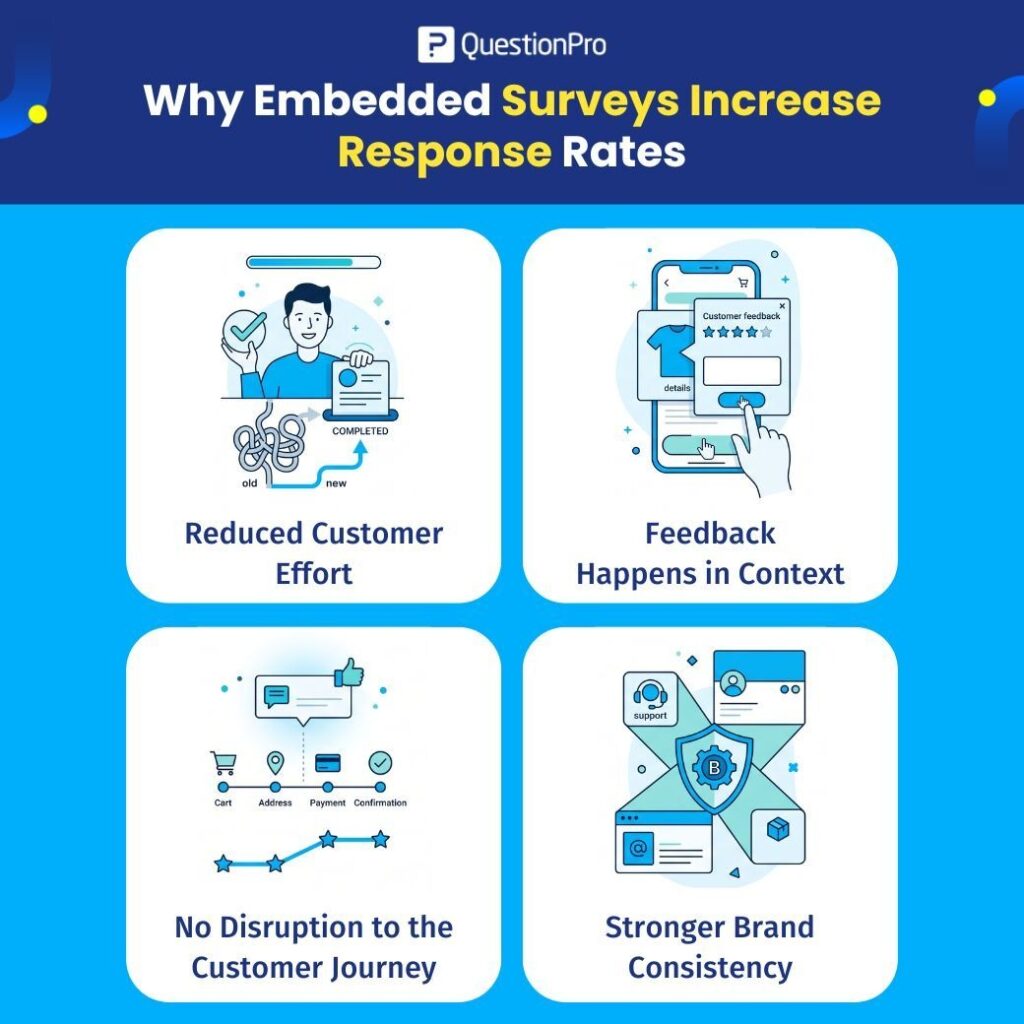
1. Reduced Customer Effort
Every additional click reduces participation.
Traditional surveys often require:
- Opening an email.
- Clicking a link.
- Waiting for a new page to load.
- Completing a separate experience.
Embedded surveys eliminate these steps.
Customers can provide feedback immediately with minimal effort.
The easier the experience, the higher the response rate.
2. Feedback Happens in Context
Customers provide better feedback when the experience is fresh.
Consider these examples:
- Asking for checkout feedback immediately after purchase.
- Collecting support satisfaction after a help article is viewed.
- Requesting feature feedback while users interact with the feature.
Context improves both participation and response quality.
Instead of asking customers to remember experiences later, organizations capture insights in real time.
3. No Disruption to the Customer Journey
Redirecting customers away from a website creates risk.
Users may:
- Abandon the survey.
- Close the browser.
- Lose their place.
- Decide to skip feedback altogether.
Embedded surveys maintain continuity.
Customers stay on the same page while providing feedback.
This significantly reduces abandonment.
4. Stronger Brand Consistency
External survey pages often feel disconnected from the primary experience.
Different branding, layouts, and navigation can create friction.
Embedded surveys inherit the surrounding digital experience.
Organizations maintain:
- Brand consistency.
- Design continuity.
- Customer trust.
- Professional experiences.
Customers feel they are still interacting with the same company.
Common Use Cases for Embedded Feedback
In-App Product Feedback
SaaS companies frequently collect feedback on:
- New features.
- Product usability.
- User onboarding.
- Feature adoption.
The feedback appears directly inside the application.
E-Commerce Experience Surveys
Retail organizations gather feedback after:
- Product purchases.
- Checkout completion.
- Order delivery.
- Returns experiences.
Immediate feedback leads to higher participation.
Customer Portal Surveys
Insurance, banking, and healthcare organizations often use embedded surveys inside customer portals.
This allows customers to provide feedback while managing their accounts.
Website Experience Measurement
Organizations can collect feedback on:
- Website navigation.
- Content quality.
- User experience.
- Conversion journeys.
This helps digital teams optimize experiences continuously.
Best Practices for Increasing Response Rates
Keep Surveys Short
The closer the survey is to the experience, the shorter it should be.
Three to five questions often outperform lengthy questionnaires.
Trigger Surveys at the Right Moment
Timing matters.
Consider:
- After completing a task.
- After viewing a support article.
- After using a feature.
- After making a purchase.
Contextual timing increases participation.
Make Surveys Relevant
Avoid showing every survey to every visitor.
Use targeting rules such as:
- Page URLs.
- Session duration.
- Scroll depth.
- User behavior.
- Customer segments.
Relevance drives engagement.
Optimize for Mobile Devices
Many customers interact through mobile devices.
Embedded surveys should:
- Load quickly.
- Display correctly on smaller screens.
- Require minimal scrolling.
- Support touch interactions.
Mobile-friendly experiences improve completion rates.
Respect Customer Attention
Feedback requests should feel helpful, not intrusive.
Organizations should:
- Limit survey frequency.
- Avoid interrupting critical tasks.
- Use clear messaging.
- Keep the experience lightweight.
Good feedback experiences encourage future participation.
Measuring the Success of Embedded Feedback
Organizations should monitor:
- Survey response rates.
- Completion rates.
- Abandonment rates.
- Time to completion.
- Customer satisfaction scores.
- Engagement by page or feature.
Comparing embedded surveys against traditional survey links often reveals substantial improvements in participation.
More responses lead to stronger insights and better decisions.
The Future of Feedback Collection
Customer expectations continue to evolve.
People expect experiences to be:
- Fast.
- Seamless.
- Personalized.
- Contextual.
Feedback collection must evolve as well.
The future belongs to in-context feedback experiences that appear naturally within customer journeys.
Rather than asking customers to leave the experience to provide feedback, organizations will increasingly capture insights exactly where interactions occur.
Embedded feedback represents this shift.
Final Thoughts
Survey response rates are not solely determined by survey design.
They are heavily influenced by customer effort.
Every additional click, page load, or redirect creates friction.
Embedded feedback removes that friction by allowing customers to share their opinions directly within the experience they are already using.
The result is:
- Higher participation.
- Better-quality feedback.
- Faster insights.
- Improved customer experiences.
The goal is no longer simply to ask for feedback.
The goal is to make providing feedback effortless.
When organizations reduce friction, customers respond.