Qualitative interviews help teams understand what people think, feel, need, avoid, choose, and struggle with.
But the way those interviews are moderated is changing.
Traditionally, a human researcher led the conversation. They asked questions, listened carefully, followed up, noticed hesitation, adjusted the flow, and interpreted what the participant really meant.
Now, AI moderated interviews give teams another option. Instead of scheduling every participant with a human moderator, researchers can create an interview guide, share a link, and let an AI moderator ask questions, probe vague answers, and collect responses asynchronously.
That creates an important question:
When should you use AI moderated interviews, and when should you still use human moderated interviews?
The answer is not that one is always better.
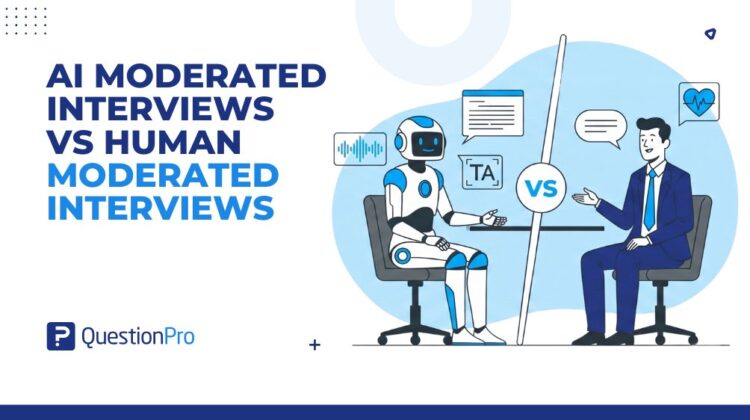
AI moderation is better for speed, scale, consistency, and repeatable research. Human moderation is better for nuance, ambiguity, sensitive topics, and conversations that require expert judgment.
The best research teams will use both.
What Are AI Moderated Interviews?
An AI moderated interview is a qualitative research interview where an AI interviewer asks participants questions, listens to their responses, asks follow-up questions, and helps organize the results into transcripts, summaries, quotes, and themes.
In an AI moderated interview, the researcher still designs the study. The researcher defines the goal, writes the interview guide, sets the probing instructions, recruits participants, and reviews the findings.
The AI helps conduct the conversation.
For example, if a participant says:
“The setup process was confusing.”
An AI moderator might ask:
“Which step in the setup process made you unsure what to do next?”
That follow-up is what separates AI moderated interviews from simple surveys or static forms.
AI moderated interviews are useful when teams want more depth than surveys can provide, but do not have the time or budget to run every interview manually.
Read more: AI Moderated Interviews: What They Are, How They Work, and When to Use Them in Research
What Are Human Moderated Interviews?
A human moderated interview is a qualitative research conversation led by a person, usually a researcher, product manager, founder, customer experience leader, or trained moderator.
The moderator guides the conversation, asks follow-up questions, notices emotional signals, adjusts the interview flow, and decides when to dig deeper.
Human moderated interviews are especially valuable when the research question is complex, sensitive, ambiguous, or exploratory.
For example, if a participant hesitates before answering a pricing question, a human moderator may notice the pause and ask gently:
“I noticed you paused there. What were you thinking about?”
That kind of judgment is difficult to fully automate.
Human moderators bring empathy, context, improvisation, and interpretation into the research conversation. That is why they remain essential for many types of qualitative research.
AI Moderated vs Human Moderated Interviews: Quick Comparison
| Factor | AI Moderated Interviews | Human Moderated Interviews |
|---|---|---|
| Best for | Scalable qualitative feedback, concept testing, churn research, product feedback | Deep discovery, sensitive topics, complex conversations, executive interviews |
| Speed | Fast to launch and collect responses | Slower because of scheduling and live moderation |
| Scale | High, many participants can complete interviews asynchronously | Limited by moderator availability |
| Cost per interview | Lower because the AI conducts the session | Higher because each session requires moderator time |
| Consistency | Very consistent across participants | Can vary by moderator style and experience |
| Follow-up questions | Adaptive, but dependent on the guide and AI quality | Highly contextual and judgment-driven |
| Emotional nuance | Limited | Stronger |
| Flexibility | Good within a defined research scope | Stronger when the conversation changes direction |
| Participant experience | Convenient and asynchronous | More personal and relationship-based |
| Analysis speed | Faster first-pass summaries and themes | Slower, but often richer interpretation |
| Best use case | Repeatable research at scale | High-value conversations where nuance matters |
Where AI Moderated Interviews Work Better
AI moderated interviews are not just a cheaper version of human interviews. They are better suited for certain research jobs.
1. When you need speed
Human moderated interviews take time.
You need to coordinate calendars, schedule sessions, send reminders, run the calls, take notes, transcribe recordings, and synthesize the findings.
AI moderated interviews reduce many of those bottlenecks. Participants can complete the interview on their own time, and the system can automatically generate transcripts, summaries, and initial themes.
This is useful when product, marketing, or CX teams need feedback quickly.
For example:
- Testing reactions to a product concept
- Understanding why users abandoned onboarding
- Collecting feedback after a feature launch
- Running churn interviews
- Gathering customer reactions before a campaign goes live
AI moderation is especially useful when waiting two or three weeks for interview scheduling would slow down a business decision.
2. When you need scale
Human interviews are limited by moderator availability.
Even if each interview takes only 30 minutes, a researcher still needs time for preparation, live moderation, note-taking, synthesis, and reporting.
AI moderated interviews can scale to many more participants because the moderator is not tied to one calendar.
That makes AI useful when you want qualitative feedback from 30, 50, 100, or more participants.
This does not mean every study needs large qualitative samples. It means AI moderated interviews make larger qualitative studies more practical when scale is valuable.
3. When the study is focused
AI moderated interviews work best when the research objective is clear.
Good examples include:
- Why did trial users not activate?
- What confused customers during onboarding?
- How do buyers react to this product concept?
- Why did customers choose a competitor?
- What objections come up around pricing?
- What words do customers use to describe the problem?
These questions are focused enough for an AI moderator to ask a structured set of questions and probe for useful details.
AI is weaker when the researcher does not yet know what they are trying to learn.
4. When consistency matters
Human moderators bring skill, but they also vary.
One moderator may ask a follow-up question differently from another. One may spend more time on pricing, while another may spend more time on usability. One may unintentionally lead the participant.
AI moderated interviews can create more consistency across sessions.
Each participant gets the same core guide, the same instructions, and the same general moderation behavior. This is useful when teams want to compare responses across participants or segments.
5. When participants need flexibility
Scheduling interviews can be a major source of friction.
Participants may be in different time zones, busy with work, or unwilling to commit to a live call.
AI moderated interviews let participants complete the session asynchronously. This can improve participation for some audiences, especially when the interview is short, clear, and easy to access.
6. When you want better depth than surveys
Surveys are useful, but open-ended responses are often shallow.
A survey might ask:
“Why did you cancel?”
The participant might answer:
“Too expensive.”
That tells you something, but not enough.
An AI moderated interview can ask:
“What were you comparing the price against?”
or:
“At what point did the product start to feel too expensive?”
That extra context helps teams understand the reason behind the response.
Where Human Moderated Interviews Work Better
Human moderated interviews are still the better choice for many types of research.
Nielsen Norman Group argues that AI interviewers are not a replacement for in-depth, human-led semi-structured interviews, especially when the goal is deep discovery rather than faster feedback at scale.
1. When the topic is sensitive
Human moderation is better when the research involves sensitive, emotional, personal, or high-risk topics.
Examples include:
- Health experiences
- Financial stress
- Trauma
- Workplace conflict
- Identity-related topics
- Legal or compliance-sensitive issues
- Deep dissatisfaction with a company or product
In these cases, participants may need empathy, reassurance, and careful handling.
A human moderator can notice discomfort, slow down, rephrase questions, skip a topic, or create a safer environment.
AI may be able to ask polite questions, but that is not the same as human care.
2. When the conversation is ambiguous
Some research starts without a clear path.
You may not know which problem matters most. You may not know what language customers use. You may not know whether the team is even asking the right question.
This is where human researchers are strongest.
A human moderator can follow unexpected threads, change the structure of the interview, and explore ideas that were not in the original guide.
AI moderation works best with a defined objective. Human moderation is better when the objective itself is still forming.
3. When emotional nuance matters
Participants do not communicate only through words.
They pause. They laugh. They hesitate. They avoid eye contact. They soften criticism. They contradict themselves. They say something is “fine” when their tone suggests otherwise.
Human moderators are better at detecting and responding to those signals.
This matters in research where emotional nuance is central, such as:
- Brand trust research
- High-consideration purchase decisions
- Enterprise buyer interviews
- Customer relationship research
- Research after a negative customer experience
AI can process language, but human moderators are still better at reading the full conversation.
4. When the participant is high-value
Some interviews are too important to fully automate.
For example:
- Enterprise decision-makers
- Strategic customers
- Lost high-value deals
- Key accounts
- Executive buyers
- Industry experts
- Partners
In these cases, the interview is not only data collection. It is also a relationship moment.
A human conversation may create trust, show respect, and open up richer discussion.
AI can be useful for supporting analysis afterward, but the live conversation should often remain human-led.
5. When the researcher needs to challenge assumptions
Good moderators do more than ask questions. They notice when the participant is avoiding something, contradicting themselves, or giving a socially acceptable answer.
A human moderator can ask:
“Earlier you said setup was easy, but now you mentioned your team needed help from support. How do those fit together?”
That kind of synthesis and challenge is difficult for AI to do reliably, especially in complex conversations.
6. When ethics and responsibility matter deeply
AI-assisted interviewing introduces questions about disclosure, consent, privacy, responsibility, and participant comfort. A recent LLM-in-the-loop study on AI-generated follow-up questions reported concerns around interaction harms, nonverbal cues, participation inequality, responsibility, privacy, disclosure, and compliance when AI is used in interview settings.
That does not mean AI should not be used. It means teams need to be thoughtful.
For high-risk studies, a human moderator may be more appropriate, or AI should be used only as a support tool, not as the primary moderator.
The Real Difference: Scale vs Judgment
The simplest way to compare the two methods is this:
AI moderated interviews scale the conversation. Human moderated interviews deepen the conversation.
That is not always absolute. AI can produce deep responses when the guide is strong and the participant is engaged. Human interviews can be shallow when the moderator is inexperienced or the study is poorly designed.
But as a general rule:
Use AI when the research is focused, repeatable, and needs scale.
Use humans when the research is complex, sensitive, ambiguous, or high-value.
When to Use AI Moderated Interviews
Use AI moderated interviews when you need to collect qualitative feedback from more participants without scheduling every session manually.
Good use cases include:
Product feedback
Use AI moderated interviews to understand how users react to a new feature, where they struggle, and what they expected.
Example questions:
- What were you trying to accomplish when you used this feature?
- What felt clear or unclear?
- Was there any point where you got stuck?
- What would make this feature more useful?
Concept testing
Use AI moderation to test reactions to product ideas, messaging, landing pages, ads, or prototypes.
Example questions:
- What is your first reaction to this concept?
- What problem do you think this solves?
- What feels believable or unbelievable?
- What would stop you from using this?
Churn research
Use AI moderated interviews to understand why customers left or why trial users did not activate.
Example questions:
- What were you hoping to accomplish when you signed up?
- Where did the experience fall short?
- Did you consider alternatives?
- What would have made you more likely to continue?
Win/loss research
Use AI moderated interviews to collect buyer feedback after deals are won or lost.
Example questions:
- What problem were you trying to solve?
- Which alternatives did you consider?
- What mattered most in your decision?
- Why did you choose one option over another?
Onboarding feedback
Use AI interviews to understand where users get stuck during setup or activation.
Example questions:
- Can you walk me through your first experience with the product?
- Which step felt easiest?
- Which step felt unclear?
- What did you expect to happen next?
Message testing
Use AI moderated interviews to understand whether your positioning is clear, relevant, and credible.
Example questions:
- What do you think this message means?
- Who do you think this product is for?
- What feels most relevant to you?
- What feels confusing or exaggerated?
When to Use Human Moderated Interviews
Use human moderated interviews when the conversation requires judgment, empathy, relationship-building, or deep exploration.
Good use cases include:
Early discovery
When you are still learning the problem space, a human researcher can explore unexpected directions and adjust the conversation as new information emerges.
Sensitive research
When the topic involves personal, emotional, or high-risk experiences, human moderation is usually safer and more responsible.
Executive interviews
Senior buyers and executives often expect a high-quality human conversation. The relationship value may matter as much as the research output.
Strategic customer conversations
If the participant is a key customer or account, human moderation helps preserve the relationship and allows for deeper follow-up.
Complex buyer journeys
Enterprise purchase decisions can involve politics, budget cycles, procurement, implementation concerns, and multiple stakeholders. Human moderators are better suited to unpack that complexity.
Research where body language matters
If hesitation, facial expression, tone, or silence are important data, a human moderator is usually better.
When to Combine AI and Human Moderation
The strongest approach is often not AI vs human. It is AI plus human.
Here are practical hybrid workflows.
1. Use human interviews first, then AI interviews at scale
Start with 5 to 8 human moderated interviews to understand the problem space.
Then use AI moderated interviews to test whether the same themes appear across a larger group.
This is useful for discovery, product feedback, churn research, and customer experience research.
2. Use AI interviews first, then human interviews for depth
Start with AI moderated interviews to identify patterns quickly.
Then invite selected participants into human moderated interviews for deeper exploration.
This works well when you want to find the most interesting cases before spending human moderator time.
3. Use AI for repetitive studies, humans for strategic studies
Some research is recurring and repeatable.
Examples:
- Post-onboarding feedback
- Trial activation research
- Churn interviews
- Feature feedback
- Post-support feedback
These can often be AI moderated.
Reserve human moderation for strategic research, sensitive topics, high-value customers, and complex discovery.
4. Use AI to assist human researchers
AI does not need to moderate the whole interview to be useful.
It can also help with:
- Drafting interview guides
- Suggesting follow-up questions
- Transcribing interviews
- Summarizing sessions
- Extracting quotes
- Finding themes across transcripts
- Preparing reports
Research on AI-generated follow-up questions has explored how LLMs can support semi-structured interviews, but it also emphasizes that AI should complement human judgment rather than replace it.
Decision Framework: Which Method Should You Use?
Use this simple decision framework.
Choose AI moderated interviews when:
- You need fast feedback
- You want to interview many participants
- Your research goal is focused
- The topic is not highly sensitive
- You need consistency across sessions
- You want asynchronous participation
- You want better depth than surveys
- You need transcripts and first-pass analysis quickly
Choose human moderated interviews when:
- The topic is sensitive
- The audience is high-value
- The conversation is exploratory
- You need emotional nuance
- The moderator may need to change direction often
- Relationship-building matters
- The research has ethical or compliance complexity
- The decision is high-stakes
Combine both when:
- You want both depth and scale
- You are exploring a new problem and then validating patterns
- You want to identify interesting participants before deeper interviews
- You want AI to handle repetitive interviews while researchers focus on interpretation
- You want faster analysis without removing human judgment
Common Mistakes to Avoid
Mistake 1: Using AI when the research question is unclear
AI moderation works best when you know what you are trying to learn.
If your team is still asking, “What should we even research?”, start with human discovery.
Mistake 2: Treating AI summaries as final truth
AI summaries are useful, but they are not enough.
Researchers should review transcripts, check quotes in context, and compare themes before making decisions.
Mistake 3: Asking too many questions
AI moderated interviews should still feel like interviews, not long forms.
Fewer questions with better follow-ups usually produce better insights.
Mistake 4: Replacing relationship conversations with automation
Do not send an AI interviewer to a strategic customer when a human conversation would show more respect and produce better depth.
Mistake 5: Assuming human interviews are always better
Human interviews can also be biased, inconsistent, expensive, and slow.
A skilled human moderator is valuable. But not every research question requires live human moderation.
How ListenAI Helps Teams Use AI Moderated Interviews
ListenAI helps teams run AI moderated interviews for product feedback, customer research, UX research, churn research, win/loss interviews, concept testing, and more.
With ListenAI, teams can create an interview guide, define the research goal, share a participant link, collect responses asynchronously, and analyze the results through transcripts, summaries, themes, quotes, and participant-level insights.
The goal is not to replace researchers.
The goal is to help researchers and teams scale the parts of qualitative research that are usually slow, repetitive, and hard to coordinate.
Human researchers still bring judgment. AI helps them move faster.
FAQ
Are AI moderated interviews better than human moderated interviews?
Not always. AI moderated interviews are better for speed, scale, consistency, and asynchronous participation. Human moderated interviews are better for sensitive topics, deep discovery, executive conversations, and emotionally nuanced research.
Can AI replace human moderators?
AI can replace some repetitive moderation tasks, but it should not replace human judgment. Researchers are still needed for study design, interpretation, ethics, and high-stakes conversations.
When should I use AI moderated interviews?
Use AI moderated interviews when your research goal is focused and you need qualitative feedback from many participants quickly. Common use cases include product feedback, churn research, concept testing, onboarding feedback, and win/loss research.
When should I use human moderated interviews?
Use human moderated interviews when the topic is sensitive, the participant is high-value, the conversation is ambiguous, or the research requires emotional nuance and expert judgment.
Are AI moderated interviews reliable?
They can be reliable when the study is well designed, the participant sample is relevant, and researchers review the results carefully. AI does not fix poor research design.
Do participants prefer AI or human moderators?
It depends on the participant and topic. Some participants may prefer AI because it feels flexible and lower pressure. Others may prefer a human because the conversation feels more personal and trustworthy.
What is the biggest advantage of AI moderated interviews?
The biggest advantage is scale. AI moderated interviews let teams collect deeper qualitative feedback from more participants without scheduling every conversation manually.
What is the biggest advantage of human moderated interviews?
The biggest advantage is judgment. Human moderators can read nuance, respond with empathy, change direction, and explore unexpected ideas in ways AI may miss.
Final Takeaway
AI moderated interviews and human moderated interviews are not enemies. They are different tools for different research jobs.
Use AI moderated interviews when you need speed, scale, consistency, and structured qualitative feedback.
Use human moderated interviews when you need nuance, empathy, deep exploration, and expert judgment.
Use both when you want the best of each: human thinking plus AI-enabled scale.
For most teams, the future of qualitative research will not be fully AI moderated or fully human moderated. It will be hybrid.
AI will help teams run more interviews, collect more feedback, and analyze conversations faster.
Human researchers will still decide what matters, what it means, and what to do next.