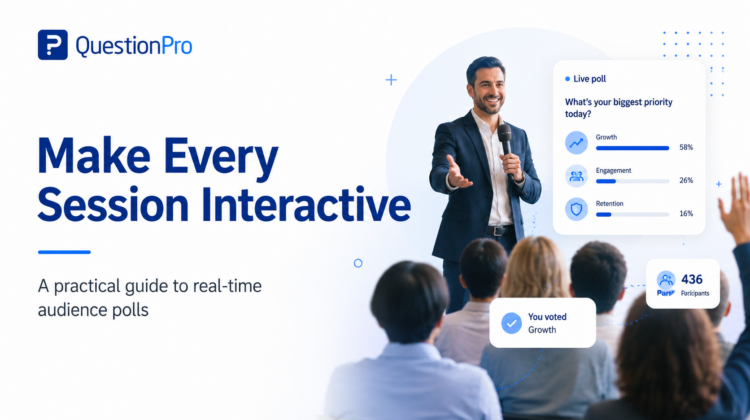
Live polling is a simple way to turn a one-way presentation into a two-way exchange. Instead of waiting until the end of a meeting, class, webinar, or event to find out what people thought, you ask a question while the session is happening, collect responses from the audience, and use the result immediately.
That immediacy is what makes live polling different from a traditional survey. A survey is usually designed to collect data for later analysis. A live poll is designed to help you understand the audience while there is still time to clarify a point, change direction, prioritize a topic, or open a discussion.
What is live polling?
Live polling is real-time audience feedback collected during a live or virtual session. Participants respond from their own devices, and results are shown to the host, and often the audience, as responses arrive.
A useful live polling workflow is:
- Ask one focused question.
- Give the audience an easy way to respond.
- Show or review the result in real time.
- Use the result to decide what to explain, discuss, test, or do next.
QuestionPro LivePolls supports interactive polls, quizzes, trivia, real-time results, browser-based joining, and integrations with Google Slides and Zoom. Depending on the plan, additional capabilities include word clouds, audience voting, multilingual support, analytics, anonymous mode, and shared workspaces. See the current LivePolls capabilities.
Live polling vs. traditional surveys
| Live polling | Traditional survey |
|---|---|
| Designed for a live moment | Usually completed before or after an interaction |
| Results are useful immediately | Results are generally analyzed later |
| Often one or a few short questions | Can support much longer research instruments |
| Helps the presenter adapt in the moment | Helps the researcher understand a broader pattern |
| Ideal for meetings, classes, presentations, webinars and events | Ideal for structured research, feedback programs and measurement |
The two approaches are complementary. A live poll can tell you that half the room is unsure about a concept right now. A survey can help you understand why that uncertainty exists across a larger population.
What can you ask in a live poll?
The best question type depends on what you need to learn.
- Multiple choice: choose between priorities, options or opinions.
- Rating: measure confidence, satisfaction or agreement on a scale.
- Live Q&A / open text: surface questions, comments and ideas that are difficult to capture with fixed options.
- Word cloud: visualize short, repeated responses so common themes become visible.
- Quiz: test knowledge using correct-answer logic, scoring and competition.
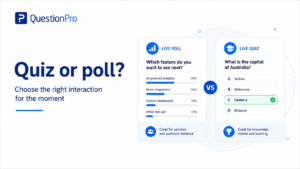
QuestionPro’s unified LivePolls editor separates unscored feedback questions from scored quiz questions, while still allowing both to be used in one session. Multiple-choice polls show dynamic voting charts, while quiz questions can use correct answers, points and leaderboards. Read about polls vs. quiz questions.
When should you use live polling?
1. Check whether your message landed
After explaining a difficult idea, ask a confidence question before moving on. If the distribution is lower than expected, clarify while the topic is still fresh.
2. Prioritize the discussion
When several topics compete for limited time, let participants vote on what they want to spend more time on. The poll becomes a decision aid, not just an engagement tactic.
3. Make meetings more inclusive
A microphone favors the people most comfortable speaking first. A live poll gives everyone the same invitation to participate.
4. Test knowledge
Use scored questions after a training module or lecture to see what people retained. For a more competitive format, quiz questions can activate scoring and leaderboards.
5. Start a conversation
A simple opinion question can expose disagreement quickly. Instead of guessing whether the room is aligned, show the result and ask people to explain their reasoning.
Want to turn your next presentation into a two-way conversation?
Examples of live poll questions
- How confident are you that you could explain this concept to someone else?
- Which of these topics deserves more time today?
- What is the biggest barrier to moving forward?
- How useful has this session been so far?
- Which option would you prioritize first?
- What’s one thing you want answered before we finish?
How to create a useful live poll
- Start with the decision. Ask yourself what you will do differently depending on the result.
- Keep the question short. People should understand it within seconds.
- Use answer options that are clearly different. Overlapping choices create noisy results.
- Explain how the result will be used. Participation feels more meaningful when people know why you are asking.
- React to what you learn. The value of a live poll comes from what happens after the votes arrive.
How QuestionPro LivePolls works
In LivePolls, you can start from scratch, use a template, or use the current AI-assisted creation workflow where available. The unified editor can combine feedback questions and scored quiz questions in the same session. Participants can join through a browser, and hosts can display live results as the session progresses. See the LivePolls creation workflow.
Frequently asked questions about live polling
Do participants need to download an app?
QuestionPro LivePolls supports browser-based participation, so participants can join without installing an app.
Can live polls be anonymous?
QuestionPro offers respondent anonymity controls and, on applicable plans, anonymous mode with randomized aliases. Always check the current plan details before designing a sensitive session.
Can I use both polls and quizzes in the same session?
Yes. The current unified editor is designed to let hosts combine unscored audience-feedback questions with scored quiz questions in a single LivePoll.
What makes a live poll effective?
The question should be short, relevant to the moment, and connected to a decision, clarification, discussion or next step. Interaction without a purpose feels like a gimmick; interaction that changes what happens next feels useful.
The bottom line
Live polling is most valuable when it gives you information you can still act on. Ask a focused question, make it easy for everyone to respond, read the signal, and adapt the session around what the audience actually needs.