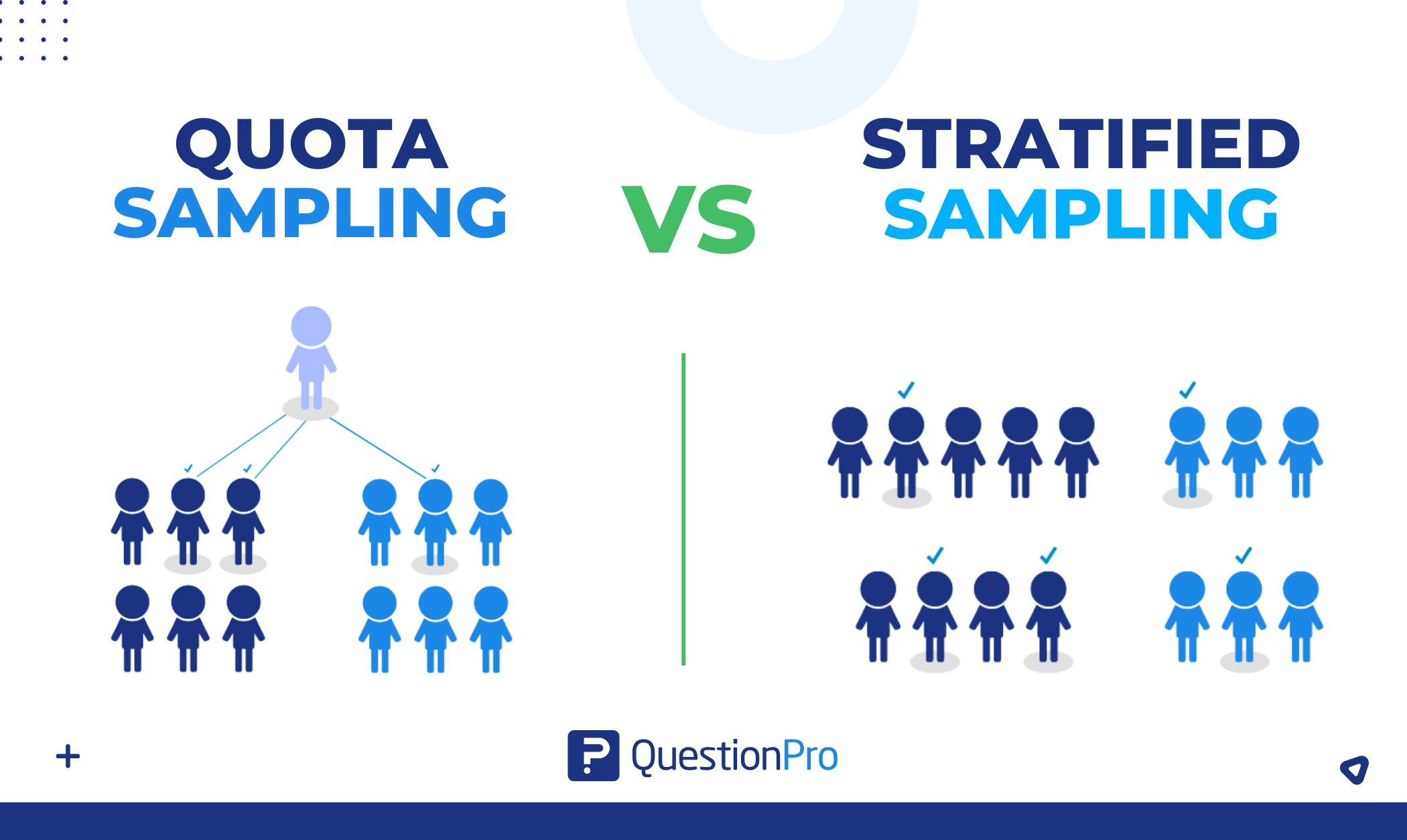
Quota sampling and stratified sampling both divide a population into subgroups first. That’s where the similarity ends. Stratified sampling then selects participants randomly within each subgroup. Quota sampling does not. That single difference changes how reliable, fast, and generalizable the results actually are.
In this blog, we break down what each method means, a full side-by-side comparison, when to use each, and real examples to help you choose the right one.
What is quota sampling?
Quota sampling is a non-probability method. Researchers divide a population into subgroups, then fill a fixed quota from each group using non-random selection.
A typical quota sampling setup includes:
- A population divided into subgroups based on relevant traits, like age or region
- A fixed number, or quota, set for each subgroup
- Non-random selection, often through convenience or judgment, to fill each quota
- No requirement for a complete list of the population beforehand
A researcher might set a quota of 300 respondents aged 18-34 and 200 aged 35-54. Interviewers then fill those numbers however is fastest, not through random chance. For a deeper breakdown of how it works, including the exact steps, see our full guide to quota sampling.
What is stratified sampling?
Stratified sampling is a probability method. Researchers divide a population into subgroups called strata, then randomly select participants from within each one.
Because selection within each stratum is random, every member of a subgroup has a known, equal chance of being chosen. That single feature makes stratified sampling a true probability method. Quota sampling divides the population the same way but skips the random step entirely. For more detail, see our guide to stratified sampling.
Quota sampling vs stratified sampling: what’s the difference?
The core difference is randomness. Stratified sampling selects participants randomly within each subgroup. Quota sampling fills each subgroup through judgment or convenience instead.
| Factor | Quota sampling | Stratified sampling |
|---|---|---|
| Selection type | Non-probability | Probability |
| Main purpose | Ensure key groups are included quickly | Improve representativeness and statistical precision |
| Randomness within subgroup | No | Yes |
| Sampling frame required | No | Yes |
| Margin of error calculable | No | Yes |
| Speed and cost | Faster, cheaper | Slower, more resource-intensive |
| Bias risk | Higher | Lower |
| Best for | Quick market research | Formal statistical inference |
In stratified sampling, researchers draw a random sample from each subgroup. In quota sampling, they select a set number of units in a non-random manner instead. That one design choice separates the two methods more than anything else on this list.
The probability sampling family, which includes stratified sampling, differs from non-probability sampling methods like quota sampling in one core way. Every population member’s chance of selection is known and calculable in the former. Neither is true in the latter.
When should you use quota sampling vs stratified sampling?
Use quota sampling when speed and cost matter more than statistical precision. Use stratified sampling when your results need to support formal statistical inference.
Quota sampling fits well when:
- You need quick results on a tight budget
- A complete list of the population isn’t available
- Statistical generalizability isn’t required for the study’s purpose
- You’re running exploratory or early-stage research
Stratified sampling fits well when:
- You need results that support formal statistical claims
- A sampling frame of the full population is available
- Precision and representativeness matter more than speed
- The study findings will inform high-stakes decisions
Studies that need a calculable margin of error should default to stratified sampling. Quota sampling cannot support that kind of statistical claim, no matter how carefully the quotas get set.
What are examples of quota sampling and stratified sampling?
A market research team studying smartphone preferences might use quota sampling. They set a quota of 300 respondents aged 18-34 and 200 aged 35-54, then fill those quotas through an online panel or convenient recruitment channel.
Quota sampling also works well for hard-to-reach professional audiences. A software company gathering feedback from business decision-makers might set separate quotas for 100 IT leaders, 100 HR leaders, and 100 finance leaders, then recruit qualified respondents until each role-based quota is filled. This kind of B2B audience is difficult to reach through random selection alone, since there’s rarely a complete list of every professional in a given role to sample from.
A university studying student performance might use stratified sampling instead. Researchers divide students into strata by grade level, then randomly select a proportional number from each grade. Because selection within each stratum is random, the university can calculate a margin of error. It can make statistically defensible claims about the entire student population. Neither the smartphone study nor the B2B feedback study, both built on quota sampling, can make that same claim.
A simple random sample drawn from the whole population, without dividing it into subgroups first, is a third option entirely. It works well when no meaningful subgroup differences exist worth preserving in the sample.
The distinction between all three comes down to:
- Simple random sampling: no subgroups at all
- Quota sampling: subgroups, filled non-randomly
- Stratified sampling: subgroups, filled randomly
What are the pros and cons of each method?
Each method trades speed and simplicity against statistical rigor in opposite directions.
Quota sampling
Pros:
- Faster to field than probability methods
- Usually more cost-effective
- Works without a complete population list
- Helps balance key respondent groups quickly
Cons:
- Higher risk of selection bias
- Cannot support a calculable margin of error
- Quality depends heavily on how well quotas are screened
Stratified sampling
The tradeoffs run in the opposite direction from quota sampling.
Pros:
- Random selection supports stronger statistical inference
- Reduces sampling error when strata are well-defined
- Produces results that generalize to the full population
Cons:
- Requires a reliable, complete sampling frame
- Takes more time and resources to design and field
- Poorly defined strata can weaken the results despite proper randomization
Which method fits your research scenario?
The right method usually becomes clear once you look at the specific research situation rather than the method names in isolation.
| Scenario | Better method |
|---|---|
| Fast consumer survey with age and gender targets | Quota sampling |
| Academic study requiring random selection across income groups | Stratified sampling |
| B2B study targeting specific job roles | Quota sampling |
| Public policy study needing population-level estimates | Stratified sampling |
| Brand awareness tracking across regions | Quota sampling |
| Healthcare study comparing patient subgroups | Stratified sampling |
What common mistakes should you avoid?
The most common mistake is treating quota sampling and stratified sampling as interchangeable just because both use subgroups. Random selection is what actually separates them.
- Assuming quota sampling is automatically representative: It can balance selected traits, but it’s still not random.
- Setting too many quota variables: This makes fielding harder and more expensive without adding much value.
- Choosing strata unrelated to the research question: Strata should connect directly to what you’re actually trying to measure.
- Overgeneralizing quota sampling results: Treat findings as directional insight, not a statistically defensible population estimate.
- Skipping documentation of the method used: Stakeholders reviewing the results need to know how the sample was actually built.
Getting your sampling method right
Choosing between these two methods comes down to one question. Does this study need to support formal statistical claims, or does it need fast, representative-enough insight on a limited budget?
A quick gut check before starting a study:
- Do you need a calculable margin of error? Choose stratified sampling.
- Is a full population list unavailable? Quota sampling may be your only practical option.
- Is speed more critical than statistical rigor right now? Lean toward quota sampling.
Getting the underlying population and sample definition right matters just as much as the method itself. Neither quota nor stratified sampling can compensate for a poorly defined target population or unclear subgroup criteria set before the study begins.
Reaching the actual respondents who fill those subgroups is a separate challenge from choosing the method. QuestionPro Audience gives researchers access to pre-vetted respondent panels. Teams can filter by the same demographic or behavioral criteria either method depends on, whether that means filling quotas quickly or drawing a properly randomized sample within each stratum.
Frequently Asked Questions (FAQs)
No, though the two are related. Quota sampling is sometimes called the non-probability counterpart to stratified sampling, since both divide a population into subgroups, but only stratified sampling uses random selection within each group.
No. Researchers select participants to fill each quota using judgment or convenience, not random selection. This is the key feature that separates it from stratified sampling, which does select randomly within groups.
It can produce useful, directionally accurate results, especially for exploratory research. It cannot support the same statistical claims as stratified sampling, since there’s no way to calculate a margin of error without random selection.
It can reflect the population on the specific traits used to set quotas, like age or region. It’s not automatically representative in a statistical sense, though, since respondents within each quota still aren’t selected randomly.
Yes. Some studies use stratified sampling to define subgroups, then apply quota-style targets within those groups to speed up recruitment, though this hybrid approach still carries the non-random selection risks of quota sampling within each stratum.