
Simple random sampling is a method for choosing a sample where every member of a population has an equal chance of being picked. It’s the most straightforward way to draw an unbiased sample. It also forms the basis for several more complex sampling methods used in research today, including stratified and cluster sampling.
In this blog, we’ll break down how simple random sampling works. We’ll walk through its formula with a worked example, then compare it to the other probability sampling methods researchers use most often.
What Is Simple Random Sampling?
Simple random sampling is a probability sampling method. Every individual in a population has an equal and independent chance of being selected for the sample.
Selection depends purely on chance rather than the researcher’s judgment. That’s what makes this method one of the fairest ways to build a sample. According to Pew Research Center, random sampling is the concept that underlies all probability-based survey research. It removes the selection bias that creeps in when researchers choose participants manually.
A few traits define this method:
- No subgroups or categories are considered during selection.
- Every possible sample of a given size has the same probability of being chosen.
- The method works as a standalone technique. It also serves as a building block inside more complex designs like stratified or cluster sampling.
Simple random sampling works best with a complete population list and a moderately sized group to sample from. Larger, harder-to-reach populations often make it difficult to apply in practice, even though the underlying concept stays simple. Finding or building an accurate list becomes the real challenge, not the math behind it.
How Does Simple Random Sampling Work?
Researchers use one of two approaches to keep selection free of bias.
- Lottery method: Every member of the population gets a unique number. Numbers are physically drawn, similar to a raffle, until the target sample size is reached. This is the oldest version of the technique, and it still works well for smaller populations where a physical draw is practical.
- Random number generator: Every member is numbered the same way, but a computer or random number table selects the sample instead of a physical draw. Researchers prefer this approach for larger populations. It removes any chance of human error or unconscious bias entering the selection process, and it scales to populations of any size without extra manual work.
Neither method requires the researcher to know anything about the individuals being sampled beforehand. The randomness itself does all the work of keeping the process fair.
Both methods rely on having a complete, accurate list of the population first. This list is called the sampling frame. Gaps in a sampling frame are one of the most common sources of sampling error. Anyone left off the list can never be selected, no matter how random the draw itself is.
What Is the Simple Random Sampling Formula?
The probability of any single person being selected equals the sample size divided by the population size. This is written as P = n / N, where n is the sample size and N is the total population.
Consider a hospital with 1,000 staff members that needs to schedule 100 people for a night shift. Every name goes into a pool. Each staff member has the same chance of being chosen, since nobody’s name gets extra weight in the draw. Using the formula, the probability for any individual is 100 divided by 1,000. That works out to a 10% chance of selection for each staff member.
This same logic scales to any population and sample size. A university surveying 500 of its 10,000 enrolled students would give each student a 500-in-10,000 chance. That comes out to a 5% probability of selection, calculated the exact same way as the hospital example above.
A smaller example makes the pattern even clearer. A book club with 40 members picking 8 people to lead the next meeting would give each member an 8-in-40 chance, or a 20% probability. The population size shrinks, the sample size shrinks with it, but the formula and the logic behind it stay identical.
The formula stays this simple specifically because simple random sampling doesn’t weight any individual differently. Methods like stratified sampling introduce more complex probability calculations precisely because they assign different selection odds to different subgroups.
How Do You Perform Simple Random Sampling?
Using the same hospital example, here’s how a researcher would actually build the sample of 100 staff members from the 1,000-person population.
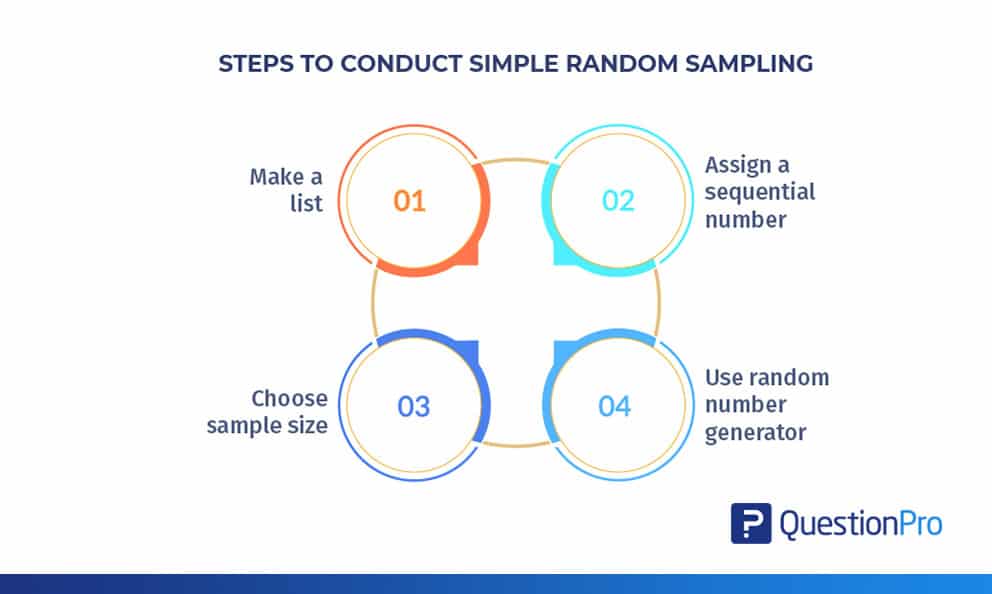
- Make a complete list. Gather the names of all 1,000 staff members. Missing even a handful of names introduces bias before the sampling process even starts, since those people can never be selected.
- Assign a sequential number. Give each staff member a number from 1 to 1,000. This numbered list is the sampling frame you’ll draw from for the rest of the process.
- Choose the sample size. Decide how many people you need. In this case, 100 staff members are needed for the night shift, based on the organization’s staffing requirements.
- Generate random numbers. Use a random number generator or table to produce 100 unique numbers between 1 and 1,000. Match each number to its corresponding staff member to build the final sample.
This process gives every staff member the same 10% chance of being selected. That equal probability is what keeps the sample statistically unbiased, regardless of who ends up chosen. The same four steps apply no matter the population size, from a small book club to a nationwide survey panel.
How Do You Determine the Right Sample Size?
Sample size depends on three factors: population size, desired confidence level, and acceptable margin of error. Getting this right matters more than the sampling method itself, since even a perfectly random sample gives unreliable results if it’s too small.
- Confidence level: Most research uses a 95% confidence level, meaning the results would hold up 95 times out of 100 if the study were repeated. A higher confidence level, such as 99%, requires a larger sample.
- Margin of error: A smaller margin of error means tighter, more precise results, but it also requires a larger sample to achieve. A 5% margin of error is common for general research; tightening it to 2% or 3% can roughly double or triple the required sample size.
- Population size: Beyond a certain point, population size stops mattering much. A sample of a few hundred can represent a population of 50,000 nearly as well as it represents 5 million, since the math depends more on variability within the population than on its total size.
For most studies targeting a 95% confidence level with a 5% margin of error, a sample in the low hundreds is usually sufficient, regardless of how large the underlying population is. Smaller samples work for internal pilot studies, but published research typically needs the larger figure to hold up to scrutiny.
Simple Random Sampling vs. Other Probability Sampling Methods
Simple random sampling isn’t the only probability-based option, and choosing the wrong one can weaken a study’s results. The table below compares it to three commonly confused alternatives.
| Method | How Samples Are Selected | Best For |
|---|---|---|
| Simple random sampling | Every individual has an equal, independent chance of selection from the full population. | Homogeneous populations with a complete list available. |
| Stratified sampling | Population is divided into subgroups (strata) first, then samples are drawn from each group. | Populations with distinct subgroups that need guaranteed representation. |
| Cluster sampling | Population is divided into natural clusters, and entire clusters are randomly selected. | Large, geographically spread populations where a full list isn’t practical. |
| Systematic sampling | A random starting point is chosen, then every nth member is selected at a fixed interval. | Ordered lists where speed matters more than pure randomization. |
The main distinction to remember is how each method treats the population before selection. Simple random sampling treats the whole population as one pool. Stratified and cluster sampling both split the population into groups first, then select within or between those groups. Systematic sampling skips grouping entirely but trades some randomness for speed and simplicity.
A quick example shows why the choice matters. A company surveying employee satisfaction across five office locations could use simple random sampling on the full employee list. But if leadership needs guaranteed feedback from every location rather than whichever happens to get picked, stratified sampling by office location is the safer choice.
What Are the Advantages and Disadvantages of Simple Random Sampling?
Simple random sampling has clear strengths, but it isn’t the right fit for every study. Weighing both sides helps determine whether it fits a specific research goal, especially before committing time and budget to data collection.
Advantages:
- Reduces bias more effectively than most other sampling methods when applied correctly.
- Requires no advance subject-matter expertise from the researcher.
- Needs only a complete list and a random selection tool, not specialized technical skills.
- Scales down easily from a very large population to a manageable sample size.
- Produces data that’s straightforward to analyze using standard statistical methods.
Disadvantages:
- Sampling errors can occur if the drawn sample doesn’t reflect the population’s actual composition.
- Excluding or underrepresenting specific subgroups can skew results, especially in diverse populations.
- Analyzing the resulting data can be time-consuming and costly for very large samples.
- Non-response bias can distort results when selected individuals decline to participate.
- Building an accurate sampling frame can be difficult or impossible for very large or dispersed populations.
When Should You Use Simple Random Sampling?
Simple random sampling works best when the population is relatively homogeneous and a complete list of members already exists.
If the population has meaningful subgroups that need guaranteed representation, plain random selection often isn’t enough. Age brackets, income levels, and similar categories are common examples. In those cases, stratified sampling or cluster sampling usually produces more reliable results instead. Stratified sampling in particular guarantees every subgroup appears in the final sample, which plain random selection can’t promise on its own.
Choosing between a full census and a sample also depends on several practical factors. Cost, available time, the degree of accuracy needed, and how homogeneous the population actually is all play a role. A small, uniform population might justify surveying everyone. A large, varied one almost always calls for sampling instead.
Getting Reliable Results From Simple Random Sampling
Simple random sampling remains one of the most dependable ways to draw an unbiased conclusion about a population. That reliability depends on two things: an accurate sampling frame and a sample size large enough to support the analysis. Skipping either step tends to undermine the fairness the method is supposed to guarantee in the first place.
A few practices make results more reliable in practice:
- Double-check the sampling frame for missing or duplicate entries before drawing any numbers.
- Choose a sample size large enough to detect meaningful differences, not just a convenient round number.
- Watch for non-response patterns that might quietly reintroduce bias after selection is already complete.
Survey platforms can also remove some of the manual work involved. QuestionPro’s sample and survey tools can generate a random sample directly from an uploaded population list. That removes the manual numbering step entirely for larger studies.
Frequently Asked Questions (FAQs)
Simple random sampling is a specific type of random sampling. All simple random samples are random, but not all random sampling methods give every individual the same independent chance of selection. Systematic and cluster sampling are both random but work differently.
Sample size depends on population size, desired accuracy, and acceptable margin of error. There’s no single universal number that works for every study. Larger samples reduce sampling error but cost more time and money to collect and analyze.
Yes, though it becomes harder to justify statistically as the population shrinks. Very small populations may not produce enough variation in a random sample. That can make the results less representative, which makes stratified sampling a safer alternative in those cases.
It guarantees an unbiased selection process, not a perfectly representative outcome every single time. Random chance can still produce a sample that skews toward certain traits by coincidence, especially when the sample size stays relatively small.
A random number generator applied to a numbered list is the fastest, least error-prone method for most studies. It removes the physical lottery step entirely and works for populations of any size, as long as the sampling frame is complete and accurate.