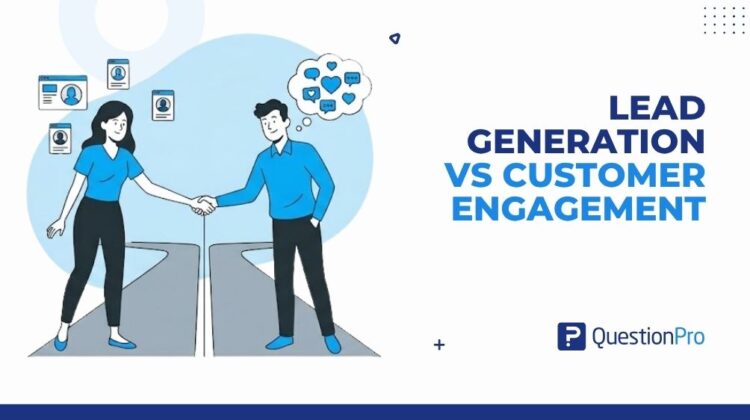
Marketing teams often treat lead generation vs customer engagement as an either-or decision. It rarely is. Lead generation fills your pipeline with qualified leads who have already shown interest in what you sell, while customer engagement keeps the people you already have close to your business.
Most companies that struggle with growth are not weak in one area. They are weak in the handoff between the two.
This guide breaks down what separates lead generation from customer engagement, when to lean on each, and how to build a strategy that uses both without wasting your budget.
What is the difference between lead generation and customer engagement?
Lead generation is the process of attracting and capturing interest from potential customers who have not yet bought from you. Customer engagement is the ongoing effort to build a relationship with people who already know your brand, whether they are leads, prospects, or paying customers.
The two serve different stages of the same journey. Lead generation asks a stranger to raise their hand. Customer engagement keeps that hand raised long enough to convert, and keeps it raised again after the sale closes.
A useful way to separate them:
- Lead generation is about reach and qualification. It answers “who might want this?”
- Customer engagement is about depth and trust. It answers “how do we keep this person interested?”
Neither works well alone. A business that only generates leads burns through prospects without building loyalty. A business that only engages current customers eventually runs out of new people to engage.
Why does lead generation still matter if engagement builds loyalty?
Lead generation still matters because engagement has nothing to work with until there is a lead to engage. Even the strongest retention program needs a steady stream of new, qualified prospects entering the funnel.
A sound lead generation strategy changes how a company reaches its audience. Traditional advertising pushes a message at people who may not want it. Lead generation instead lets prospective customers ask for information, which means the company is talking to people who already signaled interest.
This is what marketers mean when they describe “pulling” customers in with useful content instead of “pushing” ads at them. A business that shares helpful information through its website, blog, or social channels earns trust before it ever asks for a sale. Content marketing built this way now generates roughly three times more leads than outbound marketing, at a fraction of the cost, according to Content Marketing Institute data cited by HubSpot.
Well-run lead generation also supports revenue in a direct way. Because leads have already expressed interest, the probability of a closed deal is higher than with cold outreach, which improves both sales efficiency and marketing ROI over time.
Why does customer engagement matter once a lead becomes a customer?
Customer engagement matters because winning a customer is only the first transaction, not the relationship. Keeping current customers engaged protects the revenue a business already worked to earn.
It is well established that retaining an existing customer costs less than acquiring a new one, and existing customers are more open to buying additional products once they trust a brand. An engagement strategy built on helpful content and consistent communication does two things at once: it generates new leads through referrals and shares, and it keeps current customers from drifting toward a competitor.
Businesses that treat retention as a real strategy, not an afterthought, tend to see steadier revenue and a stronger customer lifetime value. That stability is exactly what makes the lead generation vs. customer engagement debate feel less like a competition and more like two halves of one system.
Lead generation vs customer engagement: A side-by-side comparison
The table below breaks down how the two approaches differ in practice, so you can see where each one earns its place in your strategy.
| Factor | Lead generation | Customer engagement |
|---|---|---|
| Primary goal | Attract new, qualified prospects | Deepen trust with existing contacts |
| Funnel stage | Top and middle of funnel | Middle and bottom of funnel, post-sale |
| Core channels | SEO, content, paid ads, landing pages | Email, surveys, community, support |
| Success metric | Lead volume, lead quality, cost per lead | Retention rate, satisfaction, repeat purchase |
| Risk if ignored | Pipeline runs dry | Existing customers churn to competitors |
How do you choose the best lead generation strategy for your business?
Choosing the right lead generation strategy starts with a clear answer to why you are collecting leads and how those leads connect to revenue.
Before picking channels or tactics, define what a “good” lead looks like for your business and what happens to that lead after capture. Once that is clear, a few approaches consistently perform well:
- Publish content that answers real buyer questions instead of promoting the product directly.
- Partner with sites that serve the same or a complementary audience.
- Use surveys, polls, and feedback forms to keep visitors engaged while collecting first-party data.
- Route every captured lead into a defined follow-up process, since an uncontacted lead is a wasted one.
Content marketing remains one of the most efficient ways to reach buyers because it works before, during, and after the sale. It generates the lead, nurtures it, and keeps the resulting customer engaged.
How do surveys and polls support both lead generation and engagement?
Surveys and polls generate leads and drive engagement at the same time by giving people a reason to interact with a brand before they are ready to buy.
Many lead generation funnels rely on landing pages, gated content, and lead magnets to earn an email address. That works, but it only captures interest. A survey does more. It starts a two-way conversation, and it gives a business real insight into what the respondent actually wants.
That insight is what turns a one-time interaction into an ongoing relationship. When a company acts on survey feedback and shows customers their input led to a real change, it builds exactly the kind of trust that the five pillars of customer experience describe as the foundation of loyalty.
How do you measure whether your strategy is actually working?
You measure lead generation and customer engagement success with different metrics, because they represent different outcomes.
For lead generation, track:
- Lead volume and lead-to-customer conversion rate
- Cost per qualified lead
- Source and channel performance
For customer engagement, track:
- Customer retention and repeat purchase rate
- Response rate to surveys, emails, and outreach
- Net Promoter Score or a comparable loyalty metric
Reviewing both sets of numbers together shows whether new leads are actually turning into long-term customers, which is the real test of a healthy funnel.
What mistakes hurt lead generation and engagement efforts?
The most common mistake is optimizing one side of the funnel while ignoring the other. A company that spends heavily on lead generation but never engages the leads it captures ends up with a full list and a low close rate. A company that only nurtures existing customers eventually runs out of new business.
Other frequent mistakes include chasing lead volume over lead quality, sending generic follow-ups instead of personalized ones, and never asking customers directly what would make them stay. Each of these is fixable with better data and a clearer process.
How can QuestionPro help connect lead generation and customer engagement?
QuestionPro’s survey tools can sit at the intersection of both strategies, helping teams collect feedback that improves lead quality and strengthens the customer relationships that follow. Businesses can use QuestionPro’s Customer Experience Software to capture feedback at key touchpoints, route insights to the right team, and track whether engagement efforts are actually improving loyalty over time.
The point is not to replace a marketing or sales process. It is to give both teams better information about the same audience, so leads convert faster, and customers stick around longer.
Getting the balance right
Lead generation and customer engagement are not competing priorities. They are sequential parts of the same growth strategy, and a business that treats them separately usually ends up weak in both.
The companies that grow steadily are the ones that keep the pipeline full while never letting the customers already inside it feel forgotten.
Frequently Asked Questions (FAQs)
Neither is more important on its own. Lead generation fills the pipeline with new prospects, while engagement keeps those prospects and existing customers loyal. Businesses that focus on only one usually see slower, less stable growth.
A qualified lead is a prospect who has shown genuine interest in a product or service, often through behavior like requesting information, downloading content, or completing a survey. Qualified leads convert at a higher rate than cold contacts.
Engaged customers refer others, leave reviews, and share content, which creates new leads without added ad spend. Strong engagement effectively turns existing customers into an ongoing, low-cost source of new prospects for the business.
Yes. Content marketing, email nurturing, and short surveys are low-cost ways to generate leads and maintain engagement simultaneously. Many small businesses start with one shared content calendar that serves both goals.
Track lead-to-customer conversion rate alongside cost per lead. A high volume of leads paired with a low conversion rate usually signals a lead quality problem, not a volume problem, and points to where to fix your targeting.