Most K-12 teachers already do a version of live polling. A show of hands, a thumbs up or down, an exit ticket on the way out the door, these are all attempts to answer the same question: did the lesson land? The digital version does not replace that instinct. It just makes the answer visible to every student at once, and makes the data usable afterward.
That distinction matters more than it sounds. A show of hands tells a teacher roughly where the room stands. A live poll tells them exactly where the room stands, broken down by student, and lets that data follow into a lesson plan for tomorrow.
Quick takeaways
- Live polls formalize what many K-12 teachers already do informally with hand-raising and exit tickets.
- The strongest use cases are low-stakes and frequent: warm-up questions, mid-lesson comprehension checks, and exit tickets, not high-pressure quizzes.
- District IT and administrators should evaluate student data handling and account setup before classroom rollout, not after.
- Rollout succeeds when it starts with one grade band or department and expands from evidence, not a district-wide mandate on day one.
Why “digital hand-raising” is not automatically engagement
The mistake many schools make is buying a polling tool and expecting engagement to follow automatically. It does not. A poll only works when a teacher already has a reason to check comprehension at that specific moment, which means the tool has to fit into lesson design, not sit on top of it as an extra step.
In practice, the schools that see the strongest results are the ones that start with a single, well-defined use case, like a two-question exit ticket at the end of every class, rather than asking teachers to reinvent their lesson plans around a new tool.
Where live polls fit inside a K-12 teacher’s existing toolkit
Here is how it usually breaks down in practice. Warm-up polls at the start of class surface prior knowledge before new content is introduced. Mid-lesson comprehension checks catch confusion while there is still time to re-teach. Exit tickets close the loop and give teachers something concrete to plan tomorrow’s lesson around, instead of guessing.
None of this requires new pedagogy. It requires a low-friction way to collect an answer from every student, not just the two or three who raise their hands first.
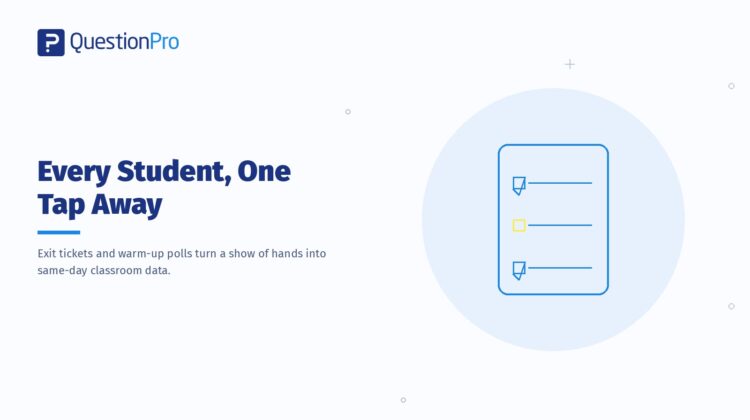
Teachers who use a two-question exit ticket after every lesson get same-day data on what needs to be re-taught, instead of waiting for the next test.
What IT and district leaders should evaluate before adopting a polling tool
For a K-12 audience specifically, data handling is not optional homework. District technology teams should confirm how student accounts are created and managed, whether the platform supports age-appropriate access without requiring students to create personal logins, and how long response data is retained. These are standard procurement questions for any classroom technology used with minors, and they should be resolved before a pilot, not discovered during one.
It also helps to confirm reporting access for administrators. A useful classroom tool for teachers becomes a useful district tool when participation and comprehension trends can be aggregated at the school or department level, without exposing individual student identities in that rollup.
Rolling it out across a school without overwhelming teachers
The better question is not whether to roll out district-wide immediately. It is which grade band or subject area can pilot the tool, prove the workflow, and give the rest of the school a working example to copy. A single successful pilot, with real before-and-after comprehension data, does more to drive adoption than any top-down mandate.
Connecting classroom polling to a broader district feedback strategy
Classroom-level polling and district-level stakeholder surveys are different instruments solving different problems, but they should not live in separate systems. QuestionPro’s LivePolls tool handles the real-time classroom layer, while the broader research and reporting workflows districts rely on for accountability and board reporting sit in the wider QuestionPro Academic solution.
What a first-semester pilot should track
Before expanding classroom polling software for K-12 beyond a single pilot classroom, agree on what evidence would justify a wider rollout. Same-day exit ticket completion rates and whether re-taught topics show improved comprehension the next day are both simple, concrete signals a principal can act on.
Avoid measuring adoption by enthusiasm alone. A teacher who likes the tool is a good sign, but a grade band that can show improved next-day comprehension data is what actually justifies budget for a school-wide license.
Frequently asked questions
Is live polling appropriate for younger elementary students, or just middle and high school?
Simple polls work well from upper elementary onward, especially for warm-ups and comprehension checks. Younger grades typically need teacher-led setup rather than independent device use.
Does live polling replace formal formative assessment?
No. It complements it. Live polling is fast and low-stakes, useful for a same-day pulse check, while formal formative assessment still plays its role in tracking progress over a unit or term.
What should a district ask a vendor about student data before piloting a polling tool?
At minimum: how student accounts are provisioned, whether individual identities are required to participate, how long response data is kept, and who at the district level can access aggregated reporting.
The bottom line
Teachers do not need to be convinced that checking for understanding matters. They already do it, informally, dozens of times a day. Live polling does not add a new task to their plate. It makes the informal check they already run visible, consistent, and usable across an entire class or grade.
See how a two-question exit ticket workflow looks in your own classroom.