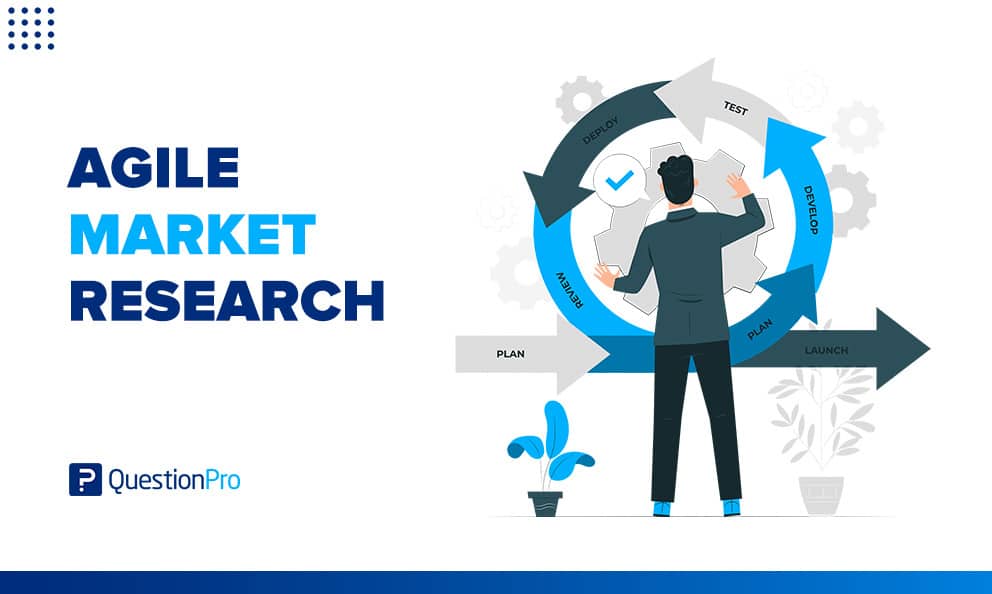
Agile market research is a way to test ideas with consumers in short, repeated cycles instead of one long study. Each cycle, called a sprint, answers one question and feeds the next. Teams get answers in days, while there is still time to change course.
Done well, it cuts launch risk and research cost. Done badly, it produces fast but shallow data. In this blog, we’ll cover how the method works, where it fits, where it does not, and how to run your first sprint with clear metrics.
What is agile market research?
Agile market research is an iterative research method that tests ideas, products, or campaigns with target consumers in short sprints. Teams use technology to collect and analyze feedback within days, so each sprint can shape the next one before the team commits budget. Three traits set it apart:
- Short cycles: Each sprint runs for days, not months.
- Linked sprints: Results from one round shape the questions in the next.
- Technology-led fieldwork: Online tools handle collection, quality checks, and reporting.
The method borrows from software development. In 2001, a group of developers published the Agile Manifesto, which values responding to change over following a plan. Researchers applied the same logic to consumer insight. They broke one big study into small, linked sprints and adjusted after each one.
A sprint, in this context, is one fixed-length research cycle with a single question, a focused sample, and a decision at the end. The goal is faster, leaner, and more digital data collection and analysis. A company can then react to market shifts and customer needs as they happen. Agile research sits inside the wider field of market research, but it changes the rhythm of the work.
Agile vs traditional market research
The clearest way to see how agile vs traditional market research differs is to compare the two side by side. Traditional research optimizes for completeness. Agile research optimizes for learning speed.
| Dimension | Traditional research | Agile research |
|---|---|---|
| Structure | One large, linear study | Several short, linked sprints |
| Questions per study | Many, covering the full topic | One or two per sprint |
| Time to results | Weeks to months, reported at the end | Days per sprint, reported as data arrives |
| Changes mid-study | Hard once fieldwork starts | Built in between sprints |
| Sample per study | Larger, built for precision | Smaller, built for direction, then confirmed |
| Team involvement | Brief, then a final debrief | Stakeholders review every sprint |
| Cost profile | Large upfront commitment | Smaller costs spread across sprints |
| Best for | Segmentation, long-term tracking, high-stakes decisions | Concept, message, pricing, and feature decisions |
| Main risk | Insights arrive after the decision | Shallow reads when sprints lack a clear question |
How agile research differs from similar terms
Several research terms sound alike and get mixed up. Each one describes something different about the work.
- Rapid research is a single study run quickly. Agile research adds repeated cycles that build on each other.
- Continuous research is always-on measurement, such as brand tracking or a standing research community. Agile sprints target specific decisions. The two work well together.
- DIY research describes who runs the study. Agile describes how you structure it. You can run agile research in-house or with an agency.
- Agile qualitative research applies the same sprint logic to interviews, video, and discussion, often asynchronously.
- Scrum and Lean are frameworks from software and manufacturing. Scrum uses fixed roles and sprint routines. Lean cuts waste. Agile market research borrows the sprint idea without requiring either.
Benefits of agile market research
Speed is the headline benefit of agile market research, but it is not the only one. The method also changes how teams decide.
- Faster time to insight: Sprints return headline results in days, so evidence arrives before the decision date.
- Lower risk before launch: Testing a product, concept, or campaign early costs far less than a rejected launch. Brand damage is harder to repair than a weak concept is to drop.
- Lower cost per decision: Smaller studies need fewer resources. Self-serve tools remove programming and data-processing hand-offs. You spend more only where early results show promise.
- Better ideas through iteration: Each sprint narrows the field. Weak concepts drop out early, and strong ones improve based on what customers say they need.
- Shared understanding across teams: Marketing, product, and sales teams read the same dashboard. Debates move from opinions to evidence.
Step-by-step guide to the agile market research process
The agile market research process follows five repeating steps: explore, test, validate, optimize, and track. You can run them in order or loop back whenever a result raises a new question.
- Step 1: Explore.
Identify target markets, unmet customer needs, and competitor positioning. You finish with a short list of ideas worth testing. - Step 2: Test.
Show several concepts to your target audience. Soft launch to a small group first to catch confusing questions, then open fieldwork fully. Ask which concept they prefer and why. You finish with a ranked list. - Step 3: Validate.
Rework the leading concepts using the test feedback. Retest them with a fresh sample to confirm the result or force a pivot. - Step 4: Optimize.
Refine the winning idea until it is launch-ready. Common targets are packaging, price, and messaging. - Step 5: Track.
After launch, benchmark performance and measure return on investment (ROI), which compares the value gained with the cost. Feed what you learn into the next round of exploring.
Example: three sprints for a new snack concept
Picture a US snack brand with six flavor ideas and a launch eight weeks away. This is an illustrative scenario, not a customer result.
- Sprint 1 (explore and test): Survey target snackers about needs and occasions, then screen all six flavors. Keep the top two.
- Sprint 2 (validate): Rewrite both concepts using the comments from sprint 1. Retest with a new sample.
- Sprint 3 (optimize): Test three price points and two pack designs on the winning flavor.
Nobody waits for a 60-slide report. Each sprint ends with a one-page readout and a clear go, change, or stop decision.
Agile market research methods: Quantitative and qualitative
Agile market research methods fall into two groups: numbers and narrative. Choose quantitative methods to measure how many people prefer something. Choose qualitative methods to learn why.
Quantitative methods for fast sprints
These methods run well in short sprints:
- Concept test: Compares product or campaign ideas before launch.
- A/B test: Compares two versions to see which performs better.
- MaxDiff: Asks people to pick the best and worst item from a set, which ranks features by importance.
- Conjoint analysis: Shows product bundles to learn which features drive choice.
- TURF analysis (total unduplicated reach and frequency): Finds the mix of products or flavors that reaches the most people.
- Van Westendorp price sensitivity meter: Asks four price questions to map an acceptable price range.
- Net Promoter Score (NPS): Measures likelihood to recommend on a 0 to 10 scale.
- Intercept survey: A short survey shown at a moment of use, such as on a website.
Most of these run inside standard online survey software, usually paired with a respondent panel. A panel is a pre-recruited group of people who agree to take surveys. Other fast options include heat maps, which show where people click or look, and image or video rating.
Qualitative methods for fast sprints
Qualitative methods explain the reasons behind the numbers. They used to slow research down because live sessions take time to schedule. Asynchronous formats remove that delay. Participants answer prompts, record short videos, or join discussions on their own schedule within a set window. This guide to asynchronous agile qualitative research shows how that works in practice.
Online focus groups, idea boards, and mobile diaries fit the same rhythm. In a mobile diary, participants log experiences on their phone over several days. A research community gives you a standing group of participants to question in every sprint.
Agile market research examples
The best agile market research examples involve decisions you can test with a short stimulus, such as a concept, message, price, or screen. A concept test is the most common starting point. The table shows frequent use cases and the decision each one informs.
| Use case | What a sprint tests | Decision it informs |
|---|---|---|
| Concept and idea testing | Which product ideas appeal most, and why | Which ideas get development budget |
| Message and claims testing | Which wording or value proposition resonates | Which campaign message to run |
| Ad testing | Whether creative is noticed, understood, and liked | Which creative gets media spend |
| Packaging and pricing | Which designs and price points people accept | Final pack and price |
| Feature and minimum viable product (MVP) testing | Which features matter to early users | What to build next |
| User experience (UX) and website testing | Where people get stuck in a flow | Which fixes ship first |
Example: How BMW Group runs agile research
The BMW Group case study shows the pattern in a large enterprise. The research team runs market research projects and panel studies on its own. It brings in QuestionPro’s project team when capacity is tight. The aim is simple: answer questions from specialist departments quickly, so those teams can decide on good data.
How to decide if agile research fits your project
Answer five yes-or-no questions before you commit. They take a minute and prevent the most common mismatch, which is using sprints on a question that needs a full study.
- Can you state the research question in one sentence?
- Is the decision due within the next few weeks?
- Can you show the idea in a short survey or video?
- Is your audience easy to reach online?
- Will someone act on the result within a week?
Four or five yes answers point to agile. Two or fewer point to a traditional study. Three means a hybrid: run a quick sprint to narrow the options, then confirm the finalists in a larger study. Treat this as a rule of thumb, not a formula.
Limits and risks of agile market research
Agile research trades depth and precision for speed and direction. Know that trade-off before you rely on it.
- Wider margins of error.
Smaller samples give directional reads, not precise estimates. - Hard-to-reach audiences.
Senior business-to-business (B2B) buyers, rare patients, and niche users take longer to recruit, which erodes the speed advantage. - Complex designs.
Full segmentation studies and multi-year tracking need design time and consistency across waves. - Weak questions at speed.
A poorly written question returns a wrong answer quickly. - Narrow optimization.
Many rounds with the same small audience can polish an idea for people who will never buy it. Refresh your sample each sprint.
How to measure agile market research success
Track four operating metrics and one precision rule. Together they show whether your sprints are fast, useful, and trustworthy. A topline is the first summary of headline results.
| Metric | How to calculate | What to do with it |
|---|---|---|
| Time to insight | Days from approved brief to topline readout | Set a target for each decision type, then track the trend |
| Sprints per decision | Number of sprints before a go, change, or stop call | A falling number suggests sharper questions |
| Cost per decision | Total research spend divided by decisions made | Compare it with the cost of one traditional study |
| Decision rate | Share of sprints that ended in a decision | A low rate signals weak questions or no owner |
For precision, use the standard sample-size formula for a yes-or-no question with an unknown split: n = 1.96² × 0.25 ÷ e², where e is the margin of error as a decimal. At 95% confidence, a margin of error of ±10% needs about 96 respondents. A margin of ±5% needs about 385. Use the wider margin to rank early concepts. Tighten it before you commit budget.
Common mistakes in agile market research
Most failed sprints share the same few causes. Each one is easy to avoid once you know it.
- Treating speed as a shortcut.
Fast research still needs a clear objective, a defined audience, and tested questions. Skipping design is how teams get quick, wrong answers. - Changing too much between sprints.
If you change the concept, audience, and questions together, you cannot tell what moved the result. Change one variable at a time. - Ignoring data quality.
Bots, duplicates, and AI-generated answers distort small samples more than large ones. Run quality checks on every sprint. - Skipping the decision owner.
Without a named owner, sprint results become interesting slides instead of actions. - Losing past findings.
Teams repeat tests because nobody can find earlier results. Keep every readout in one searchable place.
What to look for in an agile market research platform
An agile market research platform should remove delays at every step. Use this checklist when you compare options.
- Self-serve survey building with templates, so a repeat sprint starts from the last sprint’s setup
- AI-assisted drafting, so a plain-language brief becomes a first-draft questionnaire quickly
- Access to respondents through a panel, an integration, or your own customer list, with screening and quotas
- Built-in data-quality checks that catch bots, duplicates, and gibberish answers
- Real-time results and dashboards that stakeholders can open without analyst help
- Qualitative options, such as video responses and research communities
- Analysis of open-ended answers, including topic and sentiment detection
- Roles, permissions, and single sign-on (SSO), which lets people log in with one set of credentials
- Integrations with customer relationship management (CRM) and business intelligence tools, so results reach the people who decide
- Security and privacy certifications that match your industry
- Expert human support when a project hits a bottleneck
Running an agile research sprint with QuestionPro
QuestionPro Market Research Software connects the steps of a sprint in one workflow. Here is one way to run a five-day sprint with it.
| Day | Sprint task | QuestionPro capability |
|---|---|---|
| 1 | Turn the brief into a draft survey | Survey Agent builds a questionnaire from a plain-language research brief |
| 1 to 2 | Pressure-test ideas and questions | Synthetic Data and Digital Twins |
| 2 | Reach the right respondents | QuestionPro Audience offers a pre-screened panel |
| 3 | Protect data quality | Data Quality AI flags bot, AI-generated, and gibberish responses |
| 3 to 4 | Analyze open-ended and video answers | Text AI and VideoAI detect topics and sentiment |
| 4 | Share results | Smart Dashboards build charts, cross-tabs, and a written summary in one click |
| 5 | Store and reuse findings | InsightsHub AI Chat answers questions from past studies |
| Ongoing | Follow up with the same people | Communities support always-on research |
AI speeds up the manual work. Researchers should still review each finding for accuracy, context, and business relevance. Synthetic data and digital twins are computer-generated stand-ins for real respondents, built from patterns in existing data. They support early pressure-testing but do not replace real respondents for decision-grade results. For expert help at any stage, the research services team can extend your internal team.
Speed only matters when it changes a decision
Agile market research is not a shortcut. It trades one big answer for a series of smaller, faster ones. The teams that benefit most start with a narrow question, name a decision owner, and fix the sprint length before they open the survey tool.
Start with one repeatable question, such as a concept screen or a message test, and run it twice. By the second sprint, you will know what your team needs. That might be a sharper question, a better audience, or more time.
Frequently Asked Questions (FAQs)
There is no fixed length. Plan each sprint backward from the decision date, then size the questionnaire to fit. Many teams work in cycles from a few days to two weeks. Run two sprints, then adjust using your actual fieldwork and analysis time.
Not for decisions that carry real budget. Synthetic data and digital twins help pressure-test questionnaires and early ideas because they model patterns from existing data. Confirm any finding you plan to act on with real respondents from your target audience.
Yes, with limits. Senior B2B buyers are hard to reach and often absent from consumer panels, so fieldwork takes longer. Use screened B2B audiences or your own customer lists, keep instruments short, and accept smaller samples with clear, directional goals.
Repeated sprints mean repeated data collection. State laws such as the California Consumer Privacy Act (CCPA) may apply to personal data you gather. Confirm consent wording, retention periods, and opt-out handling once, then reuse the approved setup in every sprint.
Name one owner who writes each sprint question, one researcher or analyst who runs fieldwork and quality checks, and one decision-maker who commits to act on results. Small teams can combine roles, but the decision-maker should never be missing.