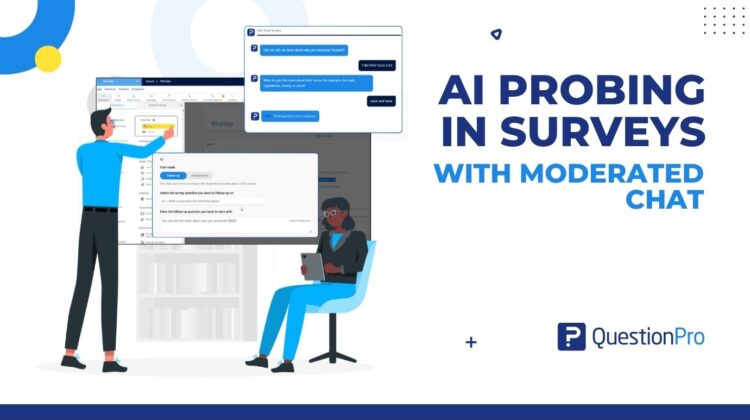
Your survey already knows what people chose. Now it can ask them why, one short conversation at a time. Your survey already knows what people chose. Now it can ask them why through AI probing in surveys, one short conversation at a time.
Quick game: guess the reason behind the 6
Here’s a row you’ve probably seen a hundred times.
A customer rated you 6 out of 10. In the comment box underneath, they typed one word: “fine.”
Now guess why. Pick one:
- Delivery took longer than promised.
- The price went up last month.
- A competitor’s ad caught their eye.
- Nothing is wrong. They just never give anyone a 9.
Trick question. You can’t know. Neither can the analyst building the deck. The score tells you what happened. The comment box was supposed to explain why, but it gave you a shrug.
That’s what usually happens when you ask “why” in a text box with nobody on the other side. And “fine” can’t be clarified because no one is there to ask, “Fine compared to what?”
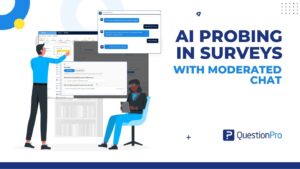
Moderated chat puts someone there. It’s a question type in QuestionPro that adds a short, AI-led text interview to your survey. You pick the moment and decide what you want to learn. Powered by QuestionPro AI, it asks the follow-up a good moderator would ask of every respondent who reaches the question.
So you stop guessing at the reason. You read it.
Learn More: Explore the moderated chat question type
What is moderated chat?
Moderated chat is a question type in QuestionPro surveys that runs a short, AI-led text interview. Place it right after a question you want to understand better, or anywhere you want to open a conversation. When the chat ends, the respondent carries on with the rest of your survey.
You’ll find it in the survey editor under the advanced question types, inside the interview question type. Chat is the first format of that question type, with voice and video planned for upcoming releases.
It isn’t a bigger comment box. A comment box waits for whatever the respondent types, while moderated chat reads the reply and asks a follow-up when it’s vague. It isn’t a script either. You write the goal, not every question. And it isn’t a separate study. The conversation happens inside the survey your respondent is already taking.
Short answers aren’t your respondents’ fault
Mostly, they’re doing exactly what the survey asked. A text box doesn’t say what a good answer looks like, and it doesn’t react when the answer is thin. So people write the minimum and move on. You’d probably do the same.
A live moderator fixes this almost by accident. They hear “too expensive” and ask: too expensive for what you got, or more than you’d planned to spend? Two questions later, you know whether you have a value problem or a budget problem. Those are very different meetings.
The catch is that live interviews take weeks to recruit, schedule, moderate, and transcribe. Moderated chat borrows the moderator’s best habit, the follow-up question, and brings it to every respondent who reaches the question. If you’re weighing the two approaches, our guide to AI-moderated interviews compares them with human-led ones.
Two ways to start the conversation
Every moderated chat question starts in one of two modes. The choice depends on whether you need an answer explained or a topic explored.
Follow-up mode: start from what they just said
Pick a source question the respondent has already answered, and the interview opens from that answer. You can even quote it back. A respondent who chose a particular brand sees an opening question that names that brand. It feels like being listened to, because it is.
This is the mode for ratings, preferred brands, and reasons for leaving.
Independent mode: start from a question you write
There’s no source question here. You write an opening question that introduces a topic, and the conversation starts there. Use it for first reactions to a new concept, or for how people describe a category in their own words. Anywhere you’d open a focus group with “tell me about…”
A simple rule: if there’s an answer you need explained, use follow-up mode. If there’s a topic you need explored, use independent mode.
The three dials you control
Think of these as the brief you’d hand a human moderator before a session.
- Key learning objectives.
This is what you want to walk away knowing. A vague objective gets you a vague interview, so be specific.
- Moderator instructions.
This is the moderator’s style: curious and neutral, warm and brief, plain language. If your brand has a voice, it goes here.
- Maximum follow-ups.
This is a ceiling, not a target. The chat decides how many follow-ups it needs and stops when the objective is met. A cap of two or three keeps things short.
Three studies that get sharper with a moderator inside
The brands here are illustrative, and so are the chats.
The concept test that kept saying “maybe”
A national snack brand in the US tests three flavor concepts. Purchase intent comes back flat, with lots of 3s on a five-point scale. The team adds moderated chat in follow-up mode right after it. The objective is simple: find the one thing that would move a 3 to a 4 or 5.
Here’s how one chat might go:
- Moderator: You rated this flavor a 3. What’s holding you back from a higher score?
- Respondent: IDK, seems a bit much
- Moderator: When you say “a bit much,” do you mean the flavor sounds too strong, or something else, like the pack size?
- Respondent: The flavor. I’d try it in a small bag first, though.
Two follow-ups, and the team learns what no rating could show. The hesitation is about intensity and trial size. That’s a packaging conversation, not a recipe rewrite.
The tracker moved, and nobody knew why
A US financial services firm sees mobile app satisfaction dip in its quarterly tracker. Leadership asks why. In the old setup, that meant a separate qualitative study and weeks of waiting. Now the tracker carries a moderated chat question after the rating. When the wave closes, the explanation arrives with the number, from the same respondents, in the same project.
The trailer test that needed more than a score
A streaming service in the US wants reactions to a new trailer. A rating says whether people liked it, not what they’ll remember tomorrow. So the team uses independent mode and asks respondents to describe the trailer as if they were telling a friend. What comes back sounds like word of mouth: the moments people repeat, the parts that confused them, the line that stuck.
If you used deep dive, here’s how it got better
Some of you have been here before. Deep dive was QuestionPro’s first take on AI follow-up, and it proved the idea: people will explain themselves if you ask the right next question.
Moderated chat is that idea with the training wheels off. Deep dive was a setting on single-select questions. Moderated chat is its own question type, so it can follow up on any earlier answer or start from a question you write. You set the objective, the moderator’s style, and the length of each conversation.
Same instinct. A lot more say in how it plays out.
The advantages of moderated chat
Here’s what you get when the follow-up question lives inside your survey:
- The reason travels with the answer. Key answers come back with their explanation attached, so you report causes, not just scores.
- Vague replies get clarified. “Fine” and “too expensive” earn a follow-up instead of a shrug.
- Your brief, not a generic probe. Learning objectives and moderator instructions keep every conversation on what you need to know.
- Short where it can be. The chat stops once the objective is met, so nobody gets asked what they’ve already answered.
- One survey, one audience, one project. No second recruit, no separate tool, no data split across platforms. It’s a practical way to blend qualitative and quantitative research in a single study.
When to use it, and when to skip it
Moderated chat earns its place when an answer needs a reason. A score, a choice or a preferred brand needs explaining. Earlier open-ended questions came back short. You need qualitative depth, but there’s no time for interviews.
Skip it when the survey is short and transactional, and extra time would hurt completion. Skip it when every respondent must see identical, scripted wording so you can compare waves. And skip it if the survey relies on randomization or a protected link. More on that in the checks below.
Rewrite one learning objective and watch the chat improve
Most of the quality comes from the objective. Here’s the difference one rewrite makes, using an online retailer’s post-purchase survey.
Too vague: “Understand the customer’s experience.” That gives the chat nothing to aim at. It might ask about delivery, then the website, then the weather.
Specific: “Find out which part of the checkout caused the low rating, and whether the respondent would buy again.” Now every follow-up has a job. The chat asks about checkout, clarifies the vague bits, and wraps up once it knows the cause and the intent.
Pair it with moderator instructions such as: “Be curious and neutral. Use plain language. Don’t suggest answers.” Then take the survey yourself before launch and see how the chat feels from the respondent’s side.
Four checks before you publish
The help file on how to use moderated chat walks through every click. Before you publish, make sure these line up:
- Placement. It can’t be the first question on a page or the last question in the survey.
- Randomization. Block randomization and question randomization need to be off.
- Security. Survey security needs to be set to none. Password-protected and invite-only surveys aren’t supported.
- Credits. Each chat a respondent takes uses one AI credit. The editor shows how many chats your balance covers, so top up first if you expect more.
One more thing: moderated chat is in beta. If you don’t see the interview question type yet, ask your account manager to turn it on.
Get started
Pick one question in your next survey that always leaves you guessing. The rating that keeps moving. The brand people choose, or walk away from. Add a moderated chat question right after it, write one clear objective, and cap the follow-ups at two.
Then see what your respondents had to say all along.
New to QuestionPro? Create a free account and see how much more a survey can tell you when it’s allowed to ask why. Already a customer? Ask your account manager to enable moderated chat for your team.
Frequently asked questions about moderated chat
Moderated chat is an AI-powered question type in QuestionPro Surveys that adds a short text interview to your survey. You choose where it sits and what you want to learn. Powered by QuestionPro AI, it asks each respondent follow-up questions based on their answers, and then they carry on with the rest of the survey.
An open-ended question accepts whatever the respondent types, even “fine,” and moves on. A moderated chat question reads the reply and asks a relevant follow-up when it is vague, guided by your learning objectives. You still get the respondent’s own words, with the context you would normally need a live moderator to draw out.
Write the one thing you want to walk away knowing, as specifically as you can. “Understand the experience” is too broad. “Find out which part of the checkout caused the low rating, and whether they would buy again” gives the chat a clear target. Keep one main objective per question and test the chat yourself before you publish.
Yes, in follow-up mode. You can insert the respondent’s answer to the source question into your opening question with a placeholder that uses that question’s ID. So a respondent who chose a brand or gave a score sees an opening question that names it. The conversation feels personal from the first line.
Because you get far more say in each conversation. Moderated chat takes over from deep dive. Deep dive was a setting for single-select questions. Moderated chat is its own question type that can follow up on any earlier answer or start from a question you write. You also set the learning objectives, the moderator’s style, and each conversation’s length.
Not at the moment. Surveys with a moderated chat question need block and question randomization turned off. Survey security must be set to none, so password-protected and invite-only surveys are not supported. The question also cannot be the first question on a page or the last question in the survey. Check these before you publish.