An artificial intelligence bot is software that reads human language, works out what a person wants, and responds or acts without a fixed script. It powers bank support chats, phone assistants, and tools such as QuestionPro AI, which drafts a survey from a short research brief.
A good bot saves hours. A poor one frustrates users and spreads errors. The difference comes down to the job you give it and the checks you keep around it.
In this blog, we’ll cover how an AI bot works, the main types, real examples, and how to choose and measure one.
What is an artificial intelligence bot?
An artificial intelligence bot is a software program that uses AI to interpret human language, decide what to do, and respond or act. It can work through text, voice, or both. People also call it an AI bot, an AI chatbot, or a virtual assistant.
Three techniques sit underneath:
- Machine learning (ML): A method where software learns patterns from data instead of following hand-written rules.
- Natural language processing (NLP): The branch of AI that lets software read, interpret, and produce human language.
- Large language model (LLM): An AI model trained on large volumes of text so it can predict and generate language.
Chatbots are not new. The first chatbots appeared in the 1960s and returned scripted replies. Modern bots use NLP and LLMs, so they can handle questions nobody scripted.
Artificial intelligence bot vs chatbot, virtual assistant, and AI agent
An AI bot is one kind of bot, and the terms around it overlap. The main difference is how much the software understands and how much it can do alone. The umbrella term is conversational AI, which covers any AI that talks with people by text or audio.
| Term | What it is | Needs AI? |
|---|---|---|
| Bot | Any software that automates a task, such as a web crawler | No |
| Chatbot | Any software that simulates conversation, scripted or not | Not always |
| AI bot or AI chatbot | A chatbot that uses ML and NLP to interpret free text | Yes |
| Virtual assistant | An AI bot that grasps intent and context and helps solve problems | Yes |
| AI agent | An AI system that plans multi-step tasks and uses tools to finish them | Yes |
The word bot is broad. Automated software made up 51% of all web traffic in 2024, according to the 2025 Imperva Bad Bot Report. That includes malicious bots as well as helpful ones, so “bot” alone says little about intelligence.
How does an artificial intelligence bot work?
An AI bot works in a loop. It receives a message, works out the intent, finds the information it needs, and then replies or acts.
- Receive the input: The user types or speaks. Voice bots first convert speech to text with automatic speech recognition (ASR).
- Interpret the intent: Natural language understanding (NLU), the part of NLP that identifies what a person means, extracts the intent and key details, such as a date.
- Gather context: The bot checks the conversation so far. It also pulls facts from connected systems, such as a knowledge base or an order database.
- Generate or select a reply: A scripted bot picks a stored answer. A generative bot uses an LLM to write a new one.
- Act or hand off: The bot answers, completes a task, or passes the chat to a person when it is unsure.
- Learn from feedback. Teams review transcripts and ratings, then adjust the bot.
Many businesses add retrieval-augmented generation (RAG), which gives the LLM relevant documents to draw from. AWS calls RAG the main way to ground answers in company data.
What are the types of AI bots?
AI bots fall into five main types, and real products often combine them. A voice bot is not a separate type. It adds speech recognition in front of any of them, which suits hands-free and call-center tasks.
A rule-based bot follows a fixed decision tree of buttons and menus. Strictly speaking, it is a chatbot rather than an AI bot, because it does not interpret language.
- Best for: predictable tasks, such as store hours.
- Limit: it fails outside its script.
Keyword and intent-based bots
A keyword bot spots words like “refund” and returns a scripted reply. An intent-based bot uses NLP to work out what the person wants, even when the wording changes. It still draws answers from a prepared library, so it stays predictable.
Generative AI bots
A generative AI bot uses an LLM to write original answers in real time.
- Best for: open questions and first drafts.
- Limit: it can state wrong answers with confidence, so it needs review.
Hybrid bots
A hybrid bot mixes fixed rules with AI. Rules handle high-stakes steps, such as identity checks, and AI handles the open conversation.
- Best for: regulated tasks in banking and healthcare.
- Limit: your team must maintain both layers.
Agentic AI bots
An agentic AI bot plans multi-step work and uses tools to finish it, such as booking a slot and sending a confirmation. Many agents reach software through Model Context Protocol (MCP), an open standard for linking AI assistants to tools and data. This type has the most autonomy, so it needs the tightest permissions.
What are real examples of AI bots in use?
AI bots work across support, travel, healthcare, and research. The table shows four common jobs.
| Use case | What the bot does | Example |
|---|---|---|
| Customer service | Answers account questions, resets passwords, and escalates hard cases | A call-center bot that checks a balance |
| Personal assistance | Orders, books, and reserves from a phone | Voice-enabled bot that serves car owners with real-time trade-in values |
| Healthcare intake | Collects patient details before a visit | An intake form completed through chat |
| Survey and research | Asks questions in a chat style and probes with follow-ups | A conversational survey that reacts to each answer |
What are the pros and cons of AI bots?
AI bots save time and extend coverage, but they add risks that a human team does not. AWS lists efficiency, flexibility, and broader engagement among the main benefits. The lists below apply to most business uses.
Pros
- Efficiency: The bot automates repetitive tasks and handles many chats at once.
- Availability: It answers at any hour and in the user’s language.
- Personalization: It tailors replies using account or order data.
- Consistency: It gives the same answer to the same question every time.
Cons
- Wrong answers: Generative bots can produce confident errors.
- Narrow scope: Rule-based bots fail outside the script.
- Privacy risk: Transcripts may hold personal data.
- Upkeep: The bot needs testing, retraining, and review.
- Frustration: Users get annoyed when they cannot reach a person.
Step-by-step guide to choosing an AI bot
Choose an AI bot by matching one job to the right level of autonomy, then testing on real questions before launch. These six steps keep the decision practical.
- Define one job.
Write the task in a single sentence, such as “answer order-status questions” or “draft survey questions.” A bot with one job is easier to test. - Match autonomy to risk.
Use rules for payments and identity checks. Use generative AI for low-risk, open questions. Use a hybrid when you need both. - Check data handling.
Ask where transcripts are stored, who can read them, and whether the vendor trains models on your data. Get the answers in writing. - Test with real questions.
Pull 50 to 100 real messages from your inbox or support log. Include messy wording, typos, and edge cases. Score each answer as correct, partly correct, or wrong. - Plan the human handoff.
Decide when the bot passes a chat to a person, who receives it, and how much context travels with it. - Pilot, then scale.
Launch on one channel with one audience for a few weeks. Expand only after the metrics in the next section hold steady.
How do you measure whether an AI bot works?
Measure an AI bot with a small set of outcome metrics and a regular transcript audit. The thresholds below are practical starting points to adjust for your business, not industry benchmarks.
| Metric | What it tells you | Starting threshold |
|---|---|---|
| Resolution rate | Share of chats solved without a person | Review any topic solved less than 70% of the time |
| Handoff rate | How often the bot escalates to a person | Investigate any jump of 10 points week over week |
| Accuracy audit | Whether answers are correct | Read 50 random transcripts weekly and act if over 5% contain a wrong answer |
| Fallback rate | Share of messages the bot did not understand | Investigate anything above 10% |
| Post-chat satisfaction | How users rate the experience | Aim for within 0.5 points of your human channel on a 5-point scale |
| Survey completion (survey bots) | Whether the chat format keeps people engaged | Run an A/B test (a side-by-side comparison of two versions) against a standard form and compare completion and answer length |
Ask users directly. A one-question survey sent through your survey software after each chat captures satisfaction better than transcripts alone.
Common mistakes when deploying an AI bot
Most failed bots share the same handful of mistakes, and nearly all are avoidable. Training data is the deepest one, because a machine learning bot is only as good as the examples it learns from.
- Training on thin data: A bot trained on airline feedback will misread retail complaints. Narrow the domain first, then widen it.
- Hiding that it is a bot: Tell users up front. Transparency as a core best practice.
- Offering no exit to a person: Every chat needs a clear route to a human.
- Measuring only deflection: A bot that ends chats is not a bot that solves problems. Track resolution and satisfaction.
- Skipping the audit: Generative bots drift and make errors. Review transcripts on a schedule.
- Overpromising: Tell users what the bot can and cannot do.
How QuestionPro applies an artificial intelligence bot to surveys
QuestionPro applies AI bots to surveys in three ways: AI that builds surveys, AI that asks follow-up questions, and AI that connects outside assistants to survey data. QuestionPro announced a generative AI survey builder called QxBot in 2023. It is now called QuestionPro AI, and the QuestionPro AI hub shows how it fits across market research.
From Locus to QuestionPro AI: How the bot evolved
QuestionPro’s bot has grown from a template helper into a family of AI tools. The table shows the path.
QuestionPro AI: The bot that builds your survey
QuestionPro AI is a generative AI tool built into the QuestionPro survey platform. You describe a research topic, and it drafts questions you can edit. It is one part of the wider AI Research Co-pilot.
- Fast first draft: A short description or a detailed brief produces a survey in as little as 60 seconds.
- Document-based creation: Add a document, and the AI uses it to shape the questions.
- Question regeneration: Rephrase a question or add response options without starting over.
- Your language: Pick a language, and the AI writes the questions in it.
Skip logic and branching still apply after the draft. Review every draft for leading wording before you launch.
Research Agent: The bot that plans and edits the survey
Research Agent is an autonomous AI agent built into QuestionPro. It plans, builds, and manages a survey from a plain-language prompt, including the flow and logic. Skip logic and branching are where it saves the most time, because they are easy to get wrong under a deadline.
You can also upload a Word or PDF brief and have the agent turn it into a structured survey. QuestionPro AI drafts questions, while Research Agent works on the whole survey. A researcher reviews the result either way.
Moderated (Chat) and ListenAI: Bots that ask follow-up questions
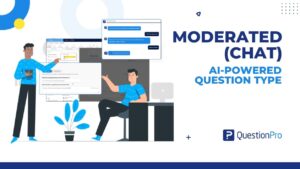
A survey score rarely explains itself, so two QuestionPro bots ask the follow-up. Moderated (Chat) adds AI follow-ups inside a survey. ListenAI runs full AI-moderated interviews.
| Functions | Moderated (Chat) | ListenAI |
|---|---|---|
| What it is | An AI-powered survey question type | An AI-moderated interview platform inside QuestionPro |
| How it works | You pick a question and set a learning objective, and the AI runs a short text interview | You describe what to learn, and the AI drafts a guide, runs each interview, and analyzes it |
| Response modes | Text | Video, audio, or written |
| Controls | Learning objectives, moderator instructions, and a cap on follow-ups | Interview guide with questions and follow-up logic, plus multilingual studies |
| Output | Follow-up answers inside your survey data | Summaries, themes, quotes, and clips |
Picture a respondent who rates onboarding 4 out of 10. Moderated (Chat) asks which step felt confusing, then probes the reply. Each chat uses one QuestionPro AI credit, and voice and video versions are planned.
ListenAI has limits too. QuestionPro advises against it for live, highly sensitive moderation, strict statistical sampling, or group interaction such as focus groups.
MCP and headless: Connecting outside assistants to QuestionPro
Model Context Protocol (MCP) is an open standard that lets AI assistants connect to tools and data. QuestionPro’s headless layer uses it, so assistants such as Claude, ChatGPT, Cursor, Windsurf, and VS Code can work with your account directly.
- What you can ask for: Build a survey, create a dashboard, analyze responses, or summarize an InsightsHub repository from one prompt.
- How it signs in: OAuth, with no API keys. The assistant acts as your account.
- What it can touch: You approve which servers and write actions an assistant can use, and you can revoke access at any time.
- What gets logged: Every consent, token issuance, and tool call.
The difference is direction. Research Agent brings AI inside your survey, while headless brings the whole platform to your assistant.
Why the best AI bot is one you can check
An artificial intelligence bot is only as useful as the job you give it and the checks you keep around it. Start narrow, test on real questions, tell people it is a bot, and keep a human within reach.
The tools keep getting more capable. The discipline stays the same: measure the results, read the transcripts, and let the evidence decide how much freedom the bot gets.
Frequently Asked Questions (FAQs)
It can be, if you vet the vendor. Ask where transcripts are stored, who can access them, and whether your data trains the model. US state privacy laws, such as the California Consumer Privacy Act, may apply, so involve legal early.
Look for a disclosure at the start, instant replies at odd hours, and repeated phrasing. Good providers state clearly that you are talking to a bot and offer a way to reach a person. If unsure, ask directly.
Not fully. Bots handle routine, repeatable tasks well, but people should own sensitive, high-stakes, and emotional cases. The strongest setups let the bot take the first pass and pass complex chats to a person with full context.
Yes, many do. Quality varies by language, so test with native speakers before launch. Some tools let you pick the language up front. QuestionPro AI, for example, builds survey questions in the language you select.
Yes. Check each draft for leading wording, double-barreled questions, and unbalanced answer scales, then pilot with a small group. AI speeds up the first draft, but the researcher stays accountable for question quality and bias.