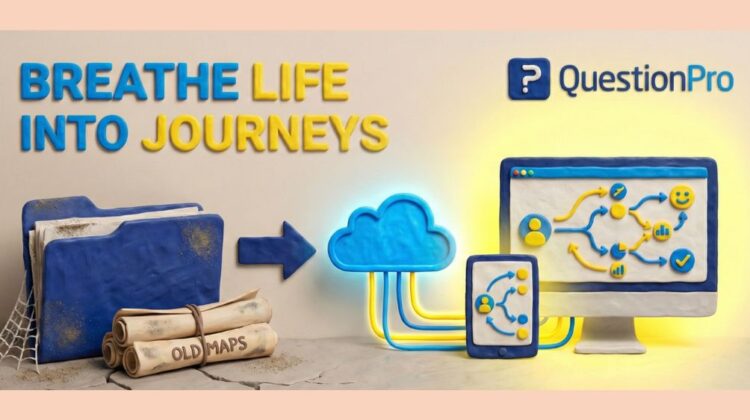
Convert them to an online system for managing customer journeys – not just mapping them
Somewhere in your organization, there’s a journey map that once sparked excitement.
- It may have come out of a well-run workshop.
- It may have aligned leadership around key pain points.
- It may have even influenced a few early improvements.
But today?
It’s sitting in a folder.
Or buried in a slide deck.
Or saved as a PDF no one has opened in months.
This is not a failure of journey mapping. It’s a failure to operationalize what was learned.
Journey maps were never meant to be static deliverables. They were meant to guide action, evolve with customers, and inform decision-making continuously. When they live offline, they lose that power.
The good news is: those maps don’t need to be recreated. They need to be reactivated.
Why Journey Maps Go Stale
Most journey maps follow a predictable lifecycle:
- Discovery– Teams invest time researching and mapping experiences.
- Alignment– Stakeholders rally around insights and opportunities.
- Delivery– The map is finalized and shared.
- Dormancy– The organization moves on, and the map is rarely revisited.
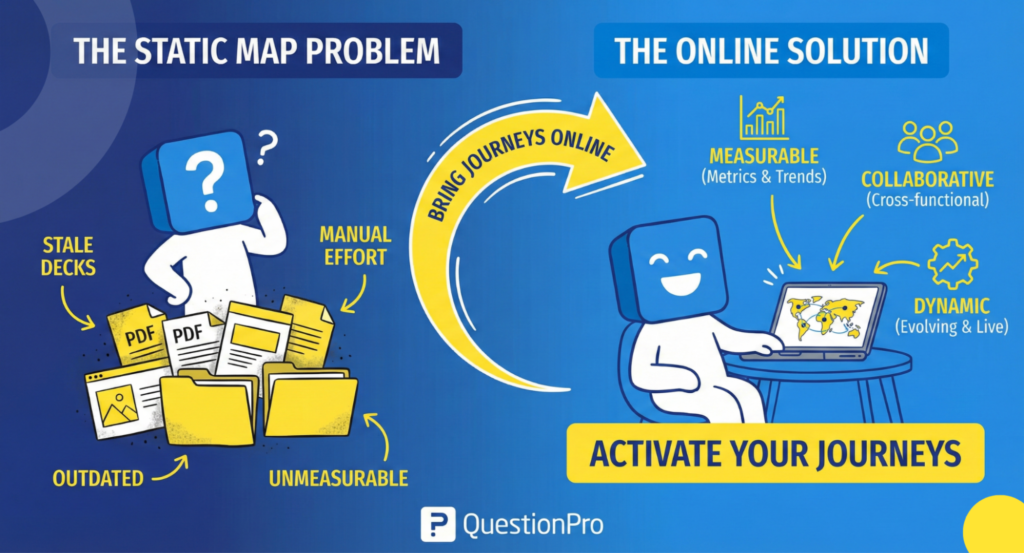
The intent was always to use the map as a guide. But because it exists in a static format, using it requires manual effort, updating slides, reconciling versions, or reinterpreting context.
Over time, the journey changes, but the map doesn’t.
– Customers evolve.
– Channels expand.
– Operational processes shift.
The map becomes a snapshot of a past reality rather than a tool for managing the present.
The Real Problem Isn’t the Map- It’s the Format
Organizations often assume their journey maps are outdated.
In reality, the insights are still valuable. The structure is still relevant. The thinking is still sound.
What’s outdated is the format.
Static files can’t:
- Connect to live customer feedback
- Reflect performance trends
- Assign ownership across teams
- Adapt to new touchpoints
- Drive accountability for improvements
To do those things, journeys must live inside a system designed to manage them, not just display them.
From Archives to Action: Bringing Journeys Online
Modern CX leaders are shifting from storing journey maps to running them inside connected platforms.
By converting offline artifacts into a digital environment, organizations can transform legacy maps into living frameworks that evolve alongside customer behavior.
With QuestionProAI, existing journey documentation, whether built in presentations, spreadsheets, or documents can be imported and structured into an online system without rebuilding from scratch.
This changes the role of the journey map entirely.
It stops being something you present.
It becomes something you manage.
What Happens When You “Bring a Map Back to Life”?
When a journey map moves into an online CX environment, it gains capabilities that static formats simply cannot support.
1. The Journey Becomes Measurable
Instead of relying on assumptions, teams can connect experience metrics directly to journey stages.
You can see:
- Where satisfaction drops
- Which steps create friction
- How experiences vary across segments
- Whether improvements are working
The journey becomes a performance lens, not just a visualization.
2. The Journey Becomes Collaborative
Offline maps are often owned by one team. Online journeys invite cross-functional participation.
- Operations can align processes.
- Product teams can prioritize enhancements.
- CX leaders can track sentiment and outcomes.
Everyone works from the same structure, reducing silos and improving coordination.
3. The Journey Becomes Dynamic
Customer behavior doesn’t stand still and neither should your journey maps.
An online system allows journeys to evolve:
- Add new channels as they emerge
- Update touchpoints as processes change
- Refine stages based on real-world data
- Continuously validate assumptions
This keeps your organization aligned with reality, not memory.
Why Reviving Existing Maps Is More Powerful Than Creating New Ones
It’s tempting to think the solution is to start fresh. But rebuilding journeys often wastes the institutional knowledge embedded in earlier work.
Those “old” maps contain:
- Hard-won customer insights
- Cross-functional alignment
- Context behind decisions
- Historical understanding of pain points
Reviving them preserves that foundation while enabling modernization.
You’re not replacing past work, you’re activating it.
Moving from Periodic Projects to Continuous Management
When journey maps live offline, they tend to resurface only during major initiatives:
- A transformation program
- A leadership review
- A redesign effort
Then they fade again.
An online journey management approach embeds experience thinking into everyday operations. Instead of revisiting journeys occasionally, organizations monitor and improve them continuously.
This creates a shift from project-based CX to programmatic CX, where managing journeys becomes part of how the business runs.
Signs Your Journey Maps Are Ready for Revival
If any of the following sound familiar, your organization is an ideal candidate for bringing journeys online:
- “We created great maps, but we don’t use them regularly.”
- “Updating them feels like too much work.”
- “Different teams have different versions.”
- “They don’t reflect what customers are experiencing now.”
- “We want to connect them to our VoC efforts.”
These aren’t mapping problems. They’re activation problems.
And they’re solvable.
A Practical Path Forward
Reviving dormant journey maps doesn’t require another round of workshops or months of redesign.
It starts with three simple steps:
Import what already exists.
Bring your current maps into a digital platform.
Validate and refine.
Ensure the structure reflects today’s reality.
Connect and manage.
Link journeys to feedback, metrics, and ownership to drive continuous improvement.
This approach allows organizations to move quickly — turning insight into execution without repeating past effort.
Let Your Journey Maps Do the Job They Were Created For
Journey maps were never meant to sit in storage.
They were meant to:
- Guide decisions
- Align teams
- Reveal opportunities
- Improve experiences
When brought online, they finally can.
Instead of collecting dust, they become active instruments of change, helping organizations listen better, act faster, and deliver experiences that evolve with their customers.
The Next Chapter of Your CX Maturity
Every organization with legacy journey maps is sitting on untapped value.
You don’t need to map again. You just need to mobilize what you already know.
By converting static artifacts into a connected journey management system, you transform past insight into present action and ensure your journeys remain as dynamic as the customers moving through them.
Your maps aren’t obsolete. They’re waiting to be reawakened.
Product Roadmap & Vision
- Launched – Import Excel & PDF based Maps
- Coming Soon – Add support for PowerPoint
- Coming Soon – Bulk Import of Maps – from a ZIP File – Import 100’s of Maps at once
- Future – Sync & Import maps from other platforms like Miro/Mural etc.