From Static Insight to Applied Intelligence
Customer journey mapping and VoC programs created an important awakening in many organizations: customers are complex, expectations are rising, and experience affects revenue. But what often happens next is a familiar pattern. Teams gather insights. They map experiences. They collect feedback. And then those artifacts sit.
The real opportunity lies in turning insight into impact through a structured, evolving approach to Customer Journey Management. CJM isn’t a project. It’s a practice that matures as an organization learns, aligns, and operationalizes experience across functions. To help teams understand where they are and where they need to go next, I’ve developed the CJM Maturity Curve, a pathway from map to momentum.
Stage 1: Exploring Customer Journeys
At this earliest stage, many organizations are just discovering the customer journey concept.
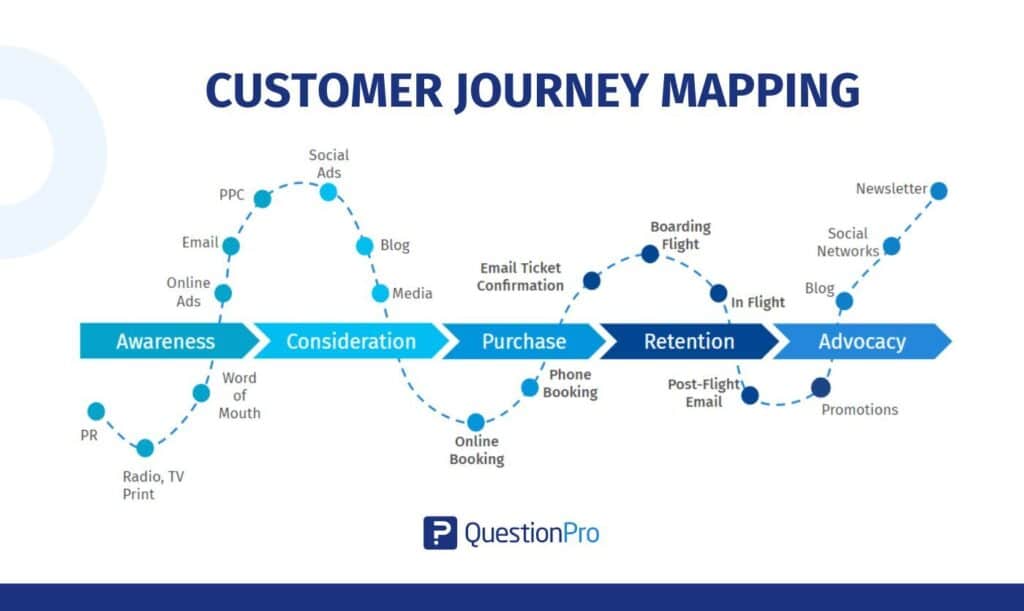
Teams build their first journey maps. Workshops take place. Personas are developed. Voice of customer programs are launched.
The focus is on discovery and visualization of the moments customers encounter, their pain points, and where things break down. It’s a necessary first step, but often static. Once the workshop ends and the PDF is shared, progress stalls.
Challenges here include:
- Maps that live on a shelf instead of in workflows
- Insights gathered but not shared across teams
- Lack of prioritization and ownership
- Feedback captured in notes but not actioned
At this stage, CJM feels like a task, not a system.
Stage 2: Connecting Insight to Action
Once teams see customer journeys clearly, the next shift is about connecting insight to action. This is where organizations begin to ask: “What do we do with this?”
Here, journey maps start to be used beyond empathy exercises. Teams pilot improvements. Cross-functional groups form to address specific friction points. Early governance begins. There might be roadmaps for change.
But action is still episodic. Improvements are made on a case-by-case basis. There’s no ecosystem that continuously feeds experience data into planning and execution.
Common indicators of this stage:
- Pilots with measurable outcomes
- Cross-functional task forces
- Prioritization frameworks applied to friction points
- Early integration of VoC data with operational metrics
However, progress is still dependent on individual champions and periodic efforts rather than ongoing practice.
Stage 3: Journey Management as a Living System
At this point, CJM stops being a side project and becomes an ongoing operating model.
A modern journey management platform is no longer just a repository. It becomes the system of record for experience work. Teams continuously update journeys based on live data, analytics, and realtime signals. Ownership is clearer. Workflows adapt as new insights emerge.
Here, journeys are:
- Visible to the entire organization
- Actionable, not just descriptive
- Living, with regular refreshes and data feeds
- Accountable, with specific ownership for outcomes
Measurement starts to align across functions. VoC feeds into product decisions, operations improvements, and customer support workflows. Continuous improvement replaces oneoff fixes.
Indicators of this stage include:
- Alerts triggered by signal changes
- Realtime dashboards showing friction hot spots
- Regular governance forums with crossfunctional attendance
- Prioritization decisions informed by impact likelihood and customer value
Organizations at this level stop asking “What does the customer journey look like?” and instead ask “How is this journey performing today?”
Stage 4: Experience-Led Strategic Organization
At the most mature end of the curve, Customer Journey Management becomes a strategic advantage. CJM is no longer owned by CX alone. It’s integrated into strategic planning, product roadmaps, service design, and enterprise goals.
In this stage:
- Journeys are part of executive dashboards
- Decisions are based on blended insight (VoC + operational + financial)
- Crossenterprise KPIs include experience outcomes
- Teams anticipate disruption with predictive signals
- Investments are made in experience infrastructure rather than patches
CJM here drives innovation, not just reaction. Experience leadership becomes a defining capability — not a support function.
Teams at this stage influence:
- Market positioning and differentiation
- Brand equity through consistent experience delivery
- Retention and expansion strategies
- Organizational design that favors systemic clarity and flow
How Organizations Advance Along the Curve
The shift from one stage to the next isn’t automatic. It doesn’t happen through ambition alone. Firms progress when they:
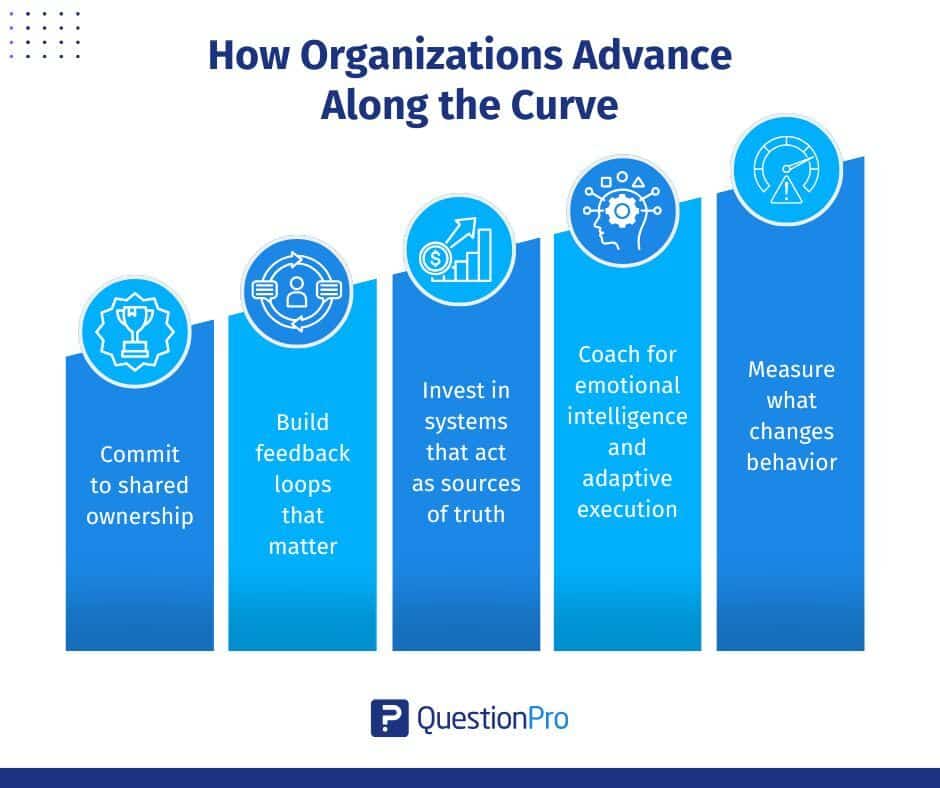
Commit to shared ownership
When journey ownership isn’t siloed, but shared, teams coalesce around common outcomes.
Build feedback loops that matter
VoC isn’t a scoreboard. Signals from interactions must tie directly into team priorities and operational metrics.
Invest in systems that act as sources of truth
Journey management technology is a foundation, not a trend. When integrated with CRM, support, product, and analytics platforms, it becomes a living system.
Coach for emotional intelligence and adaptive execution
Teams need skill in interpretation, judgment, and tradeoff thinking, not only procedural adherence.
Measure what changes behavior
Metrics that matter are not vanity scores. They align to real decisions, outcomes, and business value.
Why the CJM Maturity Curve Matters Today
Customer experience is no longer a “nice to have.” It’s a competitive necessity. But a map on the wall or a workshop in a conference room doesn’t equal impact. Real experience work is managed. It evolves. It influences decisions. It creates accountability.
The organizations that succeed with CJM don’t view it as a checklist. They treat it as an operating discipline that grows with them as their business and customers grow.
If you want CJM to move beyond insight into clear, measurable impact, ask not only what stage you’re in, but what you can do this quarter to push to the next.
Where on the CJM maturity curve is your organization? And what will it take to move forward?