
A leadership style survey is a structured questionnaire that measures how a manager leads a team based on observable behaviors like communication, coaching, trust, and decision-making. For US HR teams, it reveals whether employees feel heard, supported, and guided in ways that actually help their work.
Leadership style is not fixed. A manager might coach one employee closely, give another full autonomy, and switch to a direct approach during a crisis. That flexibility is useful, but only when the manager knows how their behavior actually lands with the people on their team.
A good leadership style survey turns those everyday experiences into feedback a manager can act on, rather than a guess about how things are going.
In this article, we’ll explore what a leadership style survey is, its importance, survey questions, and best practices.
What is a leadership style survey?
A leadership style survey is a structured questionnaire that asks employees, peers, or managers themselves to rate specific leadership behaviors rather than personality traits.
It typically covers communication, decision-making, coaching, trust, feedback, accountability, and team support. The goal is not to label someone a “good” or “bad” leader. The goal is to understand how their style affects the people who report to them.
A leadership style survey can help answer questions like:
- Does this manager communicate clearly?
- Does the team feel trusted?
- Does the manager ask for feedback and act on it?
- Does the manager support employee growth?
- Does the manager involve the team in decisions?
- Does the manager adapt their style when the situation changes?
Because it isolates specific behaviors, this type of survey is useful for leadership development, manager coaching, employee experience programs, and 360 feedback.
Leadership style vs leadership skill: What is the difference?
Leadership style describes how a manager behaves day to day, while leadership skill describes their competence at specific tasks like delegation, conflict resolution, or strategic planning.
The two get confused because they interact constantly. A manager can be highly skilled at running a project and still lead in a way that frustrates the team, for example, by withholding context or avoiding feedback. A leadership style survey measures the behavioral side, the “how,” not the technical side, the “what.”
This distinction matters when choosing a survey. If the goal is to evaluate whether someone can execute a project plan, that is a performance or skills assessment. If the goal is to understand how a manager’s behavior affects trust, communication, and morale, that calls for a leadership style survey.
Why should organizations use a leadership style survey?
Organizations should use a leadership style survey because managers strongly shape how employees experience work. Gallup research based on 2.7 million employees across 100,000 teams found that managers account for at least 70 percent of the variance in team engagement scores across business units.
When managers do not receive structured feedback, they tend to rely on assumptions about how their team feels. A survey replaces that guesswork with a clearer picture of what is working, what needs attention, and how leadership behavior shapes the broader employee experience.
A leadership style survey can help organizations:
- Identify leadership strengths worth reinforcing
- Find gaps between manager intent and employee experience
- Improve communication inside teams
- Support manager coaching with specific, behavior-based feedback
- Measure leadership effectiveness over time
- Compare leadership needs across departments
- Build fairer, evidence-based leadership development programs
Leadership feedback can also be compared against a broader employee engagement survey to see whether manager behavior is driving trust, motivation, and team commitment. For US companies with hybrid or distributed teams, this comparison is especially useful, since managers cannot always see confusion or disengagement in day-to-day interactions the way they could in person.
What leadership styles can a survey help identify?
A leadership style survey can help identify patterns in how managers guide, support, and make decisions with their teams. Most leaders use a mix of styles depending on the team, task, and pressure level, so a survey should never force one label onto a manager.
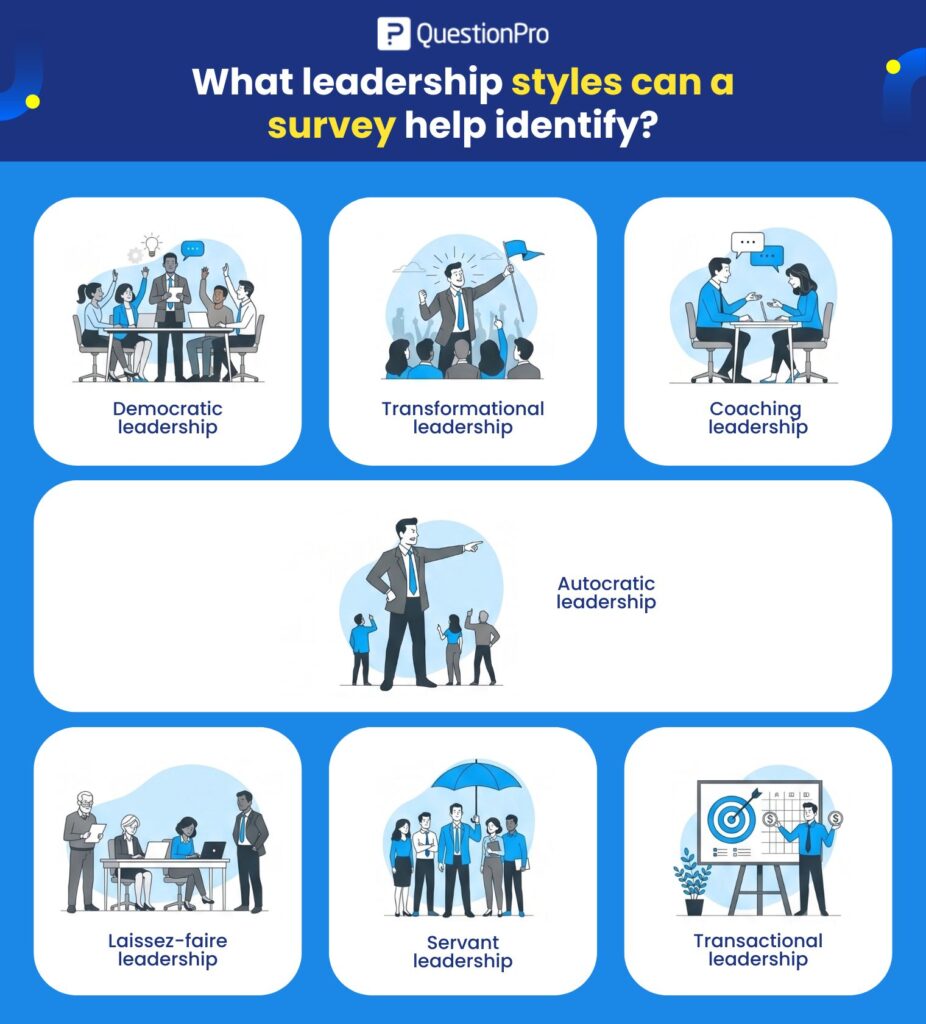
- Democratic leadership
Democratic leaders invite employee input before making decisions. This style can increase trust and participation, but it may slow decisions when fast action is needed.
- Transformational leadership
Transformational leaders focus on vision, motivation, and change. This style can inspire teams, but it needs clear execution so employees know what to do next.
- Coaching leadership
Coaching leaders support employee development through feedback, guidance, and skill-building. This style works well when employees need growth support, but it can feel slow in urgent situations.
- Autocratic leadership
Autocratic leaders make decisions with limited input from others. This style can help during emergencies, but overuse can reduce trust and autonomy.
- Laissez-faire leadership
Laissez-faire leaders give employees high independence. This can work well with experienced teams, but it may create confusion if expectations are unclear.
- Servant leadership
Servant leaders focus on team needs, trust, and support. This style can improve morale, but managers still need to set clear goals and hold people accountable.
- Transactional leadership
Transactional leaders focus on goals, rules, rewards, and performance expectations. This style creates clarity, but it can feel rigid if employees need room for creativity or coaching.
What should a leadership style survey measure?
A leadership style survey should measure behaviors that employees can observe and rate fairly, not vague personality traits. The table below outlines the core areas most leadership surveys should cover.
| Area | What it measures |
|---|---|
| Communication | Whether the manager explains goals, priorities, and decisions clearly |
| Decision-making | How the manager includes input and handles urgency |
| Feedback and coaching | Whether employees receive useful feedback, recognition, and development support |
| Trust and autonomy | Whether employees feel trusted to do their work without unnecessary control |
| Team support | Whether the manager removes blockers and supports collaboration |
| Accountability | Whether the manager sets clear standards and follows up fairly |
| Conflict handling | Whether the manager addresses problems directly and consistently |
| Change management | Whether the manager guides the team through change with clarity |
The strongest surveys combine rating-scale questions with open-ended ones. Rating scales show patterns across a team. Open-ended answers explain the reason behind the score.
What leadership survey questions should you ask employees?
Leadership survey questions should focus on specific, observable manager behaviors so responses are easy to interpret and act on. Most organizations use a five-point agreement scale, from strongly disagree to strongly agree.
Useful question groups include:
- Communication: My manager communicates goals clearly. My manager explains decisions that affect the team. My manager listens before responding.
- Feedback and coaching: My manager gives feedback that helps me improve. My manager recognizes good work. My manager supports my professional growth.
- Trust and autonomy: My manager trusts me to complete my work. My manager avoids unnecessary micromanagement. My manager gives clear direction without controlling every step.
- Decision-making: My manager includes team input when appropriate. My manager explains priorities when plans change. My manager takes responsibility for decisions.
- Team support: My manager helps remove blockers. My manager treats employees fairly. My manager creates space for honest feedback.
Open-ended questions round out the picture: What does your manager do well? What is one thing your manager should start doing? What is one thing your manager should stop doing? These work best when employees know the survey’s purpose is development, not punishment.
How do leadership self-assessment questions help managers?
Leadership self-assessment questions help managers compare how they see themselves with how their team actually experiences them, which is where most of the useful insight lives.
A self-assessment might ask a manager how often they ask for feedback, whether they explain the reasoning behind decisions, whether they adjust their style to team needs, and whether they follow through on commitments. Self-assessment alone is not enough, since managers can overrate or underrate themselves. The value comes from comparing self-ratings against employee feedback side by side.
How does a leadership assessment survey work?
A leadership assessment survey works by collecting feedback from one or more respondent groups and comparing results across leadership behaviors. The process usually follows these steps:
- Define the purpose, whether it is coaching, development, promotion readiness, or team improvement.
- Choose the respondent group, such as direct reports, peers, senior leaders, or the manager.
- Select the survey format, mixing rating-scale and open-ended questions.
- Protect confidentiality and tell employees whether responses are anonymous.
- Collect responses, giving employees enough time to answer thoughtfully.
- Analyze results by theme, not by single question.
- Share results carefully, focusing on strengths, gaps, and next steps.
- Build an action plan that turns feedback into practical behavior changes.
- Repeat the survey over time to measure whether leadership behavior improves.
This process is often part of a broader 360 feedback or manager evaluation program that pulls in feedback from multiple stakeholders at once.
How do you analyze leadership style survey results?
You analyze leadership style survey results by grouping questions into themes, such as communication, feedback, autonomy, decision-making, support, and accountability, then comparing average scores across those categories.
Three types of findings typically emerge. Strengths are areas with consistently high scores that should be recognized and maintained. Development gaps are areas with lower scores or repeated concerns in open-ended comments, which should become coaching priorities. Perception gaps happen when a manager’s self-rating differs sharply from employee ratings, for example, when a manager believes they communicate clearly but the team rates communication low.
A single strong or critical comment can matter, but a repeated theme across several responses deserves more attention than any one comment on its own.
What does a leadership survey look like in practice?
Consider a mid-size US company running its first leadership style survey across 40 managers. Employee scores show strong trust and autonomy ratings company-wide, but coaching and feedback consistently score lower, especially among newer managers.
HR pairs that finding with self-assessment data and finds a clear perception gap: new managers rate their own coaching highly, while their direct reports rate it low. Instead of a generic training rollout, the company builds a coaching-specific workshop for new managers and re-runs the survey after two quarters to check for movement. That is the difference between collecting feedback and using it.
What are the pros and cons of leadership feedback surveys?
Leadership feedback surveys are useful, but they need to be handled carefully to avoid doing more harm than good.
Pros
- Give employees a structured voice
- Help managers understand how their behavior is experienced
- Support leadership development with specific data
- Reveal team-level communication issues
- Help HR track manager effectiveness over time
- Create a baseline for future improvement
Cons
- Employees may not answer honestly without confidentiality
- Managers may become defensive if results are shared poorly
- Poorly written questions can create unclear results
- Surveys can feel like punishment if the purpose is not explained
- Small teams may struggle with anonymity
- Feedback without follow-up can quietly erode trust
What mistakes should organizations avoid when running these surveys?
The most common mistake is treating the survey as the end point instead of the starting point. Collecting feedback and doing nothing with it is often worse than not asking at all, because employees notice the silence.
Other frequent mistakes include writing vague, personality-focused questions instead of behavior-based ones, using one survey result as the sole measure of a manager’s performance, sharing raw comments in ways that could identify a specific employee, and running the survey again too soon to see any real change. SHRM’s guidance on employee surveys reinforces the same point: clear purpose, careful wording, and a structured follow-up process matter more than the survey tool itself.
How can QuestionPro Employee Experience support leadership surveys?
QuestionPro Employee Experience can help HR teams build leadership survey templates, collect 360 feedback from direct reports and peers, analyze manager-level results by theme, and track whether scores improve after a coaching intervention. It can also connect leadership feedback with broader employee experience signals, such as engagement, satisfaction, and retention risk, so leadership data does not sit in isolation from the rest of the employee lifecycle.
The goal is never to reduce leadership to a single score. It is to help managers understand their impact and build better working relationships with their teams.
Turning leadership feedback into real change
A leadership style survey is only as useful as what happens after the results come in. The best surveys do not ask employees to judge a manager’s personality. They ask about behaviors people can actually see, like communication, coaching, trust, and support. When HR teams run the survey with clear intent, careful wording, and a real follow-up process, leadership feedback becomes a genuine growth tool instead of another form to fill out.
Frequently Asked Questions (FAQs)
Most US organizations run leadership style surveys once or twice a year, with lighter pulse checks in between. Running it too often without giving managers time to change behavior can create survey fatigue without adding new insight.
No. A leadership style survey measures behavior and team experience, while a performance review evaluates results against goals. Many organizations use both together for a fuller picture of a manager’s effectiveness.
Anonymity generally produces more honest feedback, especially in smaller teams where responses could otherwise be traced back to an individual. HR should decide and communicate the anonymity policy before the survey launches, not after.
Most effective leadership surveys use 15 to 25 questions across a handful of behavior categories, plus two or three open-ended prompts. Longer surveys tend to reduce completion rates and response quality.
Share results privately first, frame the conversation around specific behaviors rather than character, and pair every gap with a concrete coaching step. Managers respond better when feedback comes with a clear path forward, not just a score.