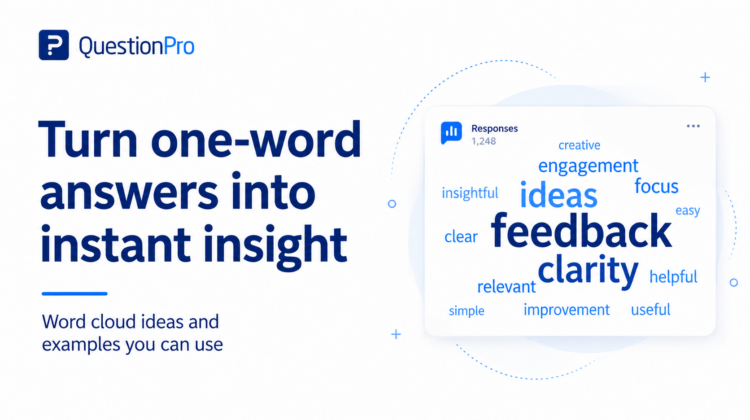
A live word cloud turns short audience responses into a visual pattern. When the same word appears repeatedly, it becomes more prominent, making shared themes easy to spot while the session is still happening.
Word clouds are particularly useful when you want the audience to contribute in their own words but do not need paragraph-length explanations.
What is a live word cloud?
A live word cloud collects short text responses from participants and displays them as a visual cloud in real time. Repeated responses receive greater visual weight, helping the audience see which words or themes are appearing most often.
QuestionPro LivePolls’ Word Cloud question type is designed for one-word audience responses and can limit the number of responses each participant submits. See how Word Cloud works in LivePolls.
When should you use a word cloud?
- Opening pulse check: capture the mood or expectation at the start.
- Brainstorming: collect many short ideas without forcing predefined options.
- Reflection: ask for one takeaway after a class or training session.
- Culture conversations: surface words people associate with a team or organization.
- Prioritization signal: identify repeated themes before moving into a deeper poll or discussion.
Turn one-word answers into a live visual your audience can see.
30 live word cloud questions
| # | Use case | Prompt |
|---|---|---|
| 1 | Meetings | What one word describes the priority for today’s meeting? |
| 2 | Meetings | What is the biggest blocker right now? |
| 3 | Meetings | What should we protect as we make this change? |
| 4 | Meetings | What word best describes our current level of alignment? |
| 5 | Meetings | What do we need more of to move faster? |
| 6 | Classes | What word comes to mind when you hear today’s topic? |
| 7 | Classes | What concept from this lesson feels most important? |
| 8 | Classes | What word describes your confidence right now? |
| 9 | Classes | What should we review next class? |
| 10 | Classes | What word best summarizes today’s lesson? |
| 11 | Training | What skill do you most want to improve? |
| 12 | Training | What is the biggest barrier to applying this? |
| 13 | Training | What word describes how ready you feel? |
| 14 | Training | What should we practice again? |
| 15 | Training | What is your biggest takeaway? |
| 16 | Presentations | What word describes your reaction to this idea? |
| 17 | Presentations | What is the biggest opportunity you see? |
| 18 | Presentations | What is the biggest risk you see? |
| 19 | Presentations | What should we talk about next? |
| 20 | Presentations | What word best describes this strategy? |
| 21 | Events | What brought you here today? |
| 22 | Events | What are you hoping to learn? |
| 23 | Events | What word describes the event so far? |
| 24 | Events | What topic should appear on next year’s agenda? |
| 25 | Events | What is your biggest takeaway? |
| 26 | Workplace | What word describes our culture today? |
| 27 | Workplace | What should leadership do more of? |
| 28 | Workplace | What helps you do your best work? |
| 29 | Workplace | What gets in the way of your best work? |
| 30 | Workplace | What word should define our next quarter? |
How to write a better word cloud question
Ask for one word or a short phrase
If the prompt invites a paragraph, the visualization becomes harder to interpret. Tell participants the expected response length directly.
Use a prompt with a clear frame
“Thoughts?” is too broad. “What is the biggest barrier to applying this?” gives the responses a common context.
Do not use a word cloud when detail matters
If you need reasons, stories or questions, use an open-ended Live Feed instead. A word cloud is a pattern detector, not a qualitative research transcript.
Word cloud vs. Live Feed
| Word cloud | Live Feed |
|---|---|
| Best for short words and themes | Best for questions, explanations and ideas |
| Repeated words become visually prominent | Responses appear as readable text |
| Excellent for pulse checks and brainstorming | Excellent for Q&A and open feedback |
| Fast visual scan | More context per response |
What should you do after the word cloud appears?
Do not admire the graphic and move on. Use it as the beginning of the discussion.
- Call out the two or three most prominent words.
- Ask whether the pattern surprises the audience.
- Choose one theme and ask a follow-up multiple-choice or Live Feed question.
- Use the result to decide where the discussion should go next.
Frequently asked questions
What kinds of questions work best for word clouds?
Prompts that can be answered meaningfully in one word or a short phrase: emotions, barriers, priorities, expectations, takeaways and associations.
Are word clouds quantitative?
They visualize frequency, but they should not be treated as a substitute for rigorous quantitative analysis. They are most useful as an immediate visual signal.
Can a word cloud be used in a quiz?
LivePolls allows Word Cloud questions within live sessions that may combine feedback and quiz content. If you need objective scoring, use a scored quiz question instead.
Use the word cloud to open the room
A live word cloud is powerful because everyone can contribute quickly and see the collective pattern. The best next move is to use that pattern to ask a sharper question.