
Understanding the customer journey is essential for delivering great experiences. But simply mapping the journey isn’t enough. To truly improve experiences, organizations must understand how different customers experience each stage of the journey.
This is where Metrics Drill-downs in Journey Management make a powerful difference.
Metrics Drill-downs allow teams to view CX metrics directly within a journey map and filter those metrics using custom variables and segments from survey responses. This enables organizations to analyze customer experiences at a much deeper level and uncover insights that traditional journey maps often miss.
In this blog, we’ll explore how Metrics Drill-downs help organizations transform static journey maps into dynamic insight engines.
Bringing Data into the Journey Map
Journey maps are widely used to visualize customer experiences, but many of them remain static documentation rather than operational tools.
Metrics Drill-downs change this by allowing organizations to integrate real customer feedback metrics such as NPS and CSAT directly into journey stages.
More importantly, these metrics can be filtered using custom variables or customer segments, ensuring the insights reflect the specific audience you want to analyze.
Instead of viewing a single overall score, teams can explore how different groups experience the same journey.
For example:
- How do new customers vs. existing customers experience onboarding?
- How does satisfaction differ across regions or customer tiers?
- Which persona struggles the most during checkout?
By embedding metrics into the journey map and enabling segmentation, businesses can understand customer experiences with much greater clarity.
Optimizing Customer Experiences with Segmented Insights
One of the most valuable applications of Metrics Drill-downs is the ability to analyze journeys for specific customer segments.
Every customer group experiences a brand differently. Without segmentation, these differences are often hidden inside aggregated metrics.
With Metrics Drill-downs, organizations can filter journey metrics using attributes such as:
- Customer persona
- Geography or region
- Customer tier or subscription level
- Product usage
- Demographic variables
This allows CX teams to see exactly how each group experiences a journey stage.
The result is more targeted improvements. Instead of implementing broad changes, companies can focus on the segments that need attention the most, leading to more effective experience optimization.
Identifying Hidden Journey Friction
A journey stage might appear healthy when looking at overall metrics, but the reality could be very different for certain customer groups.
Metrics Drill-downs help uncover hidden friction points that aggregated metrics often conceal.
For example:
A checkout stage might show a strong overall CSAT score. But when drilled down by region or customer type, a particular segment may reveal significantly lower satisfaction.
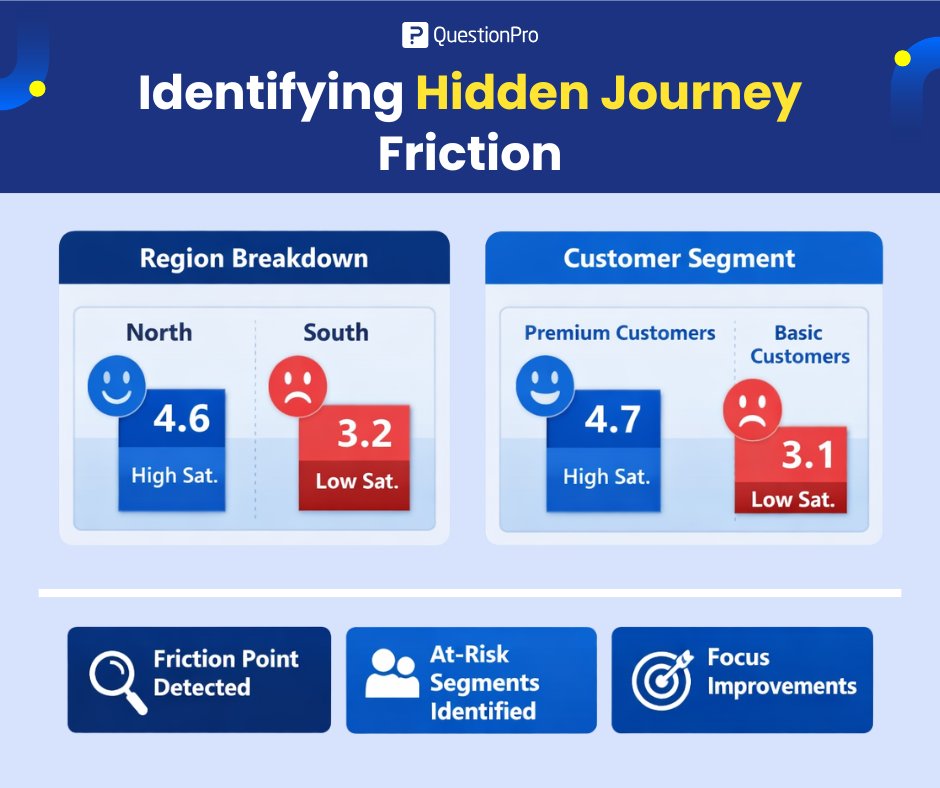
This kind of insight helps teams:
- Identify journey stages causing friction
- Understand which segments are affected
- Prioritize improvements based on real customer impact
By identifying these hidden issues early, organizations can proactively improve the journey and reduce frustration.
Improving Campaign and Experience Analysis
Metrics Drill-downs also provide valuable insights for marketing and experience teams.
By analyzing journey metrics across different customer segments, organizations can better understand how various groups respond to marketing campaigns, product experiences, or service interactions.
For example, teams can explore questions like:
- Which customer segments respond best to specific campaigns?
- How do different audiences experience key digital touchpoints?
- Which customer groups show declining satisfaction after a specific interaction?
These insights allow teams to optimize campaigns and experiences based on real behavioral and feedback data, improving both engagement and ROI.
Strengthening Data-Driven Decision Making
Organizations today collect vast amounts of customer data. The challenge is turning that data into actionable insights.
Metrics Drill-downs help bridge this gap by connecting customer feedback data with the journey stages where experiences actually occur.
By combining journey visualization with segmented metrics, teams gain a much clearer understanding of customer behavior.
This enables leaders to make more informed decisions, such as:
- Prioritizing journey improvements
- Optimizing product experiences
- Refining marketing strategies
- Enhancing support and service processes
Instead of relying on assumptions, teams can make decisions based on clear, segment-level customer insights.
Turning Journey Maps into Operational CX Tools
Traditional journey maps are often created during workshops and then rarely revisited. They become documentation rather than tools used for continuous improvement.
Metrics Drill-downs help change that.
By integrating real customer feedback data and enabling segmentation directly within the journey map, organizations can continuously monitor how experiences evolve across different customer groups.
This transforms journey maps from static diagrams into living CX management tools that support ongoing analysis and improvement.
Unlock the Full Value of Your Customer Journey Data
Understanding the customer journey is only the first step. The real value comes from uncovering the insights hidden inside that journey.
Metrics Drill-downs provide the depth and flexibility needed to explore customer experiences in detail. By allowing teams to filter metrics using custom variables and segments, this feature helps organizations understand how different customers interact with each stage of the journey.
The result is a more precise, data-driven approach to improving experiences.
With Metrics Drill-downs, organizations can move beyond simple journey visualization and begin using journey maps as a powerful engine for CX insights and continuous improvement.