Monadic testing is a research method where each participant evaluates only one concept, product, or idea in a survey. No other version is shown for comparison. That isolation is the whole point. Once people see two or three options side by side, their answers stop being pure reactions. They become comparisons instead, and comparisons hide how an idea would perform on its own.
This matters because most products, ads, and prices get experienced alone, not lined up against alternatives. A shopper sees one package on a shelf. A subscriber sees one price on a signup page. Monadic testing recreates that single-exposure moment inside a survey. The feedback reflects a real first reaction, not a ranked preference.
In this blog, we’ll explain how monadic testing works. We’ll cover how it differs from sequential and comparative designs, what a statistically sound test takes, and how to set one up with QuestionPro.
What is Monadic Testing?
Monadic testing is a survey method in which each respondent evaluates a single concept, with no exposure to any other version in the same study. Respondents get split into separate groups, or “cells.” Each cell only ever sees one concept.
The word comes from the Greek “monos,” meaning single or alone. That’s exactly what the method isolates. Nothing else competes for attention. The reaction a respondent gives stays close to a true first impression, not a judgment shaped by what else appeared on the page.
A few defining traits set monadic testing apart from other concept-testing designs:
- No side-by-side exposure. Each respondent sees only one stimulus, whether that’s a product, price, ad, or package.
- Separate respondent groups. Comparing two concepts means comparing results across two different samples, not within one respondent’s answers.
- Reduced order and comparison bias. Nothing earlier in the survey can anchor or contrast with the concept being rated.
- Mixed data types. A well-built monadic survey pairs rating-scale questions, like appeal, clarity, and purchase intent, with open-ended follow-ups that explain the reasoning behind the score.
The Quirk’s glossary of market research terms defines the method the same way. It’s a test in which a respondent evaluates only one product, used to capture unbiased, standalone feedback on that item’s individual performance.
Monadic Testing vs. Sequential Monadic vs. Comparative Testing
Monadic, sequential monadic, and comparative testing all measure how a concept performs. They differ in how many concepts a single respondent sees and how directly those concepts get compared.
Comparative testing shows two or more concepts to the same respondent at once, side by side, and asks them to pick or rank. It produces a clear preference winner fast. But that preference is relative. A concept can “win” a comparative test and still underperform in the real world, where competitors rarely sit right next to it.
Sequential monadic testing sits in between. Each respondent still rates every concept, but one at a time, in sequence, rather than side by side. It reuses the same sample across concepts, which lowers cost. The order concepts appear in, though, can shape later ratings.
Monadic testing keeps every respondent limited to one concept for the entire survey. It costs more in sample size. In exchange, it removes both direct comparison and order effects.
| Feature | Monadic Testing | Sequential Monadic | Comparative Testing |
|---|---|---|---|
| Concepts per respondent | One | Multiple, shown in sequence | Multiple, shown together |
| In-survey comparison | Not possible | Happens through repeated exposure | Direct and immediate |
| Bias risk | Low | Moderate, from order effects | Higher, from direct contrast |
| Feedback type | Independent, focused | Relative, based on sequence | Relative, based on side-by-side view |
| Sample size needed | Larger | Smaller | Smallest |
| Best for | True first impressions | Ranking with a limited budget | Fast, forced-choice screening |
Which one should you use?
Pick monadic testing for high-stakes decisions where the concept will eventually stand alone in the market. A new product launch, a price point, or a packaging redesign all fit this pattern. Sequential monadic testing works better when budget or audience size can’t support separate cells for every concept, and a ranked shortlist is good enough. Save comparative testing for early-stage, low-stakes screening, where speed matters more than isolating a true first reaction.
Why Monadic Testing matters for research teams
Monadic testing matters because it produces feedback that mirrors how people actually encounter ideas, one at a time. That makes the resulting scores easier to trust and act on.
- True first reactions.
A respondent shown a single product concept reacts the way they would when seeing it for the first time. That could be on a shelf, in an app store, or in an inbox. Nothing earlier in the survey hints at what else exists to compare it against.
- Clear, explainable metrics.
Scores for appeal, clarity, or purchase intent attach to exactly one concept. A stakeholder can look at a single number and know precisely what it describes.
- Deeper diagnostic feedback.
Respondents aren’t splitting attention across multiple ideas. Open-ended follow-up questions produce richer detail about what worked and what didn’t for that specific concept.
- Fair comparison across cells.
Respondents never see more than one concept, but results still get compared across cells afterward. A team testing three price points can still identify the strongest performer.
Consider a new snack flavor. Testing it monadically works better than a taste-comparison panel. Shoppers rarely taste two competing flavors back to back before buying one. A single-flavor reaction sits closer to that real purchase moment.
When to use Monadic Testing for better performance
Monadic testing performs best when a concept needs to be judged on its own eventual standing in the market. It’s the wrong fit when the goal is a direct, forced comparison against a competing idea in the same survey.
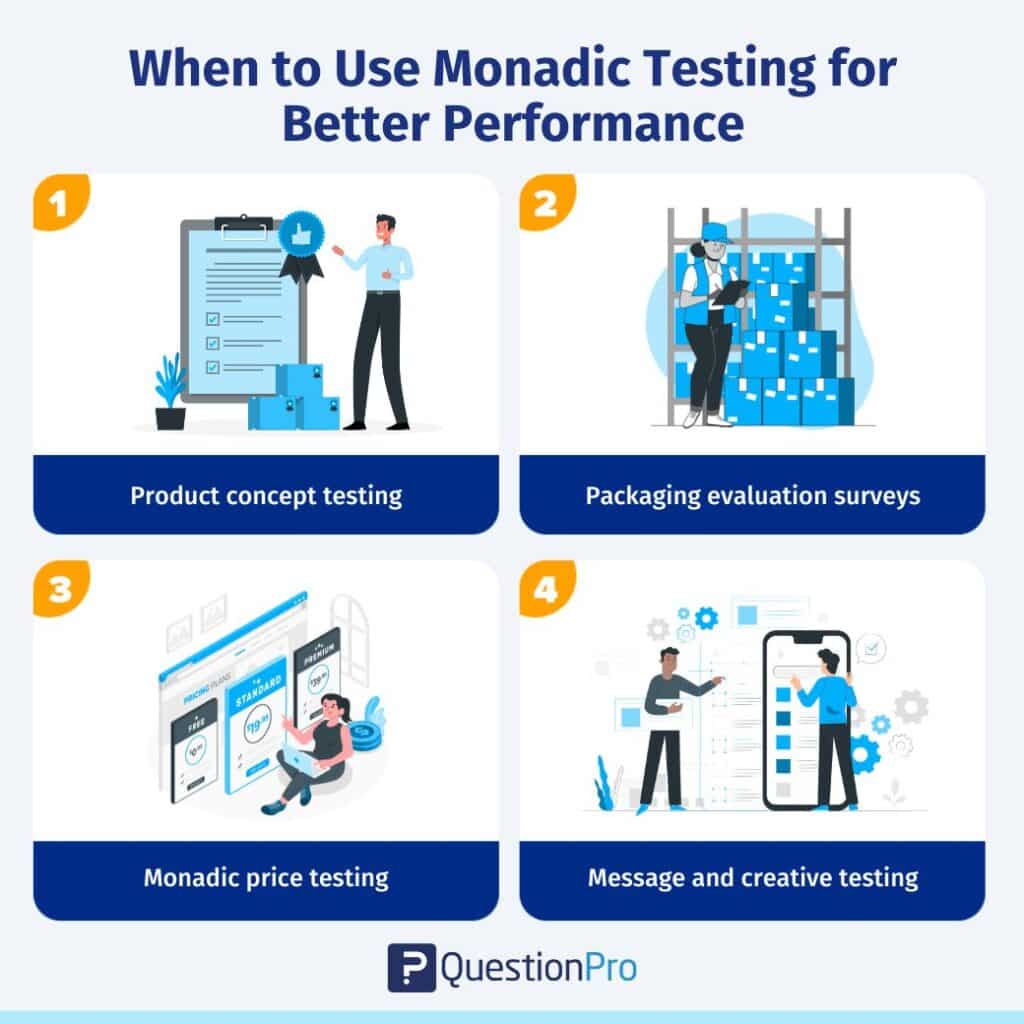
Product concept testing
Use monadic testing to measure how a single product idea performs before deciding whether to move it forward. Each respondent’s score for appeal, relevance, and purchase intent applies to that one concept alone. That makes it easy to compare a new idea against an internal benchmark, rather than against a rival concept shown in the same session. Teams often reach for this when validating a concept. The concept testing tools they already rely on typically support both formats below:
- A single new flavor, feature, or design variant, tested against a target score rather than a competing version
- An updated concept compared to a prior benchmark score from an earlier wave of research
Packaging evaluation
Small packaging changes can swing reactions more than researchers expect. A color shift, a new logo placement, or a different tagline all count. Showing one design per respondent keeps the feedback honest. Nothing nudges them to notice a difference that wouldn’t exist on a real shelf.
Monadic price testing
Each respondent in a monadic price test sees exactly one price point. A cheaper or more expensive alternative never anchors their answer. This isolates real price acceptance rather than relative preference.
- Pair it with a concept and pricing survey template to gather intent and reasoning in the same pass.
- Run a formal conjoint analysis study instead when several price and feature combinations need to be modeled together, not just one price at a time.
Message and creative testing
Taglines, ad concepts, and key messages benefit from monadic exposure. Attention stays on one version at a time, closer to how someone actually encounters a single ad in their feed. This fits naturally into a pre-launch survey built to validate messaging before a campaign goes live.
Common creative variants tested this way include:
- A single tagline or headline, scored on clarity and appeal
- One version of an ad’s key visual or hero image, scored on relevance and recall
In software and product development, teams lean on monadic testing most during concept validation. They need an unfiltered reaction to a new feature or screen before committing engineering time to build it.
How to measure and evaluate a Monadic Test
Measuring a monadic test well starts with the right sample size per cell. From there, score each concept on a small, consistent set of metrics.
Sample size per cell
Each concept needs its own independent group of respondents. Total sample size grows with every concept added.
- Split-cell pricing studies typically need around 150 respondents per cell for statistically reliable results, according to TRC Market Research.
- Three concepts at 150 per cell means fielding 450 respondents total, not 150.
- General concept tests can sometimes work with smaller cells, depending on how much variation the scores show.
Key metrics to score
Keep the same short set of questions across every cell so scores stay comparable:
- Appeal or overall liking, usually a 5- or 7-point scale
- Purchase intent, framed as likelihood to buy or use
- Clarity or believability, how easy the concept was to understand
- Uniqueness or differentiation, how different it feels from what’s already available
- Open-ended reasoning, why the respondent gave the score they did
A well-designed product testing survey builds these into a short, consistent block. That block repeats identically across every concept cell, which is what makes cross-cell comparison possible after fielding.
Checking that cells are balanced
Randomizing respondents into cells doesn’t guarantee the cells end up demographically similar. A scoring gap between concepts might reflect the sample, not the concept. Quirk’s guide to balancing monadic-cell test designs walks through the process. Before comparing scores, check each cell for skew on:
- Age and gender distribution
- Income level or spending habits relevant to the category
- Prior usage or familiarity with the product category
Limitations and common mistakes in Monadic Testing
Monadic testing is a strong method, but it isn’t the right fit for every question. Even well-chosen studies can go wrong in predictable ways.
Limitations to plan around
Every method trades one strength for another. Monadic testing gives up the following in return for cleaner data.
- Larger total sample size. Every additional concept needs its own respondent group, which raises both cost and fielding time.
- No in-survey ranking. Respondents never directly compare concepts, so a forced preference ranking isn’t available unless it’s added as a separate step.
- Less useful for competitive context. If the real decision depends on how a concept stacks up next to a named competitor, an isolated reaction may miss that dynamic.
- Slower fielding for niche audiences. Small or specialized target groups take longer to fill several separate cells than one combined sample.
Common mistakes to avoid
Most monadic testing problems trace back to one of these setup errors.
- Testing too many concepts at once. Every added concept multiplies the total sample needed, and budgets often force a compromise on cell size instead of concept count.
- Skipping the balance check. Comparing raw scores across cells without checking demographic balance can produce a false winner.
- Changing more than one variable per concept. If a price test also changes the product description, it becomes unclear which change drove the reaction.
- Ignoring survey bias in question wording. A leading or unclear question can distort a monadic score just as easily as it would in any other survey design.
How to conduct Monadic Testing with QuestionPro
Running a monadic test comes down to three things: consistent questions, automatic cell splits, and clean cross-cell comparison. QuestionPro’s market research software handles each step inside one platform.
- Write the evaluation questions once, and reuse them for every concept.
Keep wording identical across cells so scores stay comparable. QuestionPro’s ready-made question types, including rating scales, purchase intent, and open text, cover the standard metrics. QuestionPro AI can also draft a first pass of questions from a short prompt describing the concept.
- Build each concept into its own survey block or a separate survey link.
This creates the “cell” structure, so a respondent assigned to Concept A never sees Concept B.
- Randomize respondents into cells and add screening questions.
Screen by demographics, product familiarity, or category usage so that each cell represents the same target audience.
- Launch to the right audience.
Distribute through an owned panel, email list, social channel, embedded website link, or a sourced sample audience, depending on who needs to see the concept.
- Compare results across cells once fielding closes.
Use the reporting dashboard to line up appeal, purchase intent, and open-text themes for every concept side by side, then export the comparison for stakeholders.
Getting reliable answers from a single-concept test
Monadic testing earns its place whenever a concept, price, or message will eventually stand on its own in the real world. The setup costs more in sample size than a side-by-side comparison.
In exchange, it buys a cleaner read on how people actually feel about an idea before money gets committed to it. Pair it with a defined sample size per cell, a consistent scoring block, and a balance check before comparing results. That planning pays for itself in decisions a team can actually trust.
Frequently Asked Questions (FAQs)
Not quite. A/B testing usually splits live traffic between two versions of something, like a webpage, in the real environment. Monadic testing happens inside a controlled survey, often before anything launches, and can test more than two concepts across separate respondent cells.
Yes. Some teams run a hybrid, sometimes called semi-monadic. Each respondent rates one concept in full isolation, then briefly sees the others for a simple forced-choice ranking. This adds a comparison data point without giving up the isolated first reaction.
Most run 5 to 10 minutes per concept cell. Because each respondent only evaluates one idea, researchers can afford a few extra follow-up questions without risking the fatigue that longer, multi-concept surveys tend to cause.
Yes. B2B teams in the U.S. use monadic designs to test single-feature concepts, pricing tiers, or messaging with a specific buyer persona. They isolate reactions the same way consumer researchers do, just with smaller, more targeted respondent panels.
Multiply your per-cell target by the number of concepts. At roughly 150 respondents per cell, four concepts means planning for about 600 completed responses total, before accounting for any screening dropout.