Lattice alternatives are worth comparing when your HR team needs a different fit for performance reviews, engagement surveys, 360 feedback, or broader employee experience work. Lattice is a well-known people management platform, but it is not the right choice for every budget, team size, or workflow.
The right alternative usually comes down to one practical question. Does your team need a performance-first platform, an engagement-first platform, an HRIS-first system, or a flexible feedback tool that covers more than one of those at once?
This guide compares 10 Lattice competitors, explains what to check before choosing one, and breaks down where each tool tends to fit best.
What are Lattice alternatives?
Lattice alternatives are HR and employee experience platforms that offer similar core functions: performance reviews, goals, engagement surveys, feedback, recognition, and reporting.
Some alternatives lean toward performance management, with structured review cycles and goal tracking. Others focus on employee engagement, pulse surveys, and employee listening. A smaller group combines HR records and performance tools in one system.
A good alternative should help HR answer a few recurring questions: are employees engaged, are managers giving useful feedback, are goals clear across teams, and which departments need support. The right answer differs for a 75-person startup and a 5,000-person enterprise, since reporting depth and admin controls scale very differently.
Why do companies look for Lattice alternatives?
Companies look for Lattice alternatives when their current mix of features, pricing, or usability no longer matches how the organization actually works.
Common reasons include:
- Needing stronger, more flexible engagement surveys.
- Wanting simpler review workflows for busy managers.
- Requiring deeper 360 feedback for leadership development.
- Facing pricing or packaging that no longer fits company size.
- Struggling with low adoption because employees find the current tool hard to use.
A software switch should start with the problem, not a feature checklist. If low survey participation is the real issue, a stronger review-cycle tool will not fix it on its own.
How should you choose a Lattice alternative?
Choose a Lattice alternative by matching the platform to your actual HR workflow, not to a vendor’s feature list. Run through this checklist before booking demos:
- Performance reviews. Does it support manager reviews, self-reviews, peer reviews, and calibration?
- Engagement surveys. Does it offer pulse surveys, anonymous feedback, and segmentation by team or location?
- 360 feedback. Can it collect input from managers, peers, and direct reports through a dedicated 360 feedback tool for leadership development?
- Reporting. Can results be filtered by department, manager, or employee lifecycle stage?
- Integrations. Does it connect with your HRIS, SSO, and communication tools?
- Scalability. Does it support multilingual surveys and permission controls if you operate across regions?
- Support and pricing. What is included, and what costs extra as you scale.
SHRM’s guidance on employee surveys supports the same principle: a structured, well-defined approach to collecting workplace feedback should come before any tool decision.
Quick comparison of Lattice alternatives
The table below summarizes what each tool tends to do best and where teams most often run into limits.
| Tool | Best for | Watch out for |
|---|---|---|
| QuestionPro Employee Experience | Engagement surveys, 360 feedback, feedback analytics | Advanced programs benefit from setup planning |
| Culture Amp | Engagement and people insights | Pricing may not fit every small team |
| Leapsome | Performance, engagement, learning, and goals | Can feel broad if you only need surveys |
| 15Five | Weekly check-ins and manager feedback | Less built for deep survey customization |
| BambooHR | HRIS plus performance basics | Engagement analytics may need another tool |
| Betterworks | OKRs and goal alignment | More goal-focused than survey-focused |
| Engagedly | Performance and engagement management | Broad feature set needs adoption planning |
| PerformYard | Performance review workflows | Less focused on broad employee listening |
| Officevibe | Lightweight pulse feedback | Less complete for complex reviews |
| CultureMonkey | Engagement and pulse surveys | Not built for complex review cycles |
10 Lattice alternatives to compare
None of these tools is a universal winner. The goal is matching each one to the HR problem you are actually trying to solve.
1. QuestionPro Employee Experience
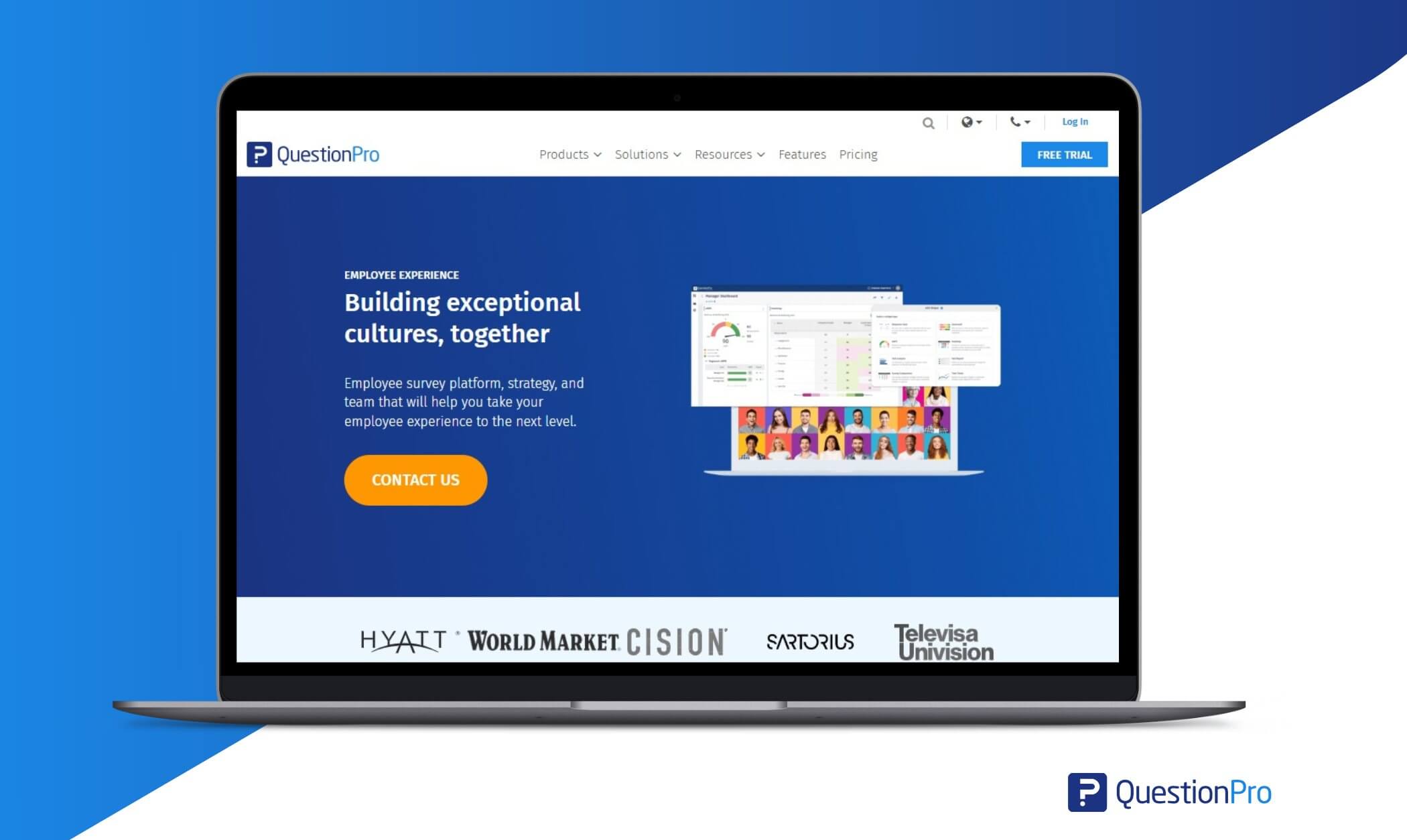
QuestionPro Employee Experience fits teams that need more than standard reviews, including engagement surveys, pulse checks, manager feedback, and leadership development programs through 360 feedback.
Best for: employee listening, survey flexibility, and experience analytics. Teams running multiple pulse survey programs at once may need some setup planning before launch.
2. Culture Amp
Culture Amp combines engagement surveys, performance tools, and people analytics in one platform, making it a common choice for companies that want structured employee listening alongside development tracking.
Smaller teams should check pricing and implementation requirements against their internal HR capacity before committing.
3. Leapsome
Leapsome combines performance reviews, OKRs, engagement surveys, and learning tools in one system, which suits teams that want development and performance managed together.
Teams that only need simple surveys may find the platform broader than necessary for their use case.
4. 15Five
15Five centers on weekly check-ins, manager enablement, and performance routines, which works well for teams trying to build consistent feedback habits between managers and employees.
Companies needing deep survey customization should compare it against more research-focused platforms first.
5. BambooHR
BambooHR pairs HR records, onboarding, and PTO tracking with basic performance tools, making it a common fit for small and mid-sized businesses that want HR operations in one place.
Advanced engagement analytics typically require pairing it with a more specialized listening tool.
6. Betterworks
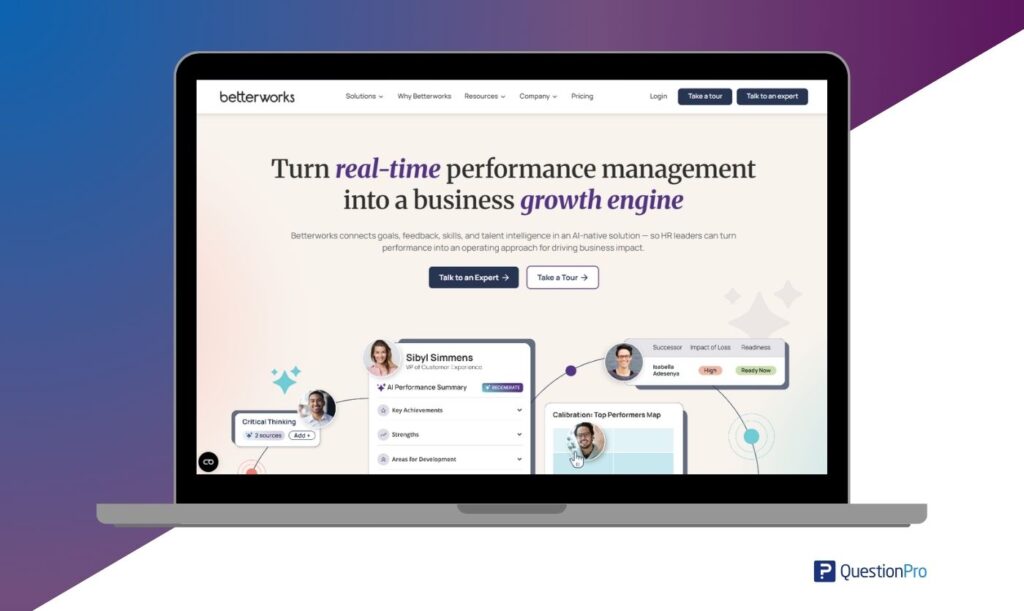
Betterworks focuses on OKRs, goal alignment, and performance conversations, which suits companies trying to keep individual and team goals connected throughout the year.
Compare engagement survey depth carefully, since the platform leans more toward goals than surveys.
7. Engagedly
Engagedly bundles performance reviews, engagement surveys, goals, recognition, and learning into one suite, which can work well for organizations wanting broad coverage in a single system.
The breadth of features means change management and admin planning matter more here than with narrower tools.
8. PerformYard
PerformYard focuses specifically on performance review workflows and goal management, without the weight of a full HR suite.
It is a strong fit for review cycles but not typically the first choice for teams prioritizing broad employee listening.
9. Officevibe
Officevibe centers on lightweight pulse surveys and manager-level insights, suiting teams that want a simple read on morale without building a full performance system.
Teams needing structured calibration or complex review cycles should compare it against performance-first tools.
10. CultureMonkey
CultureMonkey focuses on engagement surveys, anonymous feedback, and sentiment tracking across departments.
Complex performance review workflows are better handled by a performance-first platform compared alongside it.
Which Lattice alternative fits your business?
The best fit depends on which problem sits closest to the surface right now.
- Employee listening is the priority. Compare QuestionPro Employee Experience, Culture Amp, Officevibe, or CultureMonkey.
- Structured reviews are the priority. Compare 15Five, Leapsome, Betterworks, PerformYard, and Engagedly.
- Employee records are the priority. BambooHR is worth a closer look.
- Goal alignment is the priority. Betterworks or Leapsome tends to fit best.
- Needs are mixed across surveys, 360 feedback, and custom programs. A flexible employee engagement survey tool like QuestionPro Employee Experience covers the widest range in one platform.
What questions should you ask before choosing a Lattice competitor?
Before choosing a Lattice competitor, ask questions that reveal real fit rather than just feature availability.
- Can this platform run both engagement surveys and performance reviews?
- Does it support anonymous responses and 360 feedback?
- Can results be filtered by team, location, or manager?
- Does it integrate with our existing HRIS?
- What support is included during rollout, and what costs extra later?
A demo should answer how features work under normal day-to-day pressure, not just confirm that a feature exists on a list. Reading through independent G2 reviews for each shortlisted platform is a useful sanity check before signing a contract.
A tool decision should start with the problem, not the vendor
Performance-first platforms handle reviews and goals well. Engagement-first tools are stronger for surveys and listening. Broader platforms try to cover both, with more setup involved.
The right choice depends on company size, HR maturity, and which gap is causing the most friction today. Defining that gap first makes every demo afterward far more useful.
Frequently Asked Questions (FAQs)
Lattice can work for small teams, but its pricing and feature depth are often built with mid-sized to larger organizations in mind. Smaller teams sometimes find better value in lighter, survey-first or check-in-focused alternatives.
Yes, though it adds administrative overhead. Some companies pair an HRIS like BambooHR for records with a separate engagement or 360 feedback tool, while others prefer a single platform that covers both to reduce data fragmentation.
Implementation timelines vary by company size and data complexity, but most mid-sized organizations should plan for four to eight weeks to migrate data, configure workflows, and train managers on a new system.
No. 360 feedback depth varies significantly across these tools. QuestionPro Employee Experience, Culture Amp, and Leapsome offer more built-out 360 feedback options, while tools like Officevibe focus more narrowly on pulse surveys.
Start by listing the two or three workflows causing the most pain today, then compare pricing only among tools that clearly solve those specific problems, rather than comparing sticker price across tools built for different use cases.