A performance review process only works if it feels like an honest conversation instead of a form both sides are relieved to finish. Most employees have sat through a review that felt rushed, vague, or disconnected from the work they actually did that year, and the data backs up that frustration.
Only 14% of US employees strongly agree that their performance reviews inspire them to improve, according to Gallup.
That gap between intent and impact is fixable. This guide walks through what a performance review process actually includes, how it differs from ongoing performance management, and the specific steps managers can take to make reviews something employees find useful rather than dreaded.
What is a performance review process?
A performance review process is the structured cycle an organization uses to formally evaluate an employee’s work, set goals for the period ahead, and identify where coaching or development is needed. It typically runs on a set cadence, annual, quarterly, or monthly, and is conducted by a manager or supervisor.
This is different from performance management, which is the ongoing, day-to-day set of practices that keep individual and team goals aligned with the business. Think of performance management as the continuous thread and the performance review as a formal checkpoint stitched into it. A company can run frequent one-on-ones all year and still hold a single annual review that ties everything together.
Reviews typically cover a few consistent areas: a look back at goals and results, an assessment of strengths and growth areas, and a forward-looking conversation about career development and next steps.
Why the performance review process matters
Skeptics of formal reviews have a point, but the process still serves real purposes when it’s done well. Reviews give employees structured feedback they can act on, provide a fair basis for pay and promotion decisions, and create a paper trail that protects both the employee and the company when disputes arise.
The trouble is execution, not the concept itself. Gartner research found that 95% of managers report being unhappy with their organization’s performance management system, and a majority of employees say traditional reviews have little effect on how they actually perform, based on figures compiled by Gartner via myshortlister.com.
That disconnect is exactly why more companies are shifting the review process toward more frequent, lighter-touch check-ins instead of a single high-stakes annual event.
Types of performance reviews and how often to run them
Different review cadences suit different kinds of work, and many companies now combine more than one type rather than relying on a single annual cycle.
| Review type | Best fit |
|---|---|
| Weekly or biweekly | Fast-moving projects that need frequent course correction |
| Monthly | New hires, contractors, and short-term project teams |
| Quarterly | Teams working against quarterly business goals and budgets |
| Annual | Compensation and promotion decisions, paired with more frequent check-ins |
Most annual-only review systems are being phased out or supplemented, since a full year is too long for an employee to go without structured feedback.
The four-phase performance review cycle
Regardless of cadence, most performance review processes move through the same four phases.
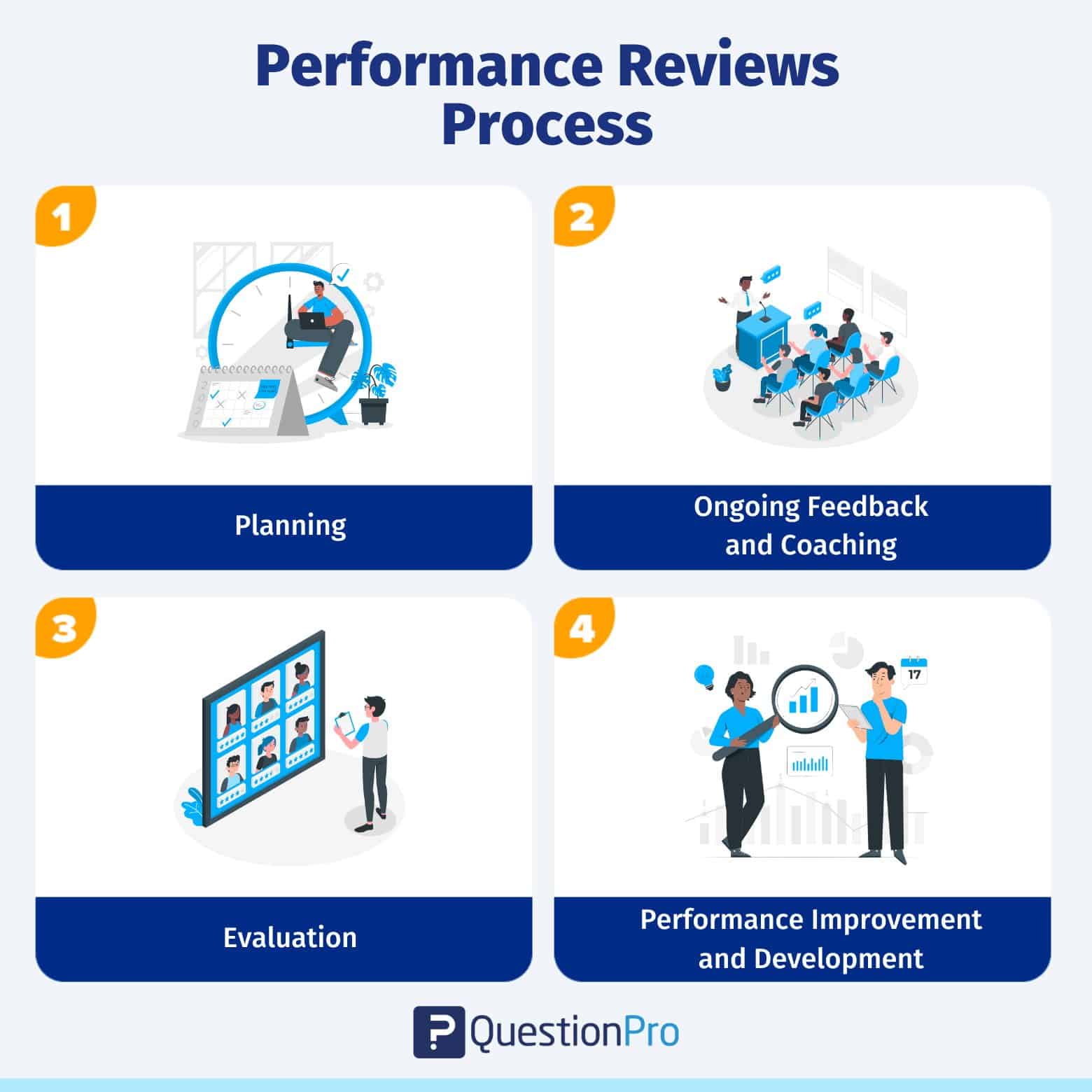
1. Planning
This phase sets the goals and expectations the rest of the cycle will measure against. Effective planning includes reviewing the employee’s job description together, setting SMART goals (specific, measurable, achievable, relevant, and time-bound), and building a short action plan for how those goals get met.
2. Ongoing feedback and coaching
Between formal reviews, managers check in regularly, offer coaching, and document progress so nothing at the final review comes as a surprise. This phase is where most of the actual performance improvement happens, not in the review meeting itself.
3. Evaluation
At the end of the cycle, the manager assesses results against the goals set in phase one, meets with the employee to discuss the outcome, and identifies clear strengths and areas for growth.
4. Performance improvement and development
The final phase turns the evaluation into a forward-looking plan, whether that means additional training, adjusted goals for the next cycle, or a formal performance improvement plan if results fell short.
How to write a performance review that actually helps
The difference between a review employees dread and one they find useful usually comes down to specificity and balance, not length.
- Start with clear expectations.
A review only feels fair if the employee already knew what they were being measured against. - Be specific, not general.
Replace “needs to communicate better” with a concrete example of a missed handoff and what better would have looked like. - Use objective criteria.
Lean on measurable outcomes and documented behaviors rather than impressions formed in the last few weeks before the review. - Focus on results and impact.
Tie feedback back to what the work actually affected, not just effort or attitude. - Balance positive and constructive feedback.
Reviews that are all praise or all criticism both fail to give employees an accurate picture. - End with forward-looking goals.
Employees should leave the conversation knowing exactly what success looks like next.
Performance review example: Turning vague feedback into something usable
A vague review comment like “Sometimes misses deadlines, needs to improve time management” gives an employee almost nothing to work with. A more useful version names the specific pattern: “Two of the last four sprint deliverables were submitted after the agreed deadline, both tied to the client onboarding project. Let’s set a plan for flagging risk earlier in that workflow.”
The second version does three things the first doesn’t. This specific feedback cites a verifiable pattern tied to a real project. It also proposes concrete next steps instead of leaving employees to guess.
Continuous feedback vs. the traditional annual review
Momentum has shifted clearly toward continuous feedback models over the strictly annual format. Frequent feedback helps companies catch performance issues early. This prevents small problems from escalating into costly annual surprises.
A pulse review approach, short and frequent rather than long and rare, gives managers a running record to draw on when the formal review comes around, so nothing said in that meeting is a surprise to either side. This also reduces the recency bias that skews so many annual reviews toward whatever happened in the last few weeks.
Common mistakes that undermine the review process
A handful of avoidable habits explain most of the frustration employees report with performance reviews.
- Waiting until the review to deliver feedback that should have been shared months earlier
- Letting recency bias dominate, where only the last few weeks shape the entire evaluation
- Writing feedback so general it could apply to almost any employee
- Skipping the forward-looking goal-setting portion entirely
- Treating the review as a one-way lecture instead of a two-way conversation
Where a survey platform fits into the review process
Gathering structured input from peers, not just a single manager’s perspective, gives a more complete picture of someone’s performance.
A 360 feedback process run through QuestionPro Employee Experience lets HR teams collect that input consistently across the company instead of relying on informal hallway conversations, and pairs naturally with an employee engagement survey cadence a company already runs.
A good review process builds trust over time, not in one meeting
No single review, however well written, fixes a performance conversation that has been avoided all year. Successful organizations treat formal review meetings as summaries of an ongoing dialogue. Feedback is exchanged continuously rather than saved for a single event.
Employees feel far less stressed when performance feedback is shared continuously throughout the year. As a result, the review meeting becomes significantly more useful for everyone involved.
Frequently Asked Questions (FAQs)
Most effective review meetings run between 30 and 60 minutes, long enough to cover results, feedback, and goal setting without rushing. Shorter check-ins throughout the year mean the formal review doesn’t need to cram in a full year of unaddressed feedback.
Employees should review their own goals from the last cycle, note specific accomplishments with measurable outcomes, and come with questions about growth opportunities. Self-assessment before the meeting also helps surface any gap between how the employee and manager see the same work.
Yes, when possible. Peer and cross-functional feedback, often gathered through a 360-degree process, catches patterns a single manager might miss, especially for employees who collaborate heavily across teams.
A performance improvement plan is a formal, time-bound document outlining specific gaps and required improvements, typically used when a review reveals a pattern of underperformance. It should include clear milestones and check-in dates, not just a list of problems.
They make the annual review shorter and less contentious, since most of the substantive feedback has already been delivered and discussed throughout the year. The annual meeting becomes more of a formal summary and compensation conversation than the primary venue for feedback.