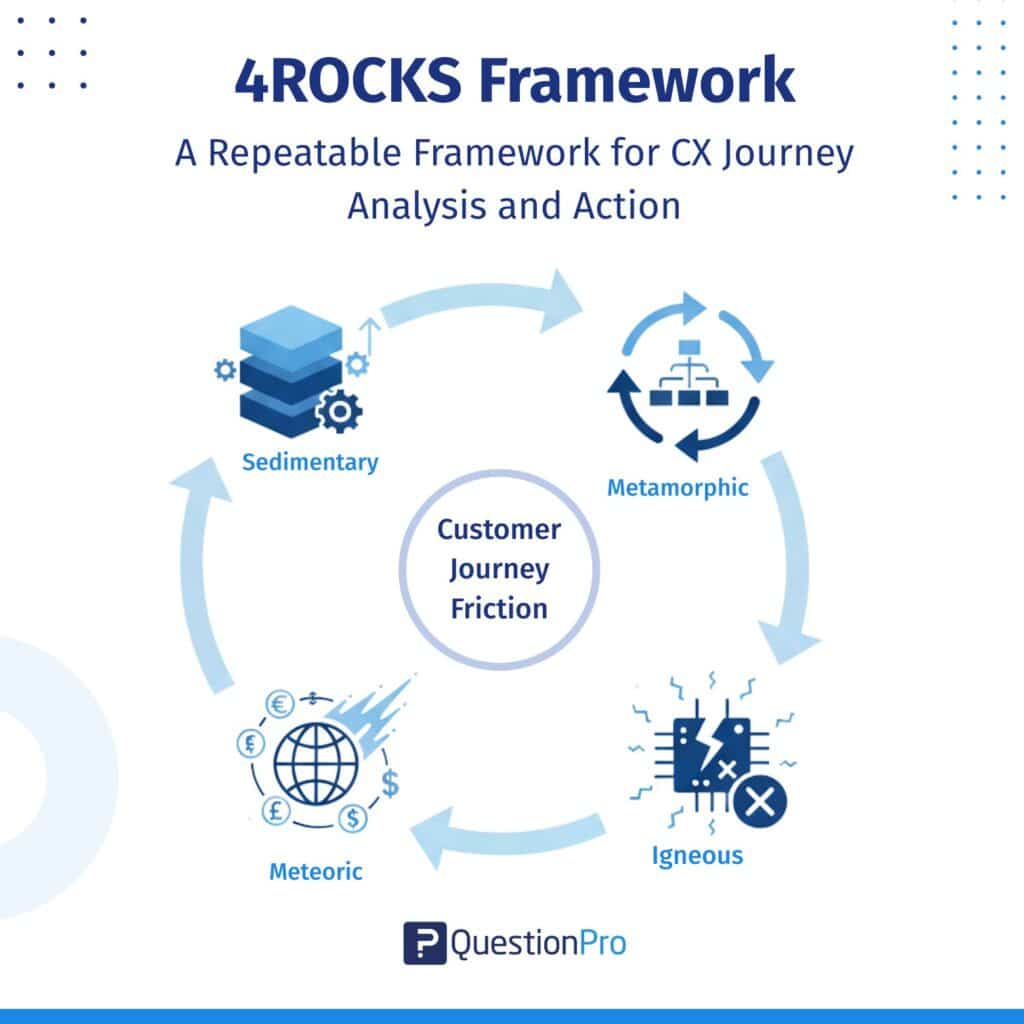
The 4ROCKS framework is a diagnostic model that sorts customer friction into four root causes: sedimentary, metamorphic, igneous, and meteoric rocks. Customer experience leader Sean Albertson created it to show teams why a journey breaks down, not only where.
A journey map shows what customers go through. It rarely shows the old policies, reorganizations, and system failures that make the trip hard.
In this blog, we’ll walk through each rock, show how to apply the framework, and explain how to measure progress.
You can’t fix what you can’t see. The 4ROCKS reveal the hidden obstacles that quietly erode your customer experience.
Sean Albertson
Sean Albertson has more than two decades of experience leading customer experience work. He details the model in his book, 4ROCKS: Reduce Effort, Drive Loyalty, Transform the Customer Journey. He now serves as Vice President, Customer Journey Management at QuestionPro.
The model rests on a river metaphor. A smooth journey is a river, and rocks are the obstacles that make customers slow down, detour, or turn back.
What is the 4ROCKS framework?
The 4ROCKS framework is a customer experience diagnostic that classifies each source of friction by its origin. It borrows four rock types from geology to name those origins:
- Sedimentary rocks: Friction that built up over time.
- Metamorphic rocks: Friction caused by internal change.
- Igneous rocks: Friction triggered by an internal failure.
- Meteoric rocks: Friction imposed from outside the company.
Why customer friction costs you loyalty
Customer friction is any obstacle that forces customers to spend more effort than they expected to get something done. It matters because effort predicts loyalty better than delight does.
Gartner research covering almost 100,000 consumers found that 96 percent of customers with a high-effort service experience became more disloyal. Only 9 percent of customers with a low-effort experience did.
Journeys are also harder to see than they used to be. Chatbots, messaging apps, voice assistants, and self-service portals send customers back and forth between digital and human channels. A modern customer journey is rarely a straight line, and customers still expect continuity at every switch.
Three early warning signs show friction is building:
- Customers contact you repeatedly about the same issue.
- Customers repeat their story at every handoff.
- Complaints rise in one segment or one journey step.
What are the four rocks?
Each rock names a different origin of friction. The origin matters because it decides who owns the fix and how quickly the fix can happen.
Sedimentary rocks: Friction from layers of legacy complexity
Sedimentary rocks are layers of separation and complexity that build up over years, such as outdated policies, siloed technology, and legacy workflows. They come from decisions nobody revisited.
A telecom company shows how this plays out. Billing, technical support, and sales sit in separate teams with separate goals, so a customer gets transferred and explains the problem again each time.
Common signs include:
- Approval steps nobody can explain.
- Customers bounced between departments.
- Staff who say “that is how we have always done it.”
Metamorphic rocks: Friction from internal change
Metamorphic rocks form under pressure from change inside the organization, such as reorganizations, shifting strategies, and new leadership mandates. Teams are still adjusting, so customers meet inconsistent answers and mixed messages.
A merger is a classic case. Product offerings, pricing, or support processes change, and customers cannot tell who to call or what still applies to them. The friction fades only when teams align on one story and one process.
Igneous rocks: Friction from internal eruptions
Igneous rocks are sudden internal eruptions, such as system outages, broken processes, and failed technology rollouts. They create chaos for employees and customers at the same time.
These rocks often appear when systems go unmaintained, fail under peak load, or when reactive fixes replace planning. A server outage or security breach at a software company is a typical example. A new ticketing system that goes live without training or customer testing is another.
Typical triggers include:
- A system outage or data incident.
- A launch that skipped testing or training.
- A process that breaks at peak volume.
Meteoric rocks: Friction from outside forces
Meteoric rocks are external, unexpected forces that land on the customer experience, such as market shifts, global events, competitor moves, and regulatory change. You cannot control the impact, but you can design journeys that bend instead of break.
The COVID-19 pandemic is the clearest example. Companies that quickly adapted their operations, service, and delivery models kept more customer trust. One caution applies: teams that blame every problem on the meteor are often hiding a sedimentary rock underneath.
Four questions to name the rock
Use these questions in a workshop to tag a pain point quickly:
- Sedimentary: Did we add this step years ago and never review it?
- Metamorphic: Did this start after a reorganization or a strategy shift?
- Igneous: Did something break, or did something launch badly?
- Meteoric: Did something outside the company change the rules?
How is 4ROCKS different from other friction models?
Most friction models sort problems by where they happen. The 4ROCKS framework sorts them by why they happen, which is the part a static map leaves out. That is one reason many teams pair mapping with journey management, where teams track, own, and update their maps.
| Approach | What it answers | Example output | What 4ROCKS adds |
|---|---|---|---|
| Friction point lists by stage | Where friction happens | “Checkout takes too many steps” | The reason: a legacy policy or a failed launch |
| Friction type models (emotional, cognitive, interaction) | What kind of effort customers feel | “Navigation feels confusing” | The internal origin behind that effort |
| Customer effort score | How hard a step felt | “Effort rose after the spring update” | What drove the rise |
| Journey map | What customers go through | Touchpoints and emotions | A root-cause tag on each pain point |
| Root cause analysis such as the 5 Whys | Why one incident happened | A cause chain for a single defect | Shared categories across many incidents |
Step-by-step guide to using the 4ROCKS framework to reduce customer effort
You can start with a workshop and a whiteboard. A journey platform helps later, but it is not a prerequisite.
- Pick one journey and one segment.
Choose a journey with visible pain, such as post-sale support for enterprise accounts. - Collect evidence from four sources.
Use customer feedback from survey software, operational metrics, text analytics, and journey analytics. Text analytics finds themes in comments, tickets, and chat transcripts. Journey analytics stitches data from many touchpoints into one view. - List every pain point on the journey.
If you already have a map, apply the rocks to it. If you do not, build one in the workshop. - Tag each pain point with its rock.
Use the four questions above. Tag the root cause, not the symptom. - Invite every department that touches the journey.
Each team sees the journey differently, and the rocks are where those views meet. - Assign an owner and a date to each rock.
A rock without an owner returns. - Fix, then re-measure.
Compare the same signals before and after each change.
How to decide which rocks to clear first
Not every rock deserves the first fix. Teams tend to chase the highest-volume complaints because they cut cost fastest. That instinct can miss smaller issues that drive churn.
A bank shows the trap. Basic account questions generate the most calls, so self-service for them looks like the obvious win. Yet a small group with fraud or disputed transactions may be far more likely to leave. They may also tell others.
Score each rock on four factors
Rate each rock from 1 to 5 on these factors:
- Customer effort: How hard the step is, based on effort scores or interviews.
- Revenue at risk: The value of the customers who hit the rock.
- Frequency: How often customers hit it.
- Fix effort: The time, cost, and number of teams needed to fix it.
Then use a simple rule: add the first three scores and divide by the fourth. The highest result goes first. A low-frequency rock that hits top-tier accounts can outrank a frequent but minor one.
Match the response to the rock
| Rock | Best-fit response | Usual owner | Can you control it? |
|---|---|---|---|
| Sedimentary | Simplify, merge, or retire the step | Operations and policy owners | Yes, but slowly |
| Metamorphic | Align teams, explain changes, retrain staff | Change leaders and department heads | Yes, with coordination |
| Igneous | Stabilize the system, add monitoring, plan a backup path | IT, product, and service operations | Yes, quickly once found |
| Meteoric | Build flexibility and communicate clearly | Executive and CX leadership | No, but you can reduce the impact |
Real-world examples of 4ROCKS in action
Two examples show the framework at work. They involve different rocks and different teams.
A technology firm clears post-sale support friction
A U.S.-based multinational technology firm saw complaints spike around post-sale support, according to this 4ROCKS case study. Interviews with 11 enterprise customers revealed long waits, repeated handoffs, and confusing escalation paths.
The team found three rocks. Outdated approval policies were sedimentary. Shifting roles after a reorganization were metamorphic. A ticketing system launched without training was igneous. The team streamlined approvals, trained staff, and clarified escalation. Results arrived within 30 days:
- Average response time fell from 22 days to 4.
- Average handle time dropped from 12 minutes 42 seconds to just over 9 minutes.
- Complaints fell, especially among top-tier accounts.
A financial services email mix-up
A financial services provider saw effort scores, unresolved issues, and handle times spike for one low-volume transaction type. Surveys, operational metrics, and text analytics pointed to the same cause.
Marketing had moved an email campaign up by two days. The link inside was not live yet, so customers hit a broken process. In 4ROCKS terms, this is an igneous rock: a sudden internal break. Because teams shared one view of the journey, the web and marketing teams fixed it within days instead of months.
How to measure whether you are clearing the rocks
Measure friction before you fix it, then measure again after each fix. Without a baseline, you cannot show that clearing a rock mattered. Customer effort score (CES) is a survey metric that asks customers how easy it was to complete a task, and it is the natural anchor.
| Signal | What it shows | Most useful for |
|---|---|---|
| CES by journey step | How hard each step feels | All rocks |
| Average response or resolution time | Delay caused by handoffs | Sedimentary and metamorphic rocks |
| Average handle time (AHT) | How long each service interaction takes | Sedimentary and igneous rocks |
| Repeat contacts and handoffs per case | Whether customers repeat themselves | Sedimentary and metamorphic rocks |
| Complaint volume tagged by rock | Which rock type generates the most pain | All rocks |
| Churn or renewal in the affected segment | Revenue impact of the rock | All rocks |
Review monthly while fixes are underway. Compare each signal against its own baseline, not against another team’s numbers.
Common mistakes when using the 4ROCKS framework
Most failures come from treating the framework as a labeling exercise. These are the patterns to avoid:
- Treating the label as the fix: Tagging a pain point does not remove it. Every tag needs an owner and a date.
- Blaming meteoric rocks for internal problems: External shocks expose weak spots. If recovery is slow, look for sedimentary rocks underneath.
- Counting only high-volume issues: Low-volume problems can carry the highest churn risk.
- Working inside one department: Rocks cross silos, so a single team will misdiagnose them.
- Removing deliberate friction: Identity checks and fraud controls add effort on purpose. Mark them as intentional and make them as light as possible.
- Stopping at the workshop: Journey maps that never lead to action become decoration.
How QuestionPro helps teams manage rocks on the journey
The framework works on a whiteboard, but rocks return when nobody tracks them. A journey management platform keeps the map, the evidence, and the owners in one place.
QuestionPro Customer Experience includes a journey management platform where teams map touchpoints, emotions, pains and gains, opportunities, owners, and deliverables. Teams can record the rock beside each pain point, so the shared journey shows both the friction and its origin.
Three capabilities matter most for rock work:
- Owners on the map: Each pain point and opportunity can carry a named owner.
- KPIs inside journey phases: Net Promoter Score (NPS), customer satisfaction score (CSAT), CES, sentiment scores, and operational KPIs can sit in any phase, so teams see a rock’s numbers move after a fix.
- Shared notes: Colleagues can add notes and commentary, which helps departments agree on the diagnosis.
Naming the rock is half the work
Friction hides behind symptoms. Long waits, repeated explanations, and confusing handoffs look like service problems. They usually trace to a policy, a reorganization, a failed launch, or a shift outside the building.
The 4ROCKS framework gives teams a shared vocabulary for that diagnosis. Once everyone can name the rock, the argument moves from who is to blame to who owns the fix.
Ready to Spot the Friction?
Whether your biggest challenge is legacy process, internal change, system breakdowns, or external disruption, the 4ROCKS framework will help you see the problem more clearly—and act on it more effectively.
Frequently Asked Questions (FAQs)
Yes. Run a one-hour session with people from sales, support, and operations, list the top ten customer complaints, and tag each with a rock. A whiteboard or spreadsheet is enough. You need no special software.
Yes. A system outage (igneous) often traces back to years of deferred maintenance (sedimentary). Tag the root cause as the primary rock and note the secondary one, so the fix addresses both the trigger and the underlying layer.
Review monthly while fixes are underway, then quarterly once things stabilize. Also run a fresh review after any reorganization, merger, major system launch, or regulatory change, because each one tends to create new rocks.
Yes. New federal or state rules are meteoric rocks, while compliance steps that outlived the rule are sedimentary. Mark required controls as intentional friction, then simplify how customers complete them without weakening compliance.
Sean Albertson explains the model in his book, 4ROCKS: Reduce Effort, Drive Loyalty, Transform the Customer Journey. He also walks through the methodology, with a financial services example, in a Social Media Examiner feature on frictionless client service.