Launching a marketing campaign without testing is a risk. The budget gets spent before you know if the idea works. Pre-launch surveys for marketing campaigns can help you to test ideas early, gather real feedback, and make informed improvements before your campaign goes live.
When planning a campaign, it is common to rely on internal opinions, past results, or assumptions. This survey helps replace those assumptions with direct input from your audience.
By validating your idea before launch, you reduce uncertainty. You see how people understand your message, how they react to your creative, and whether the campaign creates interest or action. This helps you move forward with clarity and confidence.
In this blog, we will explore when to use pre-launch surveys for marketing campaigns, what to test, validate, and how to apply the feedback to improve them.
What is a pre-launch survey?
A pre-launch survey is a short questionnaire used to test marketing ideas before launch. It shows how the intended audience reacts to the message and the concept.
The survey helps determine whether the message is clear, the idea is appealing, and the direction feels relevant to real needs.
Pre-launch surveys are a type of product survey. They depend on well-written questions that align with the campaign goal and the product category. When questions are clear and focused, the feedback is easier to interpret and act on.
These surveys are commonly used early in campaign planning. They help understand audience perceptions, identify risks, and identify areas for improvement.
Why use pre-launch surveys to validate marketing campaigns
A pre-launch survey is designed to test ideas before they reach the market. When applied to marketing campaigns, it helps you understand how your audience reacts before you invest time and budget. Instead of relying on internal assumptions, you collect early feedback from the people you want to reach.
- Reduce risk before launch
One of the main goals of a survey testing before campaign launch is to reduce uncertainty. For marketing campaigns, this means identifying weak messages or concepts early, when changes are still easy and cost-effective. - Check whether the message is understood
Pre-launch surveys allow you to see how people interpret your campaign without guidance. If the message is unclear or misunderstood, the survey reveals this before the campaign goes live.
- Use audience feedback to support decisions
Those campaign validation surveys replace opinions with real responses. When teams use audience feedback to compare ideas, decisions become clearer and less subjective. - Improve campaign performance early
A pre-launch survey allows you to fine-tune messaging, visuals, and value statements before launch. Small adjustments based on early feedback can lead to stronger engagement once the campaign is live.
Pre-launch campaign validation surveys work by showing campaign ideas to a target audience and measuring clarity, relevance, and intent before launch.
Also learn: How to use surveys to test marketing campaigns
When to use pre-launch surveys for marketing campaigns
Pre-launch surveys work best when you use them early in the campaign planning process. At this point, ideas are still flexible, so it is easier to make changes based on feedback without redoing work or increasing costs.
- When shaping new campaign messaging
If you are developing a new message or value statement, a pre-launch survey helps you validate whether it is clear and meaningful. You can check how people interpret the message in their own words and see if it aligns with what you intend to communicate. - When comparing multiple creative concepts
When you have more than one idea, surveys allow you to test them side by side. You can see which concept feels more appealing, credible, or relevant to your audience before choosing where to invest. - When launching a new product or feature
A pre-launch survey helps you understand early reactions to something new. You can identify interest levels, expectations, and potential concerns that may influence adoption after launch. - When targeting a new audience segment
If you are reaching a different group than usual, a marketing concept testing survey helps confirm that your tone, message, and offer fit that audience. This reduces the risk of using language or positioning that does not resonate. - When entering a new market
Pre-launch surveys help you validate assumptions about local preferences and message clarity. They highlight where wording, examples, or creative elements may need adjustment before launch.
Using survey testing before campaign launch at these moments makes feedback easier to act on and less expensive to apply. This is why they are a practical extension of any marketing concept testing surveys strategy focused on reducing risk and improving outcomes before launch.
Learn about: 50 Product testing survey questions, examples, and tips
How pre-launch surveys help validate campaign ideas
Before your campaign goes live, pre-launch surveys let you test how the idea performs at first contact. Instead of relying on internal reviews, you observe real reactions and identify where the campaign succeeds or falls short.
Pre-launch surveys can help you validate campaign ideas by showing how people respond across several key areas.
- Message takeaway
Can people explain what the campaign is about after seeing it once, without any guidance? - Attention focus
Which elements stand out naturally and which are overlooked? This helps you strengthen headlines, visuals, or calls to action. - Perceived relevance
Does the idea feel useful and meant for the audience you want to reach, or does it feel generic or misplaced? - Trust and credibility
Does the message feel believable and aligned with expectations, or does it raise doubts? - Emotional response
What do people feel when they see the campaign: interest, curiosity, confusion, or indifference? - Intent to engage
How likely are they to click, sign up, or learn more based on what they have seen?
Each of these signals plays a role in validation. When several of them point in the same direction, you gain confidence in your campaign idea. When they do not, pre-launch surveys help you see where changes are needed.
By reviewing these signals together, you can close the gap between what you intend to communicate and what your audience actually experiences, while there is still time to refine the campaign before launch.
What to test in pre-launch surveys
Pre-launch surveys work best when you focus on a few key signals rather than testing everything at once. Each area below helps you understand how your campaign idea is received before launch.
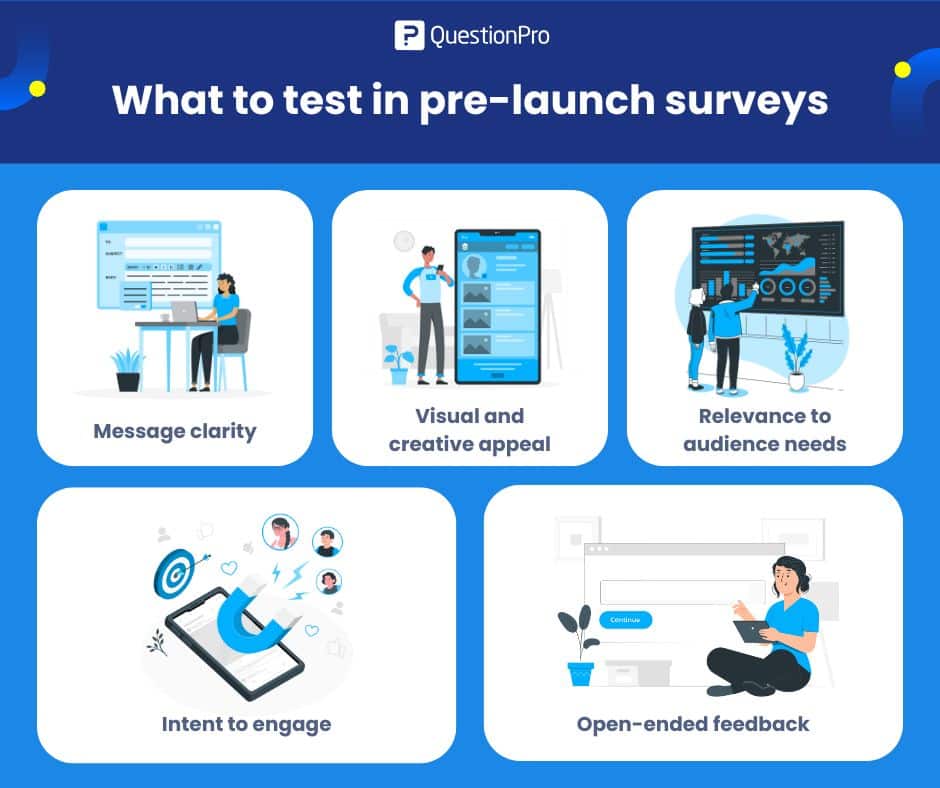
Message clarity
Message clarity is the first thing to test. A campaign should be easy to understand within seconds. If people struggle to explain what the campaign is about, the message likely needs to be simplified.
Clear messages reduce confusion and improve recall. Pre-launch surveys help reveal whether your wording communicates the intended idea without additional explanation. In your survey, you can ask questions such as:
- What do you think this campaign is about?
- What message stands out most to you?
- Is anything confusing or unclear?
- How would you explain this campaign to someone else?
Visual and creative appeal
Visual elements should support the message, not compete with it. Pre-launch surveys can help determine whether visuals feel appropriate, consistent, and easy to connect to the core idea.
Strong creative assets guide attention and reinforce meaning. Weak visuals can distract or send mixed signals. To evaluate visual and creative appeal, you can include questions like:
- How appealing do you find the visuals?
- Do the visuals match the message?
- What grabs your attention first?
Relevance to audience needs
Relevance shows whether a campaign feels meaningful to the people it is meant for. Even a clear message and strong visuals will fall short if the audience does not see how the campaign connects to their situation.
Pre-launch surveys help check if the campaign aligns with real needs, interests, or priorities. When relevance is low, it often points to issues with targeting, positioning, or the value being offered.
To assess relevance, you can ask:
- How relevant does this campaign feel to you?
- Does it speak to your needs or interests?
- Does the offer feel useful?
- Would this campaign matter to you right now?
Intent to engage
Intent questions show whether the campaign creates enough interest to prompt action. While intent does not guarantee behavior, it helps compare different concepts before launch. Lower intent scores can indicate unclear value or weak motivation.
You can measure intent to engage by asking:
- How likely are you to click or learn more?
- How likely are you to take the next step?
Learn more: What is concept testing, methods & examples
Open-ended feedback
Open-ended feedback gives respondents space to explain their thoughts in their own words. This type of input often reveals insights that structured questions cannot capture, such as emotional reactions, personal interpretations, or small points of confusion.
These responses help uncover details that influence how a campaign is perceived. They are especially useful for refining tone, wording, and overall direction before launch.
Open-ended feedback helps answer questions like what feels right, what feels off, and what is missing. In your survey, you can ask:
- What is one thing you would change or improve?
Learn about: What are open-ended questions, examples & advantages
Turning feedback into campaign improvements
Collecting responses is only useful if you turn them into clear actions. Once your pre-launch survey is complete, focus on patterns across the data rather than individual opinions. When multiple respondents point out similar issues, those signals deserve attention.
Start by grouping feedback into themes such as message clarity, relevance, creative appeal, and intent to engage. This makes it easier to see where your campaign is working and where it needs refinement.
Pre-launch survey feedback can guide improvements in several areas:
- Refine the main message
If people interpret the campaign differently than intended, simplify the message or emphasize the most important takeaway. Small wording changes can significantly improve understanding.
- Adjust visuals and tone
Feedback may reveal that visuals feel distracting, unclear, or mismatched with the message. Adjusting imagery, layout, or tone can help the campaign feel more consistent and engaging.
- Improve the call to action
If the intent to engage is low, the call to action may not be clear or compelling enough. So, clarify what the next step is and why it matters to the audience. - Select the strongest concept
When testing multiple ideas, compare results across clarity, relevance, and intent. Choose the concept that performs consistently well rather than one that excels in only one area.
How QuestionPro helps you create pre-launch surveys for marketing campaigns
QuestionPro helps you design, launch, and analyze pre-launch surveys for marketing campaigns in a simple and structured way. Instead of relying on assumptions, you can collect targeted feedback to inform better campaign decisions before launch.
Build focused surveys quickly
QuestionPro allows you to create short, goal-driven surveys without unnecessary complexity. You can choose from multiple question types, such as rating scales, multiple-choice, and open-ended questions, to test message clarity, relevance, and intent to engage. This keeps your survey aligned with what you want to validate.
Create surveys with QuestionPro AI
With QuestionPro AI, you can generate survey questions faster and with more structure. By describing your campaign idea or goal, the AI helps suggest relevant questions that align with validation needs, such as message clarity, relevance, and engagement. This reduces setup time and ensures your survey stays focused and easy to analyze.
Reach the right audience
Validating a campaign works best when feedback comes from the right people. QuestionPro supports multiple distribution methods, including email, survey links, panels, and embedded surveys, so you can reach your target audience efficiently.
Compare ideas and concepts easily
When testing multiple campaign ideas, QuestionPro helps you structure surveys to compare concepts or split them across audience groups. This makes it easier to see which message or creative direction performs better across key signals.
Collect both structured feedback and open insights
QuestionPro lets you combine quantitative data with qualitative feedback. Rating questions highlight trends, while open-ended responses explain the reasons behind those scores. Together, they provide a clear picture of how your campaign is perceived.
Turn results into clear next steps
QuestionPro’s reporting and dashboards help you identify patterns quickly. You can identify areas for improvement, prioritize changes, and decide which campaign idea is ready to move forward.
By using QuestionPro for pre-launch surveys, you move from assumptions to evidence. You validate marketing campaign ideas early, refine them with real feedback, and launch with greater confidence.
Conclusion
Marketing campaigns work better when they are tested before they are launched. Pre-launch surveys give you a clear way to check ideas early, using real feedback instead of assumptions.
They help you understand how people interpret your message, how they react to your creative, and whether the campaign feels relevant and worth engaging with. More importantly, they show you where things are unclear or missing while changes are still easy to make.
By using survey testing before campaign launch at the right moments, you reduce risk, save budget, and improve results. You move forward with ideas that have already been shaped by your audience, not just internal opinions.
With tools like QuestionPro, running these surveys becomes simple and structured. You can test smarter, adjust faster, and launch campaigns with more clarity and confidence.
In the end, pre-launch surveys are not about slowing you down. This survey assists you in launching a stronger campaign from the start.
Frequently Asked Questions (FAQs)
Answer: A pre-launch survey for marketing campaigns is a short survey used to test campaign ideas before launch. It helps you understand how your audience reacts to the message, visuals, and offer, so you can improve the campaign early.
Answer: You should run a pre-launch survey during the planning phase, before finalizing creative assets or spending the budget. This gives you enough time to act on feedback without having to rework completed campaigns.
Answer: A pre-launch survey should be short and focused. In most cases, 5 to 10 questions are enough to test clarity, relevance, and intent without causing survey fatigue.
Answer: Yes. Pre-launch surveys work for both B2B and B2C campaigns. The key is adjusting the language, examples, and audience selection to match your market.
Answer: QuestionPro offers templates, advanced question types, logic, distribution options, and AI tools to design, send, and analyze pre-launch surveys in one place.