TCXT is a section of our blog where our Director of QuestionPro Customer Experience reflects and shares his thoughts on everyday moments and their relationship to customer experience. Ken Peterson shares his thoughts on how everyday moments shape customer experience. Read on to discover his perspective.
Want to hear Ken Peterson’s thoughts directly? Watch the video summary here:
I recently had an experience with my favored grocery store that did not sit well with me. I arrived around 15 minutes before the deli was scheduled to close so I could fulfill a request for some fried chicken.
As I arrived, the person at the deli counter was speaking with a customer – this conversation went on for – 15 minutes. At which point he turned to me and stated that the deli was now closed and he could no longer take an order – even for the chicken they were about to throw out. Knowing that I had shown up late in the shift (I used to work in retail) and despite the circumstances, I accepted that I should have been there earlier and went on my way to find an alternative for dinner.
As I made my way back to the front of the store, I passed by the deli and – to my dismay – there was the same employee that rejected me helping someone else to the very same product I had asked about and was told it was unavailable. What changed? I asked and I was told that this customer had requested the rest of the chicken. Why was it allowed for him and not for me? I was unable to get a response except “well now we are closed” and was waved off with his hand.
Considering everything that happened, I wanted to provide feedback. I made my purchases and looked for the survey on the receipt. I could not find it where it normally was, so I checked my account to see if it showed up there. No again. Certainly the website would have something – once more I was thwarted in my attempt to give feedback. Sometimes customers want to give feedback, brands should not shut down avenues of communication between the customer and the company.
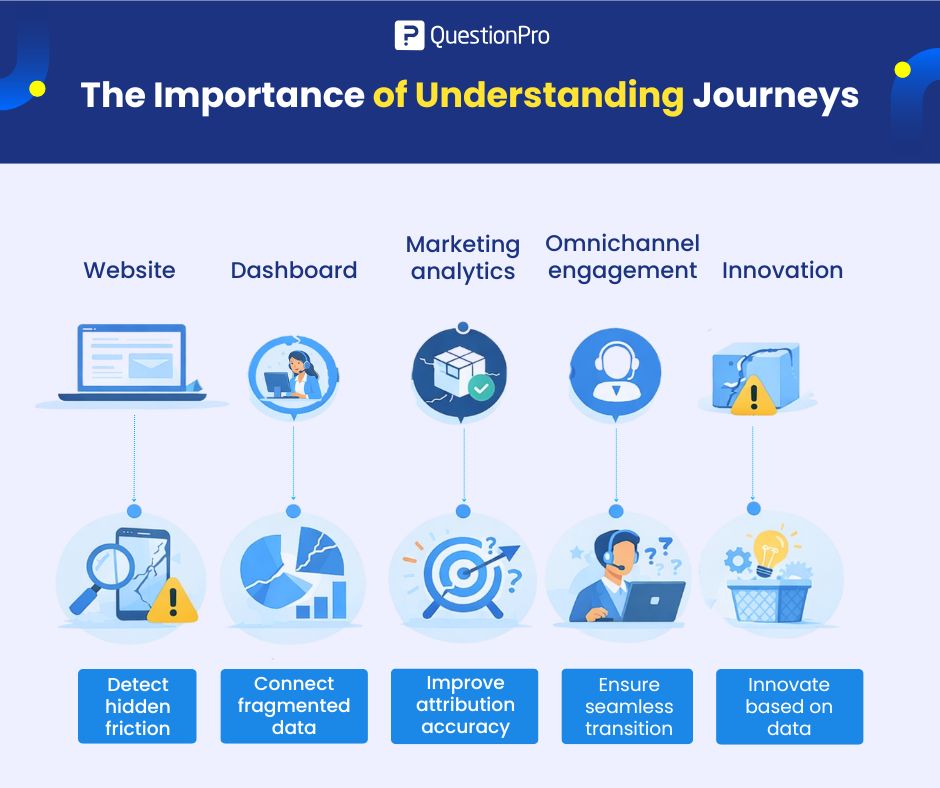
The Importance of Understanding Journeys
The customer journey has often been described as a map showing the path from awareness to purchase. These maps have many touchpoints – what we could describe in cartography as “intersections”. Some of these touchpoints are self-service, some our full-service and some are managed outside the control of the brand.
Like in a real-world map, knowing which intersections have “potholes” is important. Without measuring every touchpoint, it’s more like a map with “Here be your destination” scrawled over vast, unmeasured touchpoints. In the discipline of Customer Journey Management (CJM), the decision to leave a touchpoint unmonitored isn’t just a minor oversight—it is a strategic blind spot that can destabilize the entire brand experience. There are dangers when there are measurement gaps:
1. The “Silent Killer”: Friction in the Shadows
The most immediate danger of an unmeasured touchpoint is unidentified friction in customer touchpoints. Every interaction a customer has—whether it’s reading a privacy policy, navigating a physical store aisle, or receiving a post-purchase email—carries a cognitive load. If you don’t measure the effort required at these stages, you cannot optimize them.
A customer might struggle for ten minutes with a poorly designed “forgot password” flow. To the business, this looks like a momentary dip in active users; to the customer, it’s an infuriating barrier that can end their relationship with the brand. If it is not measured, the friction is invisible to those responsible for fixing the process. It is a reason surveys like website intercepts are important – it is an unmonitored channel.
2. The Fragmentation of the Truth
Customer Journey Management relies on a “Single Source of Truth.” When certain touchpoints are left off the dashboard, the data becomes skewed.
There are false positives: You might see high conversion rates on your website (a measured touchpoint) and simply assume that everything is working just fine. The reality can be quite different: perhaps the unmeasured “unboxing” experience is so poor that while people are buying, they are never coming back. Without holistic measurement, you risk optimizing the wrong things.
You might pour millions into a checkout flow that is already efficient while ignoring a customer service queue that is creating decreased future lifetime value.
3. The Death of Attribution and ROI
Marketing and customer experience departments are constantly under pressure to prove their worth. If you aren’t measuring a specific touchpoint – say for example, an offline event – you cannot accurately attribute success. This can lead to misallocations of resources.
If an unmonitored touchpoint is actually the primary driver of brand affinity, but you can’t prove it, that touchpoint is the first to be cut during budget reviews. You end up killing the very thing that makes your brand special simply because you didn’t have the metrics to defend it.
4. Erosion of Customer Trust
In the modern economy, customers expect a seamless transition between channels – an “omnichannel promise.” A gap exists when a touchpoint isn’t measured. The data from that interaction doesn’t follow the customer to the next touchpoint.
Imagine a customer complains on social media (unmeasured) and then calls a support agent (measured). If the agent has no record of the social media frustration, the customer has to repeat themselves. This lack of continuity shatters the illusion of a personalized relationship with customers.
5. Wasted Innovation
Innovation requires a baseline. To improve a process, you must first know how it is performing today. When a touchpoint is unmeasured, any innovation or improvement processes applied to its understanding of the innovation is essentially guesswork.
Companies might spend months revamping customer self-checkout without ever realizing that the real issue was not the user experience with the machines, but the configuration of the bagging area. This can happen simply because they were not measuring the right performance indicators (KPIs) for that specific touchpoint.
The solution to this is creating a holistic framework – organizations must shift from measuring “silos” to measuring “flows.” This involves:
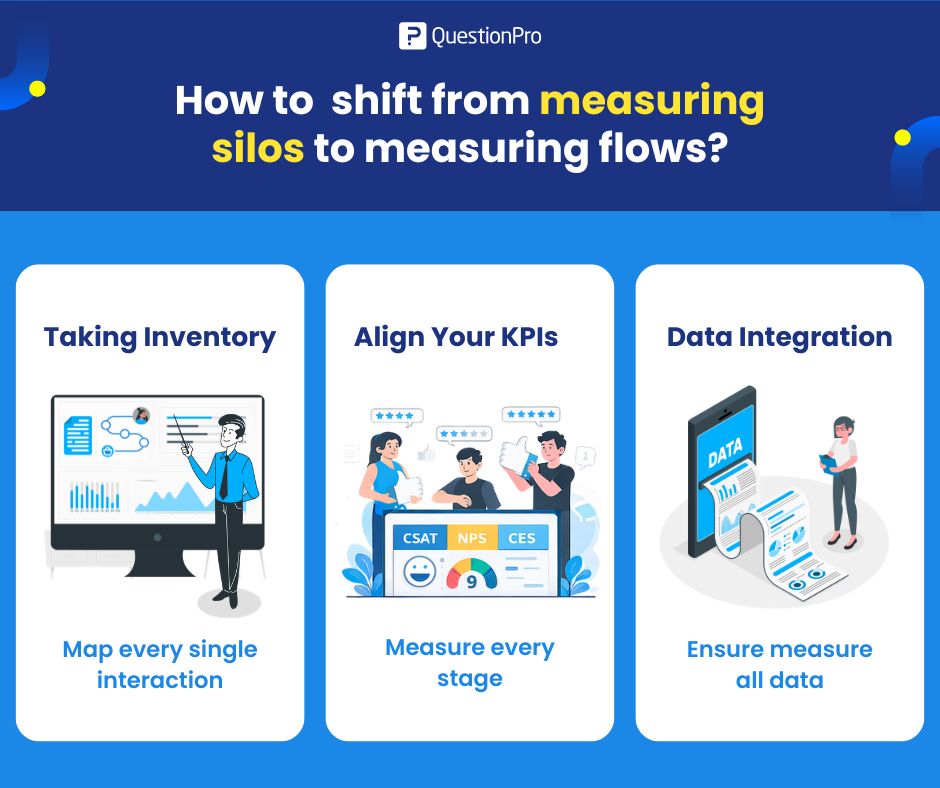
- Taking Inventory: Map every single interaction, no matter how small it seems.
- Align Your KPIs: Assign at least one metric (CSAT, NPS, Customer Effort Score) to every stage. It does not have to be from surveys, you can also measure operational metrics such as latency or page drop-out rates.
- Data Integration: Ensure you measure the unmeasured. They might include using QuestionPro CX Reputation to listen to social media or analyzing chat transcripts.
The Cost of Ignorance
In Customer Experience and Customer Journey Management, what you don’t know will hurt you. An unmeasured touchpoint is a leak in your bucket. You can keep pouring in more leads and more marketing spend, but until you identify and measure the holes, your growth will always be capped.
Measuring the full journey isn’t about micromanagement; it’s about understanding and respecting the customers’ time and effort. QuestionPro Customer Journey Management supports that by shedding light on every touchpoint, so you transform a series of disconnected events into a coherent, high-performing narrative that drives long-term loyalty which is visible to the entire organization.
If you would like to learn more about how we guide experiences through Customer Journey Management or using AI guardrails in CX, please do not hesitate to reach out to me and schedule time. I’m always excited to talk about the future.
Measure the experience you are delivering to your customers
Understanding customer satisfaction levels and their perception is essential to evaluating the impact of our efforts across every aspect of our business. Our main goal remains the same: providing a great experience.
If you’re also interested in gaining deeper insights into your customer base, QuestionPro Customer Experience offers the necessary tools to help you achieve this. Schedule a demo now—we’ll be happy to guide you through the platform and learn about the challenges in reaching your goals.