If you work with data, you’ve likely run into the question of primary vs secondary research. The distinction matters more than most teams expect. It affects cost, speed, and how confident you can be in your decisions.
Primary research gives you new information that you collect on your own. Secondary research uses information that other people have already published. When you combine both, you get a stronger picture of your audience and the market around you.
In the US, where competition moves fast and customer expectations shift quickly, choosing the wrong approach can mean acting on outdated or irrelevant insights.
In this blog, we’ll explore the difference clearly, based on how research actually works in practice.
What is primary research, and how does it work?
Primary research is the process of collecting original data directly from people or environments.
You gather information that has not been published or analyzed before. Since you create the questions and choose the audience, the primary research data fits your exact goal.
In the USA, companies often conduct primary research to test new products before national rollout, especially in competitive industries.
Common primary research methods:
- Surveys
- Interviews
- Focus groups
- Usability testing
- Field observations
These are examples of data collection methods designed to answer a specific question.
A retail brand in California runs a customer satisfaction survey after launching a new checkout experience. That data did not exist before. It is created for that exact purpose.
When you look at how organizations apply primary research, a few consistent advantages stand out:
- You control the questions
- You get current data
- You can target specific audiences
This is the foundation of strong market research, especially when decisions depend on precise customer feedback.
What is secondary research, and how does it work?
Secondary research uses existing data collected by others.
Instead of gathering new data yourself, you review reports, articles, studies, databases, and other existing sources. This helps you understand market trends, audience behavior, and background context without starting from scratch.
Researchers use secondary research when they need quick, low-cost insights or to support their primary research with broader information.
Common secondary research sources:
- Government datasets (e.g., US Census Bureau)
- Industry reports
- Academic studies
- Company internal data
- Public databases
For example, the US Census Bureau provides free demographic data widely used in research.
A startup analyzes US population trends using census data before entering a new market. They did not collect the data themselves.
Looking at how businesses apply secondary research in practice, a few clear advantages explain why it is widely used:
- It is fast
- It is cost-effective
- It helps build context before deeper research
Secondary research is often the first step in understanding a market before investing in more targeted data collection.
What is the difference between primary and secondary research?
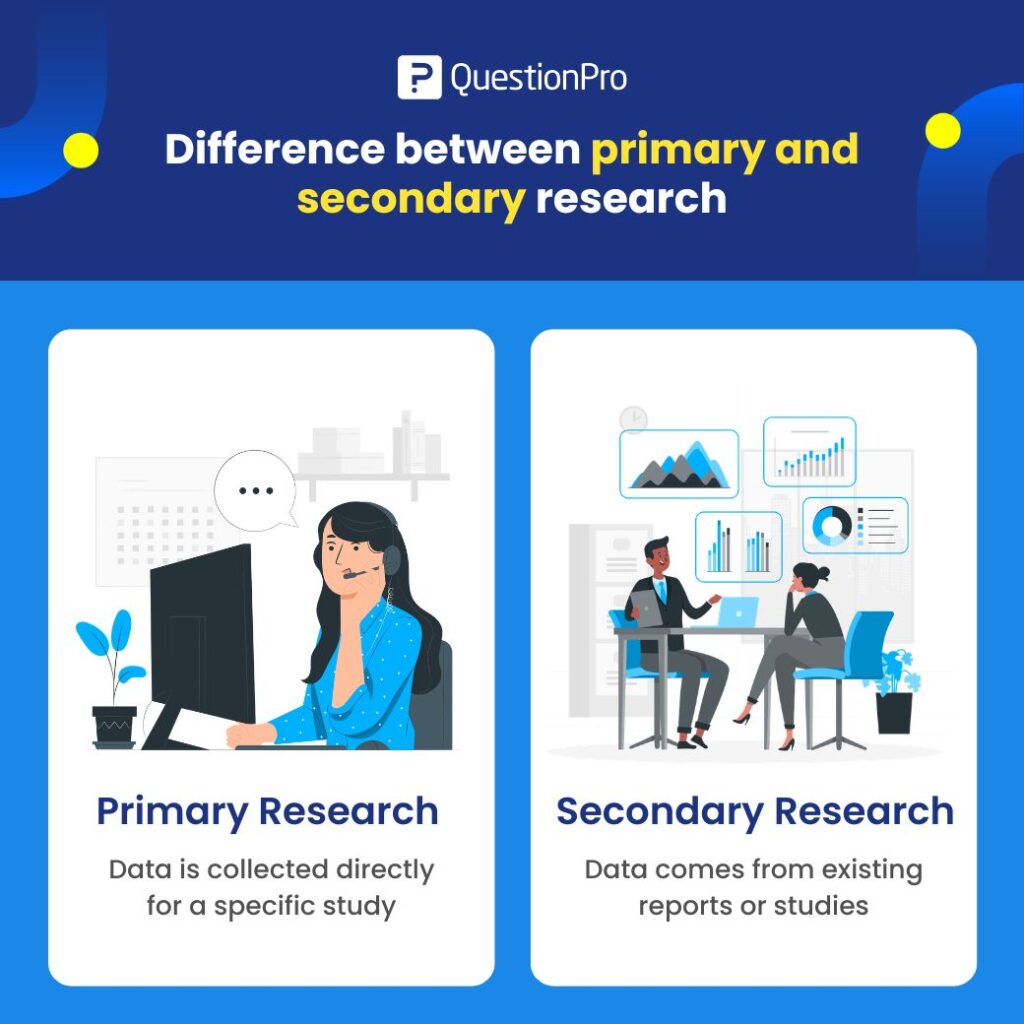
The difference between primary and secondary research comes down to control, cost, and purpose. Each approach serves a different role depending on what you need to learn and how quickly you need it.
Instead of choosing one over the other, it helps to understand how they compare across key factors like data ownership, time investment, and how closely the insights match your specific research question.
| Aspect | Primary Research | Secondary Research |
| Source of data | Data is collected directly from respondents or environments for a specific study | Data is sourced from existing reports, databases, or studies created by others |
| Cost | Typically higher due to survey tools, incentives, and fieldwork expenses | Usually lower since the data is already available, often free or purchased once |
| Time | Takes longer to design, collect, and analyze data | Faster to access and use since the data has already been compiled |
| Relevance | Highly specific to your research objective and target audience | May be more general and not fully aligned with your exact research needs |
| Control | Full control over methodology, questions, and sample selection | Limited control over how the data was originally collected and structured |
In practice, most experienced companies use both together to balance speed, cost, and accuracy.
When should you use primary research?
Use primary research when you need answers that do not already exist.
It is the right choice when you need specific, direct answers. It helps you understand real opinions, behaviors, and needs from your own audience.
In practice, companies rely on primary research in situations where direct input is critical to decision-making, such as:
- Testing a new product or feature
- Measuring customer satisfaction
- Understanding user behavior
- Validating assumptions before a launch
In US product teams, primary research is often used right before major releases. It reduces risk because decisions rely on direct feedback, not assumptions.
Get the full story: Methods for Measuring Customer Satisfaction
When should you use secondary research?
Use secondary research when you need context, trends, or background information quickly.
It is best when you are at an early stage. It helps you understand what is already known before collecting new data.
In real-world use, businesses turn to secondary research when they need a quick overview or baseline understanding, including:
- Market sizing
- Competitor analysis
- Industry benchmarking
- Early-stage research
Before running surveys, many US companies review industry reports to understand baseline expectations. This prevents asking obvious or redundant questions.
Pros and cons of primary vs secondary research
Both primary and secondary research have their strengths and weaknesses. Understanding them helps you choose the right approach for your goal and avoid relying on the wrong type of data.
Primary research
Primary research gives you first-hand information. You collect the data yourself, so it fits your exact question and audience.
When teams evaluate primary research, they usually focus on the benefits that come from having full control over the data:
Pros:
- Highly relevant: Data is collected specifically for your research goal
- Up-to-date: Reflects current opinions, behaviors, and market conditions
- Customizable: You design the questions, audience, and methodology
At the same time, there are practical limitations that teams need to consider before starting:
Cons:
- Expensive: Costs include tools, incentives, and resources
- Time-consuming: Planning, collecting, and analyzing data takes time
- Requires expertise: Poor design can lead to unreliable results
Secondary research
Secondary research relies on data that already exists. Instead of collecting new information, you analyze sources that have been created by others.
Businesses often choose secondary research because it helps them move quickly and build context without heavy investment.
When looking at its advantages, a few clear benefits explain why it is widely used:
Pros:
- Affordable: Many sources are free or cheaper than running new studies
- Fast access: Data is available immediately, with no collection phase
- Broad coverage: Covers large populations, industries, or time periods
However, relying on existing data also comes with trade-offs that can affect accuracy:
Cons:
- May be outdated: Data might not reflect current market conditions
- Less specific: Not tailored to your exact research question
- Quality varies: Reliability depends on the original source and methodology
How do primary and secondary research work together?
Strong research strategies rarely rely on just one approach. In real-world projects, especially in the US, businesses combine both to get faster and more reliable insights.
The logic is simple. Secondary research gives you direction. Primary research gives you precision.
Most research projects follow a structured sequence where each step builds on the previous one:
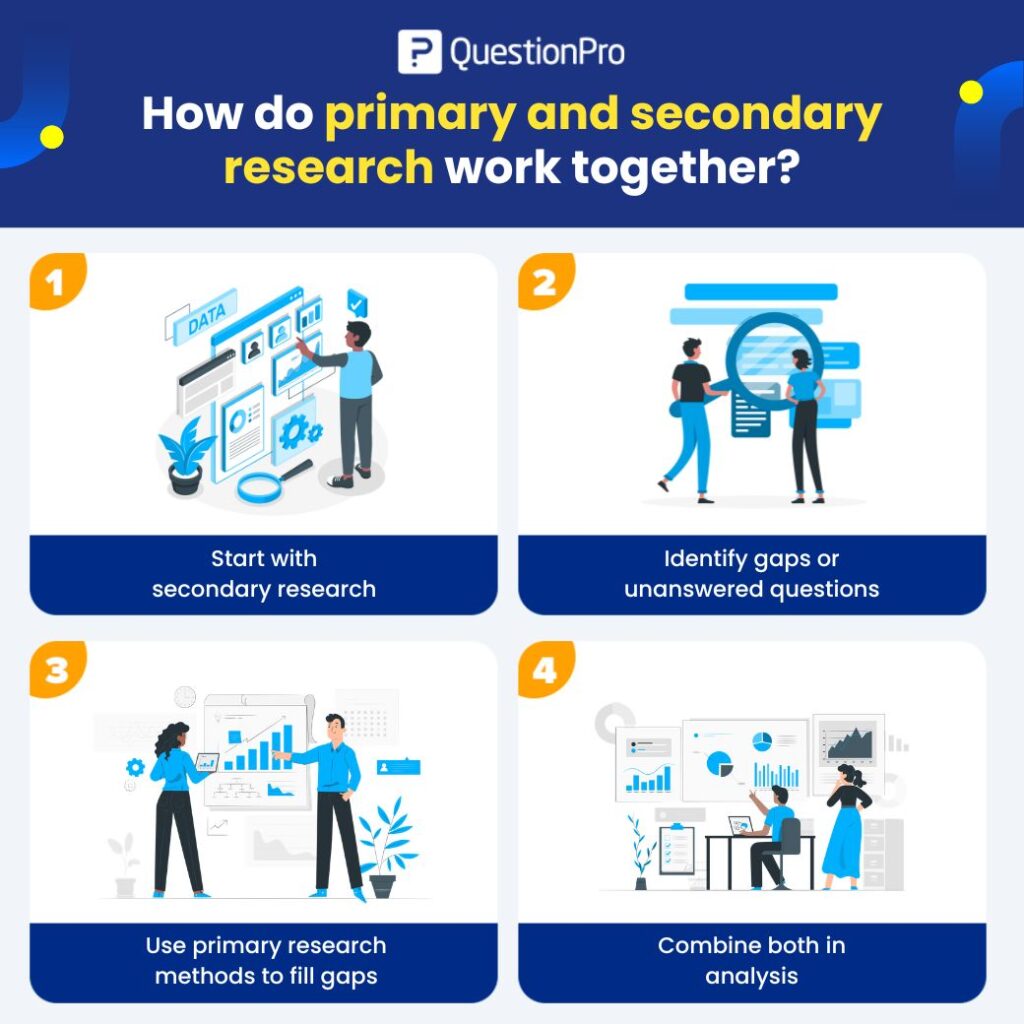
- Start with secondary research to understand the landscape
- Identify gaps or unanswered questions
- Use primary research methods to fill those gaps
- Combine both in analysis
This layered method avoids two common problems. Relying only on secondary data can lead to generic insights. Jumping straight into primary research can waste time and budget on questions that were already answered elsewhere.
By combining both, businesses can improve:
- Accuracy: Insights are validated with real user input
- Efficiency: Less time spent collecting unnecessary data
- Confidence: Decisions are backed by both context and evidence
This is how most US companies approach research. They do not choose between primary and secondary research. They use both, each for what it does best.
Examples of primary and secondary research in marketing
Primary and secondary research work together in most marketing projects. Primary research gives you direct answers from your own audience, while secondary research helps you understand the broader market, trends, and competitors.
Below is a simple, real-world example showing how both types support marketing decisions.
Primary research: Asking customers about a new product idea
A US snack brand plans to launch a new flavor of chips in Texas.
They run an online survey with their target audience and present different flavor options. Respondents rate each flavor, explain their preferences, and share price expectations.
The brand also invites a small group to taste samples and discuss flavor, packaging, and portion size.
What this gives them:
- Clear insight into which flavor performs best
- Specific feedback to improve taste and packaging
- A realistic price range based on customer expectations
Secondary research: Understanding the snack market
Before launching, the same brand reviews industry reports on snack trends. They analyze which flavors are growing, which segments are saturated, and how competitors price similar products.
What this gives them:
- A clear view of overall market growth
- Insight into crowded vs emerging flavor categories
- Directions on how to position the new product
How do both types of research work together
Primary research shapes the product itself. Secondary research shapes how the product is positioned in the market.
Used together, they help teams avoid two risks:
- Launching something customers do not want
- Entering a market without understanding the competition
This is how most US marketing teams approach product launches, combining direct customer feedback with broader market context to make informed decisions.
What are common mistakes when choosing between primary and secondary research?
Choosing between primary and secondary research is not just about preference. It is about timing, context, and how well you understand your objective. In practice, most mistakes happen when teams skip steps or rely too heavily on one approach.
Here are the most common issues:
- Relying only on secondary data: This leads to outdated or generic insights.
- Running primary research too early: Without context, you risk asking the wrong questions.
- Ignoring data quality: Not all secondary research sources are reliable.
- Over-collecting data: More data does not always mean better decisions.
How does QuestionPro support primary and secondary research?
Once you understand how primary and secondary research work together, the next step is execution. Platforms like QuestionPro help businesses manage both types of research within a single workflow, reducing the need to switch between tools or manually combine data.
For primary research
When collecting new data, survey software simplifies the entire process:
- Survey creation: Build targeted surveys with different question types
- Audience targeting: Reach specific segments based on demographics or behavior
- Real-time data collection: Gather responses instantly across web, mobile, and email
- Advanced logic: Use branching and skip logic to personalize surveys
This makes it easier to run structured primary research methods without a heavy setup.
For secondary research
While secondary research relies on existing data, tools still play a role in organizing and analyzing it:
- Data integration: Combine survey results with external datasets
- Dashboards and reporting: Visualize trends from multiple sources
- Segmentation: Compare internal data with broader market benchmarks
- Trend tracking: Monitor changes over time
This helps companies connect internal insights with external context.
Most US-based research teams do not struggle with access to data. They struggle with turning it into something actionable.
Using a single platform for both primary and secondary research helps:
- Reduce manual work and tool switching
- Keep your data consistent across studies
- Move faster from insight to decision
In competitive US markets, speed and clarity are often the difference between reacting and leading. The goal is not just to run research, but to run it in a way that actually drives decisions forward.
Frequently Asked Questions (FAQs)
Primary research involves collecting original data directly from your target audience, while secondary research uses existing data from reports, studies, or databases. The key difference lies in data ownership, specificity, and how the information is collected.
Use primary research when you need specific, up-to-date insights that are not available elsewhere. It is especially useful for testing products, measuring customer satisfaction, or understanding behaviors directly from your target audience.
Secondary research can be reliable if the source is credible, such as government data or established research firms. However, it may lack specificity or be outdated, so it is often used alongside primary research for better accuracy.
Yes, combining both is a common approach. Secondary research provides context and direction, while primary research validates assumptions and fills gaps with specific, real-time data, leading to more informed and balanced decisions.
Secondary research is generally more cost-effective because it uses existing data. Primary research requires more resources, including time, tools, and participants, but provides more targeted and relevant insights for specific business needs.
Primary research includes surveys or interviews conducted with US customers. Secondary research includes analyzing US Census data, industry reports, or academic studies to understand market trends and population insights without collecting new data.