Product feature prioritization is the process product teams use to decide which features to build first, based on customer value, business impact, effort, and risk. Without a clear process, roadmaps fill up with whatever request is loudest instead of the work that actually moves the product forward.
Every sprint brings competing asks from sales, support, leadership, and customers. A defined prioritization process turns that noise into a roadmap the whole team can explain and defend.
This guide breaks down how to prioritize product features, the frameworks worth using in 2026, and the research that makes those decisions easier to justify.
What is product feature prioritization?
Product feature prioritization is the process of ranking feature ideas so a product team knows what to build now, what to delay, and what to drop from the roadmap entirely.
This is a core product management skill, not a one-time exercise. Teams that skip it tend to build whatever gets requested most often, which is not the same as building what matters most.
Product teams typically score features against five criteria:
- Customer value: How much the feature helps users complete a task or solve a problem.
- Business impact: How strongly it supports revenue, retention, or growth goals.
- Technical effort: How much design, engineering, and QA time it needs.
- Risk: How uncertain the outcome is, technically or in terms of adoption.
- Strategic fit: How well it supports where the product is headed.
The goal is not to build every requested feature. The goal is to build the right features in the right order, with a process the team can point to when a request gets pushed down the list.
Product feature vs. feature request vs. backlog item
These three terms get used interchangeably, which causes confusion during planning meetings. Each one describes a different stage of the same idea.
| Term | What it actually means |
|---|---|
| Feature request | A raw ask from a customer, stakeholder, or sales rep, with no validation yet |
| Backlog item | A request that has been logged and described well enough to evaluate |
| Product feature | A scoped, prioritized piece of work that has been approved for a roadmap slot |
A feature request is a signal, not a commitment. It only becomes a backlog item once someone writes down the problem it solves and who is affected. It only becomes a product feature once it has been scored, prioritized, and scheduled.
Why does product feature prioritization matter for product teams
Product feature prioritization matters because engineering time, design time, and QA time are all fixed resources. Every feature chosen means another one waits.
A working prioritization process helps teams:
- Focus on features that solve real, validated customer problems.
- Reduce roadmap arguments that come down to opinion instead of evidence.
- Explain clearly why a request was delayed or declined.
- Keep sales, support, marketing, and leadership pointed at the same priorities.
- Tie roadmap decisions back to measurable outcomes like retention or adoption.
Analyst research backs this up structurally, not just anecdotally. Forrester’s Needs Prioritization Framework was built specifically because product and portfolio teams needed a consistent, evidence-based method for deciding which customer needs to pursue first, rather than relying on whoever argued the loudest in a planning meeting.
For US SaaS, ecommerce, healthcare, and fintech teams competing on release speed, prioritization is often the line between a focused roadmap and a backlog that never stops growing.
How do you prioritize product features step by step
To prioritize product features, a team collects ideas from reliable sources, defines the goal each feature should serve, estimates value against effort, applies a scoring framework, and revisits the roadmap on a regular cadence.
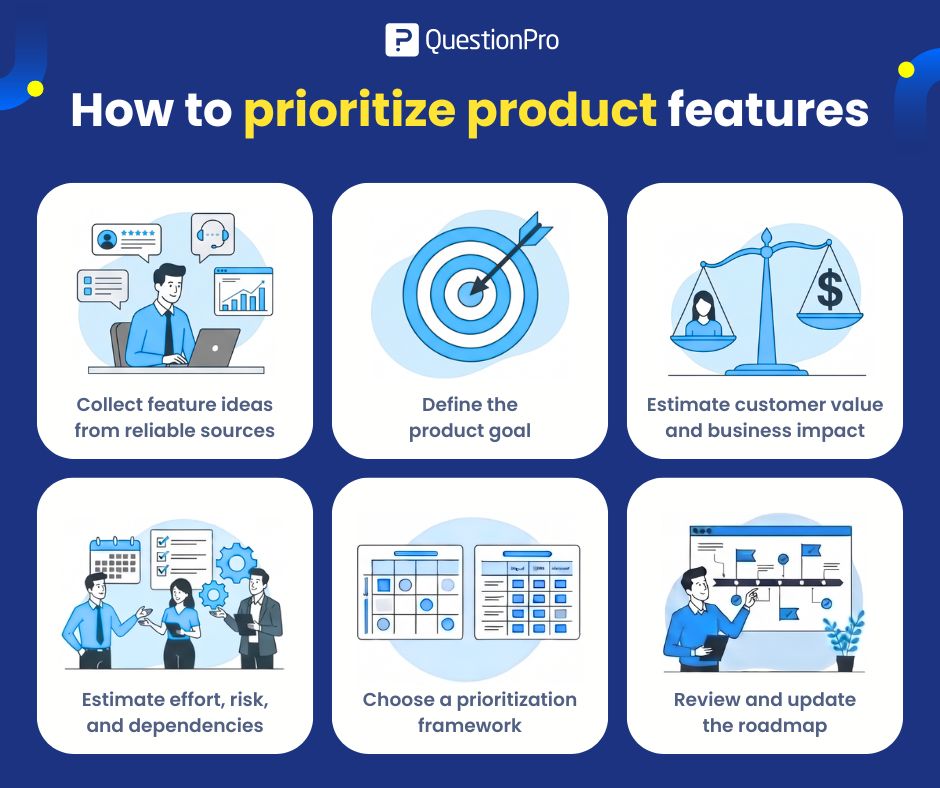
1. Collect feature ideas from reliable sources
Feature ideas should never come from internal brainstorming alone. Strong sources include customer feedback surveys, support tickets, sales calls, product usage data, churn interviews, and usability testing sessions.
A feature request is not proof that a feature should be built. It is a signal that needs more context before it earns a spot on the roadmap.
2. Define the product goal before scoring anything
Before scoring a single feature, decide what outcome the team is actually trying to move. Common goals include increasing adoption, improving retention, reducing churn, improving onboarding, or reducing support volume.
A feature that looks strong for one goal may do nothing for another. A faster signup flow helps conversion; it rarely helps retention on its own.
3. Estimate customer value and business impact
Customer value describes how much a feature helps someone finish a task or avoid a frustration. Business impact describes how much it moves revenue, retention, or market position.
Open-ended follow-up “why” questions, gathered through online survey software, often reveal the actual problem behind a request, which can look very different from the feature someone originally asked for.
4. Estimate effort, risk, and dependencies
Effort covers the work needed from product, design, engineering, QA, data, and sometimes legal or compliance teams. Risk covers uncertainty around technical complexity, adoption, or delivery timeline.
Dependencies are the systems or tasks that must be finished before a feature can ship at all. A small, high-value feature can often ship before a large, strategic one that has more moving parts.
5. Choose a prioritization framework
A framework gives the team shared criteria for comparing features instead of debating them from scratch every time. The right one depends on how complex the decision is and how much evidence exists.
The frameworks section below covers the six most useful options for 2026 roadmaps.
6. Review and update the product roadmap regularly
Prioritization is not a single meeting. Product teams should revisit priorities whenever new customer feedback, usage data, or business goals shift the picture.
A product roadmap should stay stable enough to guide daily work, but flexible enough to change when better evidence shows up.
What are the best feature prioritization frameworks in 2026?
The best feature prioritization frameworks compare features using shared, repeatable criteria such as value, effort, confidence, and urgency. No single framework fits every decision.
| Framework | Best for | Main limitation |
|---|---|---|
| MoSCoW | Release planning and stakeholder alignment | Too many items get labeled “must-have” |
| RICE | Comparing many features with measurable estimates | Needs solid reach and impact data |
| ICE | Fast scoring with limited data | Less precise than RICE |
| Impact vs. effort matrix | Quick visual workshops | Oversimplifies complex or risky features |
| Kano model | Understanding what delights vs. satisfies users | Requires structured customer survey data |
| Weighted scorecard | Custom, team-specific criteria | Needs agreement on scoring weights upfront |
MoSCoW prioritization
MoSCoW sorts features into four buckets: Must-have, Should-have, Could-have, and Won’t-have for this cycle. It works well for release planning because it forces a hard line between essential and optional work.
The common failure mode is labeling too many features “must-have.” Setting strict rules before the planning session starts helps avoid that.
RICE prioritization
RICE scores features by Reach, Impact, Confidence, and Effort, then divides the product of the first three by the last one. Intercom, which created the RICE framework, built it specifically to compare dozens of competing feature ideas with a shared, defensible score instead of gut feel.
RICE works well once a team has real usage or survey data to estimate reach and impact. It falls apart quickly when every input is a guess.
ICE score
ICE is a lighter version of RICE that scores features on Impact, Confidence, and Ease, without factoring in reach. It trades precision for speed.
Early-stage teams and fast-moving startups often start here because it takes minutes to score a feature list, not hours.
Impact vs. effort matrix
This matrix plots features on two axes: how valuable they are and how hard they are to build. High-impact, low-effort features get built first; low-impact, high-effort ones get dropped or delayed.
It works well in workshops because it is visual and fast. It should not carry a major roadmap decision alone, since it skips risk, dependencies, and long-term strategy.
Kano model
The Kano model sorts features into basic expectations, performance features, and delighters, based on how satisfaction changes with investment. A basic expectation, like login working reliably, creates no delight when present but real frustration when missing.
This framework is useful for spotting features that quietly matter more to users than internal teams assume.
Pros and cons of the Kano model
Pros:
- Centers the customer’s actual experience, not internal opinion
- Separates “must exist” features from “nice surprise” features clearly
- Works well alongside customer satisfaction and NPS data
Cons:
- Needs structured survey data to score accurately
- Takes longer to run than a quick impact vs. effort session
- Can be harder to explain to non-research stakeholders
Weighted scorecard
A weighted scorecard lets a team define its own criteria, such as customer value, revenue potential, risk, and compliance need, then assign a weight to each one. Every feature gets scored against the same list.
This method works best when multiple teams need to align on what “priority” actually means before scoring begins.
How do you choose the right feature prioritization method?
Choosing a method depends on the type of decision, how much evidence exists, and how much time the team has for the exercise.
- Use MoSCoW for release planning with multiple stakeholders in the room.
- Use RICE when comparing many ideas with real usage or survey data.
- Use ICE for a fast gut-check on a smaller list.
- Use an impact vs. effort matrix for a quick, visual workshop.
- Use Kano when the goal is understanding what will delight users, not just satisfy them.
- Use a weighted scorecard when several teams need shared, custom criteria.
No framework should run the roadmap alone. It should make the tradeoffs visible so the product manager can apply judgment on top of it, not replace that judgment.
Real examples of feature prioritization in practice
Intercom’s own product team is a well-documented example. Facing a growing backlog with no shared scoring method, they built RICE specifically so product managers across the company could compare unrelated feature ideas on the same scale.
A more everyday example: a mid-market SaaS team notices rising churn among newer accounts. Support tickets and onboarding survey data both point to a confusing setup flow, not the flashy integration sales has been requesting.
Scoring both options against the same retention goal makes the tradeoff visible. The integration might still ship later, but the onboarding fix earns the next sprint because it is tied to a validated, measurable problem.
How can product research support feature prioritization?
Product research supports feature prioritization by showing which problems are frequent, painful, and worth solving, instead of leaving that judgment to whoever spoke up last in a meeting.
Research can help answer:
- Which feature requests come from a pattern of users, not just one loud account?
- Which issues are driving churn or support ticket volume?
- Which workflows are slowing users down without generating complaints?
QuestionPro’s Market Research Software fits naturally into this stage when a team needs to collect, organize, and analyze structured customer feedback before features get scored. The priority decision still belongs to the product team, but connecting feedback to what customers actually value makes that decision easier to defend.
How do you measure whether a prioritized feature succeeded?
A feature isn’t done once it ships. Measuring the outcome closes the loop and tells the team whether the scoring was right.
Useful signals to track after launch include:
- Adoption rate among the segment the feature targeted.
- Change in retention or churn for accounts that used it.
- Support ticket volume for the problem the feature was meant to fix.
- Movement in Net Promoter Score (NPS) among users exposed to the change.
If a feature scored high on paper but none of these signals move, that gap is worth reviewing before the next scoring round. It usually means an estimate, not the framework itself, was off.
What mistakes should product teams avoid?
Product teams should avoid treating feature prioritization as a popularity contest. The loudest request is rarely the highest-value one.
Common mistakes include:
- Scoring features before defining what goal they should serve.
- Treating every stakeholder request as equally urgent.
- Ignoring technical debt and its effect on future effort estimates.
- Copying a competitor’s feature without validating that users need it.
- Using one framework for every type of decision the team faces.
- Adding features to the backlog but never removing stale ones.
A useful gut check: if the team cannot explain who a feature helps and what outcome it supports, it is not ready to be scored yet.
Prioritization is a discipline, not a one-time decision
Product feature prioritization works best when customer evidence, business goals, effort estimates, and strategic judgment all inform the same decision. Frameworks like RICE, MoSCoW, ICE, Kano, and weighted scorecards make tradeoffs visible, but none of them replace the product manager’s judgment.
The point was never to build more features. It was always to build the ones that create real value for customers and the business, in an order the team can explain to anyone who asks.
Frequently Asked Questions (FAQs)
The main goal is choosing which features to build first based on customer value, business impact, effort, and strategic fit. It keeps engineering and design time focused on work most likely to move a specific product outcome forward.
ICE is usually the fastest starting point for a small or early-stage team because it scores features on just three factors: impact, confidence, and ease. It works well before a team has the usage data RICE typically needs.
Yes, particularly for identifying which features quietly frustrate users versus which ones genuinely delight them. It requires structured survey input, so it works best paired with a customer feedback program rather than as a standalone exercise.
US SaaS teams should score compliance-driven features, such as accessibility or data privacy work, on risk and strategic fit rather than raw customer demand. These features rarely generate loud requests but can block enterprise deals or create legal exposure if delayed too long.
Occasionally, yes, particularly for a strategic account at risk of churning or a compliance deadline with a hard date. Those cases should be flagged as exceptions and documented, not used as a reason to skip scoring for every future request.