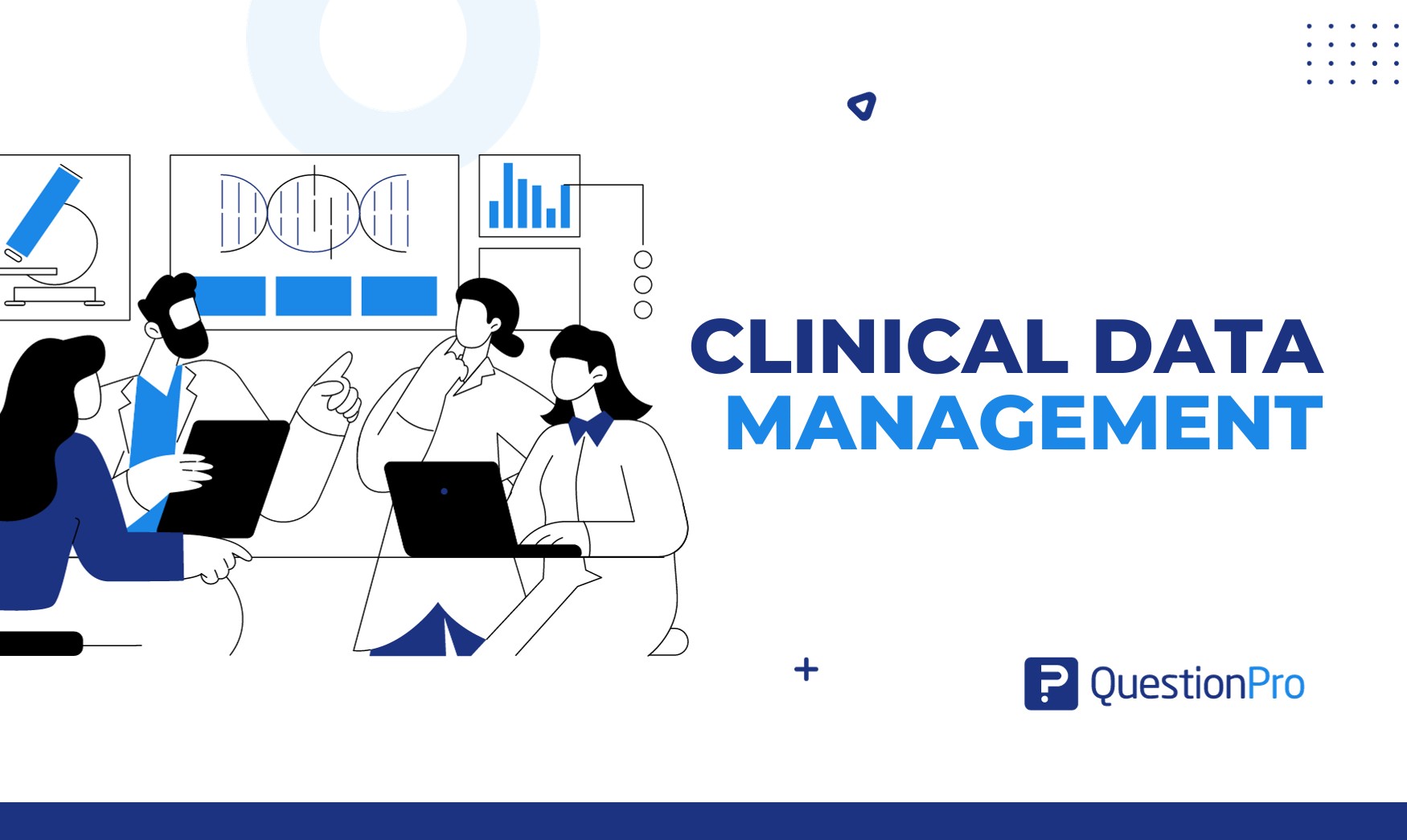
Clinical data management (CDM) is the process of collecting, cleaning, and securing the data a clinical trial produces so it is accurate, complete, and ready for statistical analysis. Every efficacy result and safety signal in a regulatory submission depends on it.
Trials now generate far more data than they did a decade ago. Total data points in phase 3 trials grew from about 929,000 in 2012 to about 3.56 million in 2020.
In this guide, we break down what CDM covers and the stages of the process. We also cover the systems teams use, the rules that govern them, and how to judge data quality.
What is clinical data management?
Clinical data management is the discipline that turns raw trial observations into a reliable, analysis-ready database. It covers planning what to collect, capturing it, cleaning it, coding it, and locking it for analysis.
A clinical data manager usually owns this work. Their goal is simple: the final database must match what happened to participants, and every change must be traceable.
CDM covers five core activities:
- Planning which data the protocol needs
- Capturing it at sites and from devices
- Cleaning it through checks and queries
- Coding it to standard medical dictionaries
- Locking and archiving the final dataset
CDM sits between the clinic and the biostatistician. Sites record what they observe. Data managers make sure those records are complete, consistent, and defensible before anyone runs a single analysis.
How is clinical data management different from EDC, CDMS, and CTMS?
CDM is the work. EDC, CDMS, and CTMS are software that supports parts of it. People often use the terms interchangeably, which causes confusion when teams evaluate vendors.
| Term | What it is | Main job |
|---|---|---|
| CDM | The discipline and process | Produce clean, analysis-ready trial data |
| EDC (electronic data capture) | Software for entering data at sites | Replace paper case report forms |
| CDMS (clinical data management system) | Software that stores and manages trial data | Hold the database, edit checks, and audit trail |
| CTMS (clinical trial management system) | Software for trial operations | Track sites, visits, milestones, and budgets |
| eCRF (electronic case report form) | The digital form a site completes | Capture the data the protocol requires |
Many modern platforms bundle EDC and CDMS together. A CTMS usually stays separate because it manages operations, not patient data.
Why does clinical data management matter?
Trial decisions rest on the data. If the data is wrong, a safe drug can look unsafe, or an unsafe one can look safe.
Good CDM protects three things:
- Participant safety: Adverse events reach reviewers quickly and accurately.
- Regulatory acceptance: Regulators can trace every value back to its source.
- Time and cost: Clean data at entry avoids weeks of rework before database lock.
There is also a focus problem. The same TransCelerate analysis found that about one-third of data points across 105 phase 2 and 3 trials were not needed for key analyses. The study is a preprint and has not been peer reviewed, but it shows why a sharp data plan matters.
Collecting less, and collecting it well, is often the fastest route to cleaner data.
What are the stages of clinical data management?
The CDM process runs from protocol review to archived records. It usually has eight stages, grouped into setup, trial conduct, and closeout.
Setup: Stages 1 to 3
Setup decides how good the data can be. Mistakes here are the most expensive to fix later.
- Protocol review and data management plan (DMP): The DMP is the document that defines what is collected, who handles it, which standards apply, and how quality is checked.
- eCRF design: Teams build forms that match the protocol and follow standards such as CDASH, the CDISC standard for how to collect data.
- Database build and testing: Programmers build the database, add edit checks, and run user acceptance testing with dummy data before the first participant enrolls.
Trial conduct: Stages 4 to 6
During conduct, data flows in daily. The job shifts from building to monitoring.
Sites enter data through EDC, or it arrives automatically from labs, wearables, and electronic health records. Edit checks fire when a value looks wrong, such as a blood pressure reading outside a plausible range. Data managers then raise queries, which are questions sent to the site asking it to confirm or correct a value.
Medical coders also work in this window. They map free-text terms, such as an adverse event written as “bad headache,” to a standard dictionary like MedDRA for events or WHODrug for medications. Reconciliation follows, where data managers compare safety data across systems so the same event looks the same everywhere.
Closeout: Stages 7 and 8
Closeout turns a working database into a final record.
- Final quality review: Teams resolve open queries, check the error rate, and confirm that all coding is complete.
- Database lock: The database is frozen. After this point, changes need a formal, documented process.
- Archiving: The final dataset, audit trail, and trial documents are retained for the period regulators require.
Who does what on a clinical data team?
A CDM team is a small group of specialists, and roles overlap on smaller studies. Knowing the split helps when you plan staffing or write a vendor contract.
| Role | Core responsibility |
|---|---|
| Clinical data manager | Owns the DMP, timelines, and database lock |
| Database programmer | Builds the database, forms, and edit checks |
| Data entry or review associate | Enters or verifies data and tracks queries |
| Medical coder | Codes adverse events, conditions, and medications |
| Quality control associate | Audits samples of data against source records |
| Biostatistician | Defines analysis needs and receives the locked data |
Which clinical data management tools do teams use?
Teams rarely use one tool. They connect several systems, and each handles a different slice of the work. The right stack depends on trial size, data sources, and how much of the work a CRO handles for you.
Core system types
| System | What it does | Example use |
|---|---|---|
| EDC | Captures site data in eCRFs | Nurse enters vital signs at a visit |
| CDMS | Stores data, runs checks, keeps the audit trail | Data manager reviews open queries |
| ePRO/eCOA | Collects patient-reported outcomes on a phone or tablet | Participant logs daily pain scores |
| RTSM/IRT | Handles randomization and drug supply | Assigns a participant to a treatment arm |
| CTMS | Tracks operations | Operations lead monitors site enrollment |
| Medical coding tools | Maps terms to MedDRA and WHODrug | Coder standardizes an adverse event |
Well-known EDC and CDMS platforms include Medidata Rave, Oracle Clinical One, Veeva Vault CDMS, Castor EDC, and OpenClinica. Always check current features and pricing with each vendor, because both change often.
How do you choose a clinical data management system?
Start with the trial, not the vendor demo. A phase 1 study with 40 participants has very different needs from a global phase 3 with 20 countries.
Score each candidate against these criteria:
- Compliance: Does it support 21 CFR Part 11 controls, audit trails, and role-based access?
- Standards support: Can it export in CDISC formats such as SDTM?
- Integrations: Can it pull in lab, wearable, imaging, and ePRO data without manual transfers?
- Build speed: How long does a standard study take to configure and validate?
- Usability for sites: Will busy coordinators enter data correctly with little training?
- Total cost: Include build fees, per-study charges, validation effort, and support.
Ask for a pilot on a real protocol. A demo with sample data hides the friction that appears with your actual forms.
What regulations and standards govern clinical data management?
Regulators oversee CDM because the data supports decisions about human health. In the US, four frameworks come up most.
| Framework | What it requires | Why it matters to CDM |
|---|---|---|
| 21 CFR Part 11 | Sets FDA criteria for trustworthy electronic records and signatures | Drives audit trails, access control, and signature rules |
| ICH E6(R3) GCP | Good Clinical Practice, with a risk-based and proportionate approach | Shapes data governance and system validation |
| HIPAA | Protects identifiable US health information | Guides how sites and sponsors share and store participant data |
| CDISC standards | Common formats such as CDASH and SDTM | Makes data consistent and ready for FDA submission |
The FDA published ICH E6(R3) in September 2025, after ICH adopted it in January 2025. It says source records should be attributable, legible, contemporaneous, original, accurate, and complete. It also states that computerized systems should be fit for purpose, for example through risk-based validation.
Trials with EU participants must also follow GDPR, the European Union’s data protection law.
How do you measure clinical data quality?
You measure data quality with numbers agreed before the trial starts. Vague goals such as “clean enough” do not survive an audit.
The Society for Clinical Data Management (SCDM) describes the error rate as errors found divided by fields inspected, usually expressed per 10,000 fields. The SCDM guidance on measuring data quality notes that:
- A common acceptable level is about 50 errors per 10,000 fields overall.
- Critical variables, such as primary endpoints and serious adverse events, often target 0 to 10 errors per 10,000 fields.
- Teams should review 100% of critical variables.
SCDM stresses that these are not industry-wide standards. Define yours in the DMP.
Track these metrics alongside the error rate:
- Query rate: Queries raised per page or per 100 data points, which flags confusing forms.
- Query resolution time: Days between a query opening and closing.
- Missing data rate: Share of required fields left blank.
- Time to database lock: Days from last participant visit to lock.
How are AI and decentralized trials changing clinical data management?
Two shifts are changing daily CDM work: more data sources and more automation. Both raise the value of a clear data plan.
Decentralized and hybrid trials let participants complete visits from home. That brings wearables, home devices, and ePRO apps into the data flow, and each source needs mapping and validation. Real-time data lets teams spot problems during the trial, not weeks after.
AI tools now support three routine tasks:
- Medical coding: Suggested dictionary terms for free-text entries.
- Automated edit checks: Flags for values that look out of pattern.
- Anomaly detection: Early signals of site-level data problems.
These tools speed up routine work, but a human still reviews the output. Under ICH E6(R3), any system used this way must be fit for purpose and validated in proportion to risk.
What does clinical data management look like in practice?
These three scenarios are illustrative, not reported case studies. They show how CDM decisions play out.
A site enters weight in pounds, not kilograms
A coordinator at a US site types 154 into a field that expects kilograms.
- Catch: An edit check flags the value as implausible.
- Fix: The data manager raises a query, and the site corrects it the same day.
Two systems record the same adverse event differently
The safety database lists “myocardial infarction.” The EDC says “heart attack.”
- Catch: A reconciliation review spots the mismatch.
- Fix: The coder maps both records to the same MedDRA term before the safety report goes out.
A form generates hundreds of queries
A new visit form asks for a date in three different places. Sites enter conflicting dates, and queries pile up.
- Catch: The query rate for that form is far above the others.
- Fix: The team simplifies the form and the rate drops. The fix was a design change, not more cleaning.
What are the most common clinical data management mistakes?
Most CDM problems start before the first participant enrolls. Teams that review these patterns early avoid the costliest ones.
- Collecting data nobody will analyze: Every extra field adds burden for sites and participants.
- Skipping realistic testing: Edit checks that were never tested on messy data miss real errors.
- Weak query discipline: Vague queries confuse sites and slow resolution.
- No source-to-database traceability: Auditors cannot confirm where a value came from.
- Late coding and reconciliation: Leaving these to the end delays database lock.
- Unclear data ownership with CROs: Nobody knows who approves a change.
- Ignoring privacy early: Identifiable data ends up in places it should not be.
Where do survey tools fit into clinical data work?
Survey platforms do not replace a validated EDC for regulated trial data. They fit around it, for the feedback and experience data that surrounds a study.
Teams use survey software in three places around a study:
- Site feasibility: Questionnaires sent before the trial starts.
- Participant experience: Feedback collected after visits.
- Coordinator workload: Short pulse checks on data entry burden.
That evidence can improve forms and visit schedules, which cuts the query problems described above.
QuestionPro’s healthcare solution supports patient, clinician, and staff feedback programs, with security and HIPAA compliance built into the platform. For the collection itself, survey software handles multilingual questionnaires and live response tracking.
Once responses arrive, the same cleaning discipline applies. Guides on data cleansing and data validation cover how to remove duplicates, flag illogical answers, and set checks that catch errors at entry. For repeat follow-ups with the same participants, see this guide to longitudinal data. Teams can then review trends in QuestionPro BI dashboards.
Confirm with your sponsor and compliance team which data may sit outside the validated trial system.
Clean data is a design decision, not a cleanup task
The best clinical data is rarely rescued at the end. It comes from a tight protocol, a short list of fields that matter, forms that sites can fill in correctly, and quality targets written down before the first visit.
CDM rewards teams that plan early and measure honestly. Three habits separate strong programs from weak ones:
- Pick systems that fit the study.
- Define error thresholds in the DMP.
- Treat every query as feedback on form design.
Frequently Asked Questions (FAQs)
A clinical data manager plans how trial data is collected, designs and tests the database, reviews incoming data, manages queries with sites, oversees coding, and leads database lock. They also write the data management plan and keep audit-ready records.
Timelines vary by trial size and data quality. Many teams aim for a few weeks, but outstanding queries, coding, and reconciliation drive the schedule. Cleaning data continuously during the trial is the most reliable way to shorten the gap.
For regulated trials, usually not. Spreadsheets lack validated audit trails, access controls, and electronic signatures that 21 CFR Part 11 expects. Small non-regulated or pilot studies may use them, but a validated EDC is the standard choice for submission data.
The sponsor owns the trial and is ultimately responsible for data integrity. A contract research organization (CRO) may run data management on the sponsor’s behalf. The contract should state who approves database changes and who holds the final dataset.
Core skills include knowledge of Good Clinical Practice, CDISC standards, and data management software, plus strong attention to detail. SQL or SAS familiarity helps. Communication with sites and statisticians matters just as much, because most data problems get solved through clear questions.