TCXT is a section of our blog where our Director of QuestionPro Customer Experience reflects and shares his thoughts on everyday moments and their relationship to customer experience. Ken Peterson shares his thoughts on how everyday moments shape customer experience. Read on to discover his perspective.
Want to hear Ken Peterson’s thoughts directly? Watch the video summary here:
I was speaking with a colleague last week about customer experience budgets and the observation that some companies are even eliminating customer experience roles. In research in 2025 published by Nasdaq, it found that 92% of business leaders view Customer Experience as a top strategy for their organization and nearly as many acknowledge the link to revenue growth. Yet, only 28% feel it is “extremely important” to invest in Customer Experience.
I think this is for two reasons that I had considered even before reading the research. The first, 80% of leaders think they are already meeting the expectations of customers (hint: only 24% of customers agree). The second is that even with increased customer feedback and insights, the investments are not delivering returns:
- 43% feel their Customer Experience spend is not realizing return-on-investment
- 53% of leaders admit that insights are not used properly due to staff & training gaps
- 55% point to unclear Customer Experience metrics
Source
In the world of Customer Experience, there is a persistent trap that many organizations fall into: the “Insight Loop.” Companies spend millions on sophisticated surveys, implementation of programs, tracking the Net Promoter Score tracking, and sentiment analysis, only to let that data sit in a dashboard like a trophy on a shelf.
The reality is that customers don’t give feedback because they want to be studied, analyzed, segmented and ranked. Customers give feedback because they want things to change. However, without ACTION and ACCOUNTABILITY, even the most advanced Voice of the Customer program with all the features is nothing more than expensive lip service.
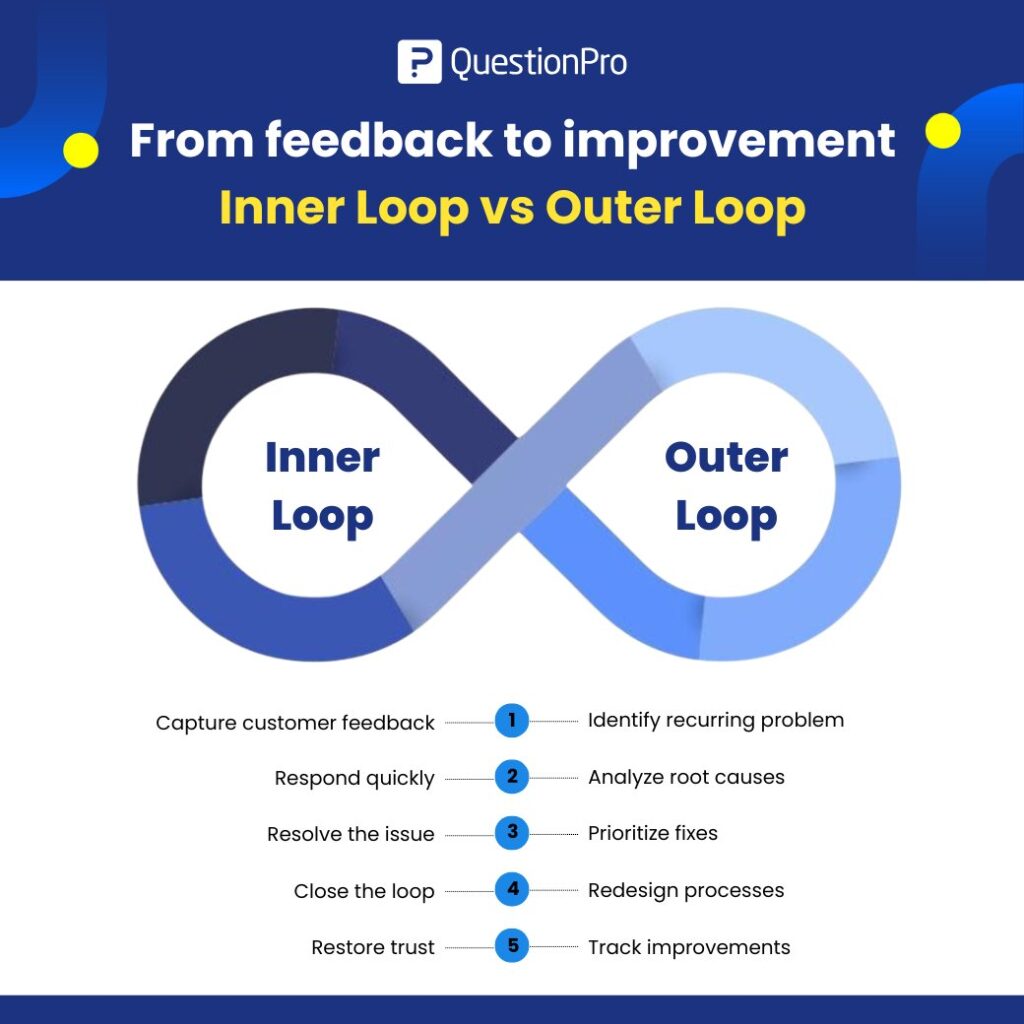
The solution: strategic action. Action is the bridge between hearing what a customer says and actually improving the experience for them. In Customer Experience, action typically manifests in two distinct layers: the “Inner Loop” and the “Outer Loop.”
The Inner Loop (Individual Resolution)
When a customer reports a negative experience, the clock starts ticking. Action at this level is about closing the loop. This involves reaching out to dissatisfied customers, resolving their specific issues, and restoring the relationships. This immediate action prevents churn and often turns a detractor into a loyal advocate because it proves the company is actually listening.
The Outer Loop (Systems Improvement)
While the Inner Loop fixes individual customers’ problems, the Outer Loop fixes the root cause of recurring problems for everyone. If ten customers complain about a confusing checkout process, the “action” requires redesigning that process. Without systemic action, an organization finds itself constantly putting out the same fires, which is inefficient and has a negative impact on both employees and customers.
Beyond the Loops
Often Customer Experience programs speak about action in terms of the tactical closed inner loop and action taken from the strategic executive level of the outer loop. However, action can also be taken on a daily basis from all the feedback received even before reviewing insights from scores. Now, AI agents can make recommendations on “local micro actions” that can be done at the front line level based on observations gathered during the feedback process, but not severe enough to trigger a closed loop action. It could be something small like “the store was not as clean as I would hope” – not triggering a CX ticket, but something that can still easily be actioned – if someone is reading, listening and ready to act on the feedback.
Personal & Organizational Accountability
If Action is the “what,” Accountability is the “who” and “how.” Accountability ensures that the customer experience isn’t just “a job for someone else”, rather it is core to the culture. Accountability fails when it is vague. In high-performing organizations, the customer experience metrics (beyond NPS and CSAT) are tied to specific departments and individuals. For example:
- The Product Team is accountable for “ease of use”.
- The Support Team is accountable for resolution time.
- The Marketing Team is accountable for setting accurate expectations.
When everyone is responsible for “the customer,” often nobody is. In building RACI charts, it is better to have no one own the task rather than multiple people “owning” the task. True accountability requires clear ownership where leaders and front-line teams are empowered to make decisions that prioritize the long-term customer relationship over short-term internal KPIs. Telling the organization that the primary goal is to “raise the NPS score” means no one single person owns the experience and instead fingers get pointed. Actions should be broken down into locally manageable pieces.
Accountability thrives when there is transparency. This is when Customer Experience data is shared transparently across the organization, not just buried in a report for the C-suite. It will also create a culture of peer-to-peer accountability. When a team sees their individual impact on customer satisfaction scores in real-time, it fosters a sense of pride and urgency that a generic “mission statement” never could.
Action without Accountability bestows chaos. It leads to disjointed efforts where teams try to fix things in silos, often creating new problems elsewhere. You might have a rogue customer service agent who depends on giving out free credits to keep customers happy (Action), but without a framework (Accountability) to track why those credits are needed, the underlying product defect never gets fixed.
Conversely, Accountability without Action creates frustration in the organization. There is nothing more soul-crushing for employees than being held responsible for a company-wide metric like NPS without being given the resources, authority, or budget to take action and improve it. This often leads to gaming where employees beg customers for 10’s on surveys rather than actually improving the experience.
In industries where products become increasingly commoditized, the “experience” can become the only true differentiator. And customers can recognize the difference between companies that “campaign” on customer experience and those that have a culture of experience improvement. When a company says “We value your feedback”, customers quickly recognize that statement is a lie because nothing ever changes after they take the time to speak up about their observations.
Action and Accountability transform Customer Experience from a department with a budget into an identity that aligns with the company culture. It only happens when that company demonstrates consistent action – it builds “brand integrity” and customers begin to trust that, even if something goes wrong, the company will own it and fix it. This trust is the foundation of building customer loyalty. Furthermore, the company doing this creates a virtuous cycle: as customers see their feedback resulting in tangible changes, they become more likely to provide high-quality feedback in the future, providing the organization with more information to take action, and the budgets are increased – not only for a “program”, but for the projects that will develop a permanent roadmap for growth through CX.
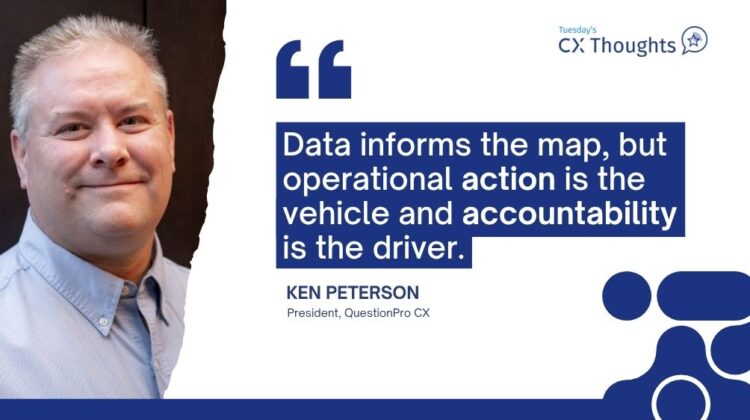
Managing customer experience is not a project with a start and end date; it is an operating system. Data informs the map, but operational action is the vehicle and accountability is the driver. Without both, your CX strategy is just a parked car—full of potential, but going nowhere.
If you would like to learn more about how we guide experiences through Customer Journey Management and the Voice of the Customer, please do not hesitate to reach out to me and schedule time. I’m always excited to talk about how your company can become more actionable.
Measure the experience you are delivering to your customers
Understanding customer satisfaction levels and their perception is essential to evaluating the impact of our efforts across every aspect of our business. Our main goal remains the same: providing a great experience.
If you’re also interested in gaining deeper insights into your customer base, QuestionPro Customer Experience offers the necessary tools to help you achieve this. Schedule a demo now—we’ll be happy to guide you through the platform and learn about the challenges in reaching your goals.