Adidas customer experience sits at the center of how the sportswear brand competes against Nike, Puma, and a growing list of direct-to-consumer challengers. Products alone no longer win loyalty on their own. The brand invests heavily in personalization, membership, and omnichannel retail to keep customers coming back.
From its adiClub loyalty program to its flagship stores, Adidas treats every customer touchpoint as a chance to build trust. These choices offer a useful case study for any brand trying to turn one-time buyers into repeat customers.
In this article, we’ll break down the strategy behind Adidas customer experience, walk through its customer journey map, and share lessons you can apply to your own CX program.
What is the Adidas customer experience strategy?
Adidas customer experience refers to how the brand designs every customer touchpoint, from the first ad a shopper sees to the support call they make after a purchase. The strategy blends personalization, digital tools, and physical retail into one connected system rather than treating each channel as its own project.
It is different from customer service, which covers only direct support interactions. Customer experience is broader. It includes product design, app usability, store layout, and loyalty rewards, not just how a support agent responds to a complaint.
It is also different from adiClub, the loyalty program. adiClub is one tool inside a wider customer experience strategy. It is not the whole strategy on its own.
Why customer experience matters for a brand like Adidas
Sportswear is a crowded category. Price and product alone rarely decide which brand a shopper chooses twice. Experience often does.
Research backs this up. Research found that a company’s performance across complete customer journeys predicts overall satisfaction and churn more reliably than its performance on any single touchpoint.
For Adidas, that means a well-designed shoe matters less if the website is hard to navigate or a return takes too long. Every weak link in the journey chips away at trust, even when the product itself is strong.
This is part of why customer experience management has become its own discipline inside large retailers. Someone has to own the full picture, not just one channel.
Key initiatives shaping the Adidas customer experience
Adidas pulls several levers at once to shape how customers feel about the brand. These initiatives work together instead of running in isolation.
- Personalized shopping and the Adidas app: The app uses browsing history, past purchases, and stated preferences to surface relevant products and content, cutting down the effort it takes to find what a shopper actually wants.
- Omnichannel integration: Adidas connects its website, app, and physical stores so a customer can browse online and pick up in store, or start a return in one channel and finish it in another.
- adiClub membership: A free, tiered loyalty program rewards customers for purchases and for activity like logging runs, tying engagement to real behavior rather than spending alone.
- Flagship and experiential stores: Locations such as the Beijing flagship use digital displays and interactive features to turn a store visit into a brand experience, not just a transaction.
- Product customization: Through its customization platform, Adidas lets shoppers design footwear around their own fit, function, and style preferences.
- Sustainability as part of the experience: Recycled materials and circular product lines now factor into how Adidas frames the experience itself, not just a separate marketing message.
adiClub: Adidas’s loyalty program and its role in CX
adiClub is Adidas’s free membership program. Members earn points for purchases, app activity, and participation in events, then redeem those points for rewards, early product access, and exclusive experiences.
The program replaced the earlier Creators Club in 2022. It now operates across the Adidas app, the Confirmed app, and the Adidas Running app, so activity in any of them can count toward a member’s tier.
What makes adiClub notable is that it rewards behavior beyond spending. A member who logs runs or attends an event can move up a tier the same way a frequent shopper does. That design keeps the brand present in a customer’s life between purchases, not only at checkout.
Adidas customer journey map: From awareness to advocacy
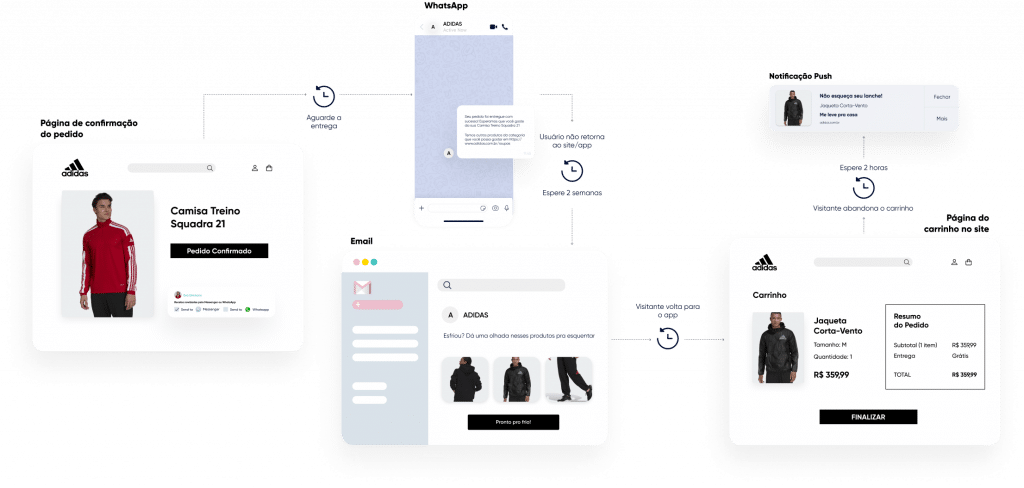
A customer journey map lays out every stage a customer moves through, from first hearing about a brand to becoming a vocal advocate for it. Mapping it out shows where an experience breaks down and where it already works well.
The table below outlines a simplified Adidas journey, built from publicly reported touchpoints and initiatives. Use it as a model for mapping your own brand’s journey with a customer journey mapping tool, paired with survey software to collect feedback at each stage.
| Stage | Key touchpoint | Common pain point | How Adidas responds |
|---|---|---|---|
| Awareness | Website, app, flagship stores | Shoppers struggle to find what they want | Improved search, app recommendations, and store signage |
| Consideration | Personalization, customization tools | Irrelevant product suggestions | Machine learning-driven recommendations |
| Purchase | Website, app, in-store checkout | Slow or complex checkout | Streamlined mobile and in-store payment flows |
| Usage | App, customer support | Confusing app navigation, slow support | Clearer app guidance and better-trained support staff |
| Loyalty | adiClub | Unclear program benefits | Transparent tier structure and visible rewards |
| Advocacy | Social media, creator partnerships | Low engagement with brand content | Influencer collaborations and user-generated content campaigns |
How to measure whether a customer experience strategy is working
Strategy only matters if a brand can prove it is working. Adidas and other retailers track a mix of metrics to see whether experience investments pay off.
| Metric | What it measures |
|---|---|
| Net Promoter Score (NPS) | Whether customers would recommend the brand to others |
| Customer Satisfaction (CSAT) | Satisfaction with a specific interaction, like a purchase or support call |
| Customer Effort Score (CES) | How easy or hard it was to complete an action |
| Repeat purchase rate | Whether customers return after their first purchase |
| Churn rate | How many customers stop engaging with the brand over time |
No single metric tells the whole story. Most retailers track several of these together, often alongside customer pain points surfaced through direct feedback, to see exactly where an experience is breaking down.
Common mistakes brands make when copying Adidas’s playbook
Adidas’s results come from years of investment, not a single tactic. Brands that copy pieces of it without the underlying data often fall short.
- Launching a loyalty program without a clear value proposition: Points alone do not build loyalty if the rewards feel generic or hard to reach.
- Personalizing without enough data: Recommendation engines need accurate purchase and browsing history to work well. Without it, suggestions feel random instead of helpful.
- Treating the customer journey map as a one-time project: Customer behavior shifts over time. A map built once and never revisited goes stale quickly.
- Ignoring the in-store experience: Digital investment matters, but physical retail still shapes how customers perceive a brand overall.
- Collecting feedback without acting on it: Surveys and reviews only help when a team closes the loop and makes visible changes.
Building a customer experience strategy that lasts
Adidas shows what is possible when a brand treats experience as a connected system instead of a list of separate projects. Personalization, loyalty, and journey mapping all reinforce each other when they share the same customer data.
Most brands do not need Adidas’s budget to get started. A clear view of customer touchpoints, a way to collect feedback at each stage, and a willingness to act on what customers say will cover most of the gap.
QuestionPro Customer Experience software supports this kind of work. It helps teams run satisfaction studies, map journeys, and close the feedback loop with customers. Learn more about QuestionPro Customer Experience if you want a structured way to start measuring your own strategy.
Experience is never finished. The brands that keep listening tend to keep winning.
Frequently Asked Questions (FAQs)
Adidas combines personalization, a behavior-based loyalty program, and experiential flagship stores into one connected strategy. Competitors often focus on just one or two of these levers, which makes Adidas’s full-funnel approach harder to replicate quickly.
Yes. adiClub operates in the United States alongside its presence in Europe and other global markets, rewarding members for purchases, app activity, and participation in Adidas-run events and training programs.
Adidas draws on browsing history, past purchases, app activity, and stated preferences like favorite sports or styles. This data feeds recommendation algorithms that surface more relevant products and content to each shopper.
Yes. Core ideas, such as mapping the customer journey, collecting feedback at each stage, and rewarding engagement beyond spending, do not require Adidas’s scale. Many apply just as well to a small direct-to-consumer brand.
Flagship stores extend the brand’s digital experience into physical space, using interactive displays and customization bars. They give customers a reason to visit in person instead of shopping online exclusively.