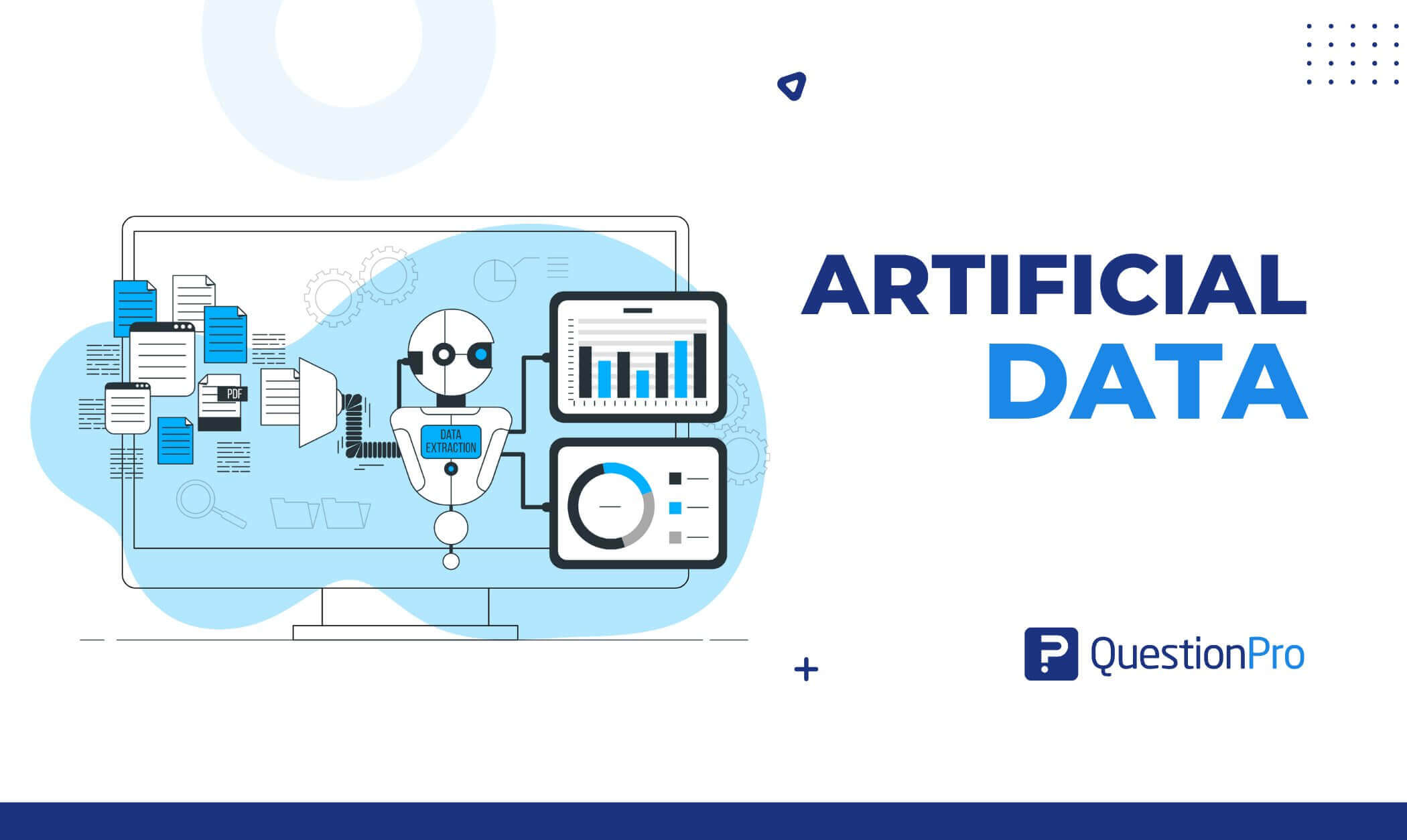
Artificial data is information that algorithms, rules, or simulations create instead of people and real events. Researchers use it to test surveys, train models, and explore ideas when real responses are slow, scarce, or too sensitive to share.
The term often gets mixed up with synthetic data, simulated data, and fake data. Each one means something slightly different, and those differences decide how far you can trust the results.
In this guide, we’ll define artificial data, show how teams make it, walk through US examples, and explain how to check its quality before you rely on it.
What is artificial data?
Artificial data is any data that a computer system creates instead of collecting it from real people, devices, or events. Rules, statistical models, simulations, or generative AI can produce it.
The simplest test is origin. If a person answered, a sensor recorded, or a transaction happened, the data is real. If an algorithm produced the values, the data is artificial, even when it looks identical to the real thing.
Artificial data covers several forms:
- Synthetic datasets that copy the statistical shape of real data
- Simulated outputs from a model of a system or process
- Augmented records that modify real examples
- Mock values that fill fields during software testing
Synthetic data is the form most readers mean when they search this term. The next section separates the terms.
How is artificial data different from synthetic, simulated, and augmented data?
Artificial data is the broad category, and synthetic, simulated, augmented, and mock data sit inside or beside it. The dividing line is whether real data feeds the process.
| Term | How it comes about | Real data as input? | Common use |
|---|---|---|---|
| Artificial data | Any algorithm, rule, or simulation creates it | Sometimes | Umbrella term for the rows below |
| Synthetic data | A model learns patterns from real data and generates new records | Yes | AI training, privacy-conscious sharing, survey modeling |
| Simulated data | A theoretical model or rule set mimics a process | Not required | Stress tests, forecasts, what-if scenarios |
| Augmented data | Small changes to real records expand a dataset | Yes | Image and text model training, small samples |
| Mock or dummy data | Random or rule-based placeholders fill fields | No | Software testing, interface demos |
| Anonymized data | Teams remove or mask identifiers on real records | Yes, and it stays real | Sharing records with lower identification risk |
Anonymized data is not artificial. It is real data with identifiers removed, so someone may still link records back to real people.
Most articles use “synthetic data” for the high-fidelity subtype. A separate guide to synthetic data covers its types and methods, and a comparison of synthetic data vs simulated data separates the two closest terms.
What types of artificial data exist?
Artificial data comes in types based on how much real data it contains and what form it takes. Knowing both helps you pick a generation method.
By real-data content
- Fully artificial: The generator creates every value. No original record appears in the output.
- Partially artificial: The generator replaces only sensitive fields, such as names or income. The remaining fields stay real.
- Hybrid: Real and artificial records sit side by side, often to fill gaps in small or skewed samples.
By format
- Tabular: Rows and columns, like survey responses or customer records.
- Text: Reviews, chat transcripts, and open-ended comments.
- Images and video: Product photos, road scenes, or medical scans for computer vision.
- Time series: Sensor readings, demand curves, or website traffic over time.
- Respondent-level: Simulated survey answers that follow the patterns of a real audience.
Researchers who mapped the field treat real and artificial data as parts of one data ecosystem, with hybrid data combining both.
How does artificial data generation work?
Artificial data generation works by defining or learning the patterns of a target dataset, then producing new records that follow them. The right method depends on how much real data you have and how realistic the output must be. A fuller walkthrough sits in the guide to synthetic data generation.
Rule-based and distribution-based generation
This method builds values from rules you write or probability distributions you choose. A probability distribution describes how often each value should appear. It works when you know the structure you need but lack real data.
Typical examples include:
- Satisfaction scores drawn from a bell curve
- Purchase counts by age band with set spending limits
- Test profiles with valid state and ZIP code combinations
Statistical modeling
Statistical modeling learns how variables move together in real data, such as age, region, and satisfaction. It then samples new records that keep those relationships. NIST describes the first step as building a probabilistic model of the population (a statistical picture of the group the data came from) and calls it the hardest part. Each generated record then stands for a person who does not exist.
Generative AI models
Generative adversarial networks (GANs) pair two models. One creates records, and the other tries to spot the fakes, so both improve. Variational autoencoders (VAEs) learn a compressed version of the data and decode new examples from it. Large language models (LLMs), the systems behind modern chatbots, generate text such as artificial reviews or interview answers.
These models handle images, text, and complex tables well. Watch for three problems:
- They can copy bias from the source data
- They can leak rare records
- They can produce values that look right but break real-world rules
Simulation and agent-based modeling
Simulation builds a model of a system and runs it to produce data. Agent-based modeling, one style of simulation, gives each person, vehicle, or machine its own rules and lets them interact. Public policy researchers use it to model how people move through a city, for example.
Data augmentation
Data augmentation creates new examples by modifying real ones. It helps models generalize, which means performing well on data they have not seen. It also guards against overfitting, which happens when a model memorizes training examples instead of learning general patterns.
Common changes include:
- Adding noise or distortion
- Rotating, cropping, or resizing images
- Masking certain fields
- Swapping words for synonyms in text
Tools that automate generation
Three tool types cover most needs: open-source libraries for data teams, enterprise platforms built for regulated data, and research platforms that generate respondent-level data from survey results. Pricing and fit vary widely, so compare options against your data type and privacy needs.
What are the benefits of artificial data?
Artificial data helps when real data is slow, scarce, costly, or sensitive. Synthetic data would make up more than 60% of AI training data by the end of 2024, up from 1% in 2021, according to Tech Monitor’s coverage of the report. Treat that number as a forecast, not a measurement. The practical benefits are easier to verify:
- On-demand volume: Generate test data whenever you need it instead of waiting for fieldwork.
- Lower collection cost: Skip panel fees and annotation work for early-stage tests.
- Rare-case coverage: Create examples of fraud, equipment failure, or unusual customer behavior.
- Known ground truth: You plant the pattern, so you can check whether an analysis method finds it. A published sports forecasting study calls this control over relationships a major advantage.
- Safer sharing: Fewer real records in circulation means fewer chances to expose them.
- Segment balance: Add records for small groups, but only if the source data represents them accurately.
What are real-world examples of artificial data?
Artificial data already supports work in government, healthcare, finance, transportation, retail, and software. The table shows what it replaces in each field. More scenarios appear in this list of synthetic data use cases.
| Field | Example | What artificial data replaces |
|---|---|---|
| Federal statistics | US Census Bureau SIPP Synthetic Beta | Restricted survey and tax records |
| Healthcare | Simulated patient records to test treatments and flag anomalies | Real patient records |
| Finance | Generated transactions to train fraud models and test credit risk | Scarce fraud examples |
| Automotive | Simulated crash and road scenes for driving systems | Rare real-world crashes |
| Retail and e-commerce | Modeled shopper behavior to test promotions and predict purchases | Live campaign tests |
| Software quality assurance | Generated customer profiles with set state, account type, and spending limits | Production data |
| Survey research | Simulated responses to test questionnaire logic | Live pilot respondents |
A US example: The Census Bureau’s SIPP Synthetic Beta
The SIPP Synthetic Beta is a Census Bureau product that links respondents from the Survey of Income and Program Participation to Social Security Administration and IRS records. Census models every variable so that no record matches a real person while the relationships between variables stay intact, according to the Census Bureau’s own guidance. Staff tested whether any record could be linked to a real person before release and judged that chance negligible.
The accuracy record is mixed. A Census working paper found the file replicates many results from the confidential data, including descriptive statistics and regression coefficients. Similarity declined when analyses relied on merged external data or on changes in a person’s earnings over time. The lesson applies to any team: artificial data suits exploration, and final results need validation against real data.
How do market researchers and customer experience teams use artificial data?
Research teams use artificial data to prepare studies, not to replace them. It lets you test the plan before real respondents see it.
- Questionnaire testing: Generate answers to test the survey before launch. That covers skip logic (routing past irrelevant questions), piping (reusing earlier answers), and quotas (caps per respondent group).
- Dashboard building: Fill reports with realistic placeholder data so stakeholders can review layouts without exposing customer records.
- Early concept screening: Simulate how segments might react to a price or feature idea, then validate the promising ones with real respondents.
- Hard-to-reach planning: Estimate how a niche audience might answer when recruiting them is slow or costly.
- Analyst training: Give new analysts a realistic dataset for practicing analysis, such as cross-tabs (comparing answers across groups).
- Model preparation: Train sentiment or churn models on augmented data before enough real feedback exists.
Real responses still supply what artificial data cannot: emotion, context, and the stories behind the numbers.
Should you use artificial data or real data?
Use artificial data to prepare and explore, and use real data to measure and decide. Neither type wins on every criterion, as the comparison shows.
| Criterion | Artificial data | Real data |
|---|---|---|
| Speed | Available on demand | Depends on fieldwork or collection |
| Cost | Low after setup | Higher, driven by recruitment and incentives |
| Privacy exposure | Lower, but not zero | Higher, with identifiable details |
| Rare events | Can be created deliberately | Scarce by definition |
| Realism | Limited to what the generator learned | Complete, including surprises |
| Emotional context | None | Rich, in respondents’ own words |
| Defensibility for decisions | Needs validation | Strongest evidence |
Artificial data complements real data and does not replace it. The strongest research programs use both.
How do you decide if artificial data fits your project?
Artificial data fits when the stakes are low to moderate, the goal is preparation or exploration, and you can validate the output. Work through these five steps before you generate anything.
- Name the decision.
Write down what the data will support, such as testing a survey flow or training a model. - Rate the stakes.
Testing and rehearsal are low stakes. Published findings, compliance filings, and pricing decisions are high stakes and need real data. - Check your source data.
Statistical and generative methods need enough real records to learn from. Rule-based methods need none. - Choose the simplest method that works.
Use rules for software tests, statistical models for tabular data, and generative models for images and text. - Set pass marks and a label.
Define acceptance tests before generating, and tag every record as real or artificial.
How do you evaluate artificial data quality?
Evaluate artificial data on three things: fidelity, utility, and privacy. Fidelity is how closely the data matches the statistics of the real data. Utility is whether it supports the task you built it for. Privacy is whether it avoids exposing real records.
| Test | Checks | Example pass mark |
|---|---|---|
| Distribution match | Fidelity | Category shares within 2 percentage points and means within 5% of the real data |
| Correlation gap | Fidelity | Pairwise correlations differ from the real data by 0.10 or less |
| Train on artificial, test on real | Utility | A model scores within 5 points of the same model trained on real data |
| Segment coverage | Utility | Every segment above 1% of the real data appears in the output |
| Exact-match check | Privacy | Zero artificial rows duplicate a real row |
| Nearest-neighbor distance | Privacy | No artificial row sits closer to a real record than real records sit to each other |
These pass marks are examples, not industry standards. Set them before you generate, tighten them as stakes rise, and store the results next to the dataset.
What are the risks and common mistakes with artificial data?
Artificial data fails quietly because it looks clean, so teams trust it too soon. These are the most common mistakes and their fixes.
- Treating it as ground truth: It reflects its source and its model. Validate headline findings against real responses.
- Copying source bias: Skewed source data produces skewed artificial data. Audit group-level balance before you generate.
- Assuming it is private: Rare combinations can still point to real people. Run exact-match and nearest-neighbor tests.
- Overfitting to generator quirks: Models can learn patterns that exist only in the artificial data. Always test on held-out real data.
- Building feedback loops: Training new generators on generated data compounds errors. Keep real data in every cycle.
- Skipping labels: Mixed datasets lose their history. Tag every record as real or artificial.
- Over-scoping: Exploration-grade data should not drive decisions that need statistical confidence.
Is artificial data the same as AI-generated survey fraud?
No. Artificial data is created on purpose, labeled, and kept apart from real results. AI-generated survey fraud is unlabeled bot or AI output that slips into a real dataset and passes as a human answer.
The risk runs in opposite directions. Deliberate artificial data helps you prepare. Hidden artificial responses distort measurement and can sink a study.
Three checks separate them: intent, labeling, and location. Deliberate artificial data has a purpose, a tag, and a separate file. Fraud has none of the three.
Does artificial data meet US privacy requirements?
Not automatically. US privacy rules such as the Health Insurance Portability and Accountability Act (HIPAA) and the California Consumer Privacy Act (CCPA) focus on whether data can identify a person. Artificial data can still point to real people if the generator copies rare records. This is general information, not legal advice.
NIST notes that many synthetic data techniques offer no formal privacy guarantee. Differential privacy, a mathematical framework that limits what anyone can learn about one person in a dataset, provides a formal privacy guarantee, though accuracy is its main challenge.
Before you share artificial data outside your team:
- Run exact-match and nearest-neighbor tests
- Document the source data, method, and date
- Ask privacy counsel whether the dataset counts as personal information
- Consider differential privacy for health, finance, and employee data
How does QuestionPro support artificial data in research?
QuestionPro’s Synthetic Data tools generate artificial respondent-level data from the survey and community data already in your account. Inside the Market Research Software, businesses use it for survey testing, forecasting, modeling, and scenario analysis. The help documentation lists Advanced, Team Edition, Research Edition, and Communities licenses as eligible.
Sync your data first
Synthetic research starts with a sync, which tells the system which real data to model. The Synthetic data help page outlines the steps:
- Go to Audience → Synthetic data and select Sync data.
- Choose Surveys or Communities as the source. A batch sync takes up to 5 surveys, and each needs more than 100 responses and at least 20 questions.
- Name the sync job and confirm. The system then starts synthesizing the data.
Choose a research mode
After the sync, you pick one of two modes.
| Mode | What it does | Best for |
|---|---|---|
| Synthetic responses | Simulates answers to a survey you select; unsupported question types mark the survey invalid | Testing questionnaires and spotting early trends |
| Synthetic cohort | Matches synthetic members to your study purpose, runs interview-style questions with 1 to 50 of them, and drafts a report with takeaways, quotes, and recommended actions | Early qualitative exploration |
The synthetic data for research page also describes Converse AI, which lets you hold follow-up conversations with synthetic personas. Treat every output as directional, and confirm key findings with real respondents.
Keep real and artificial data separate
QuestionPro states that other users cannot access your data and that it does not use customer data to train large language models or other AI models. On the intake side, Data Quality AI scores incoming answers in real time. It flags bot submissions, AI-generated responses, and gibberish, so unlabeled artificial answers stay out of your real dataset.
Artificial data works best as a rehearsal, not a replacement
Artificial data earns its place when it prepares you for real work. It helps you test a survey, rehearse an analysis, or find the gaps in a plan before real respondents spend their time. It cannot tell you how people actually feel.
The teams that get the most from it follow three habits:
- They label every artificial record
- They set pass marks before generating
- They confirm important findings with real data
Treat artificial data as a rehearsal, and it will make your real studies faster and sharper.
Frequently Asked Questions (FAQs)
Not quite. Fake data is a casual label for random placeholder values. Teams build artificial data on purpose, often to match defined patterns and relationships, so it can support testing, modeling, and exploration. Random fake values rarely can.
You can, but test the model on held-out real data (records kept aside from training) before relying on it. Artificial data can miss rare behaviors, and models can learn the generator’s quirks. A real test set shows whether performance holds up outside the artificial dataset.
It depends on the method. Rule-based generation needs none, while statistical and generative methods need enough real records to learn from. In QuestionPro, each survey you sync needs more than 100 responses and at least 20 questions.
Only with clear labeling and validation. The Census Bureau strongly urges researchers not to publish results from its SIPP Synthetic Beta without first validating them against confidential data. In any report, disclose the method, source data, and limits.
A digital twin is a virtual model of a real person, segment, or system that mirrors measured behavior. Research teams build twins from real respondent data, then simulate how that audience might answer new questions before they run a live study.