Synthetic data generation is the process of creating artificial datasets that reflect the structure, patterns, and statistical relationships of real data. Teams use it for AI training, software testing, privacy-safe analysis, simulations, and data sharing when real data is limited, sensitive, or difficult to access.
The goal is not to create random fake data. The goal is to create useful synthetic data that behaves enough like the original data to support a specific task without directly exposing sensitive records.
This matters in the USA because many teams work with regulated or sensitive data in healthcare, finance, education, government, and consumer research. Synthetic data can help reduce privacy risk, but it still needs validation, bias checks, and clear rules for use.
What does synthetic data generation mean?
Synthetic data generation means creating artificial data that resembles real data patterns without intentionally exposing original individual records. The generated data can be used for testing, model training, simulations, forecasting, research, or privacy-conscious data sharing.
A synthetic dataset may copy the statistical shape of real data, such as value ranges, distributions, correlations, patterns, and category relationships. It should not simply copy real rows from the original dataset.
For example, a company may create a synthetic customer dataset that reflects common purchase patterns, age groups, regions, product interests, and transaction behavior. The records are artificial, but the patterns can still support software testing or early model development.
For readers who want the parent-topic context, QuestionPro has a full guide on synthetic data and its types, methods, and use cases.
How does synthetic data generation work?
Synthetic data generation works by learning or defining the structure of a target dataset, generating artificial records, and testing whether the output is useful and safe for the intended purpose.
A practical process includes six steps:
- Define the use case: Decide whether the data is for model training, software testing, sharing, simulation, forecasting, or research.
- Review the source data or target schema: Understand the fields, formats, relationships, missing values, distributions, and sensitive variables.
- Choose a generation method: Select a technique based on data type, privacy risk, complexity, and required realism.
- Generate the synthetic dataset: Create artificial records that follow the needed patterns or rules.
- Validate quality and privacy risk: Check statistical similarity, task performance, bias, and re-identification risk.
- Use and monitor the dataset: Apply the data to the planned use case and revalidate it when the source data or business context changes.
The process should start with the goal. A dataset for software testing does not need the same level of fidelity as a dataset used to train a machine learning model.
What types of data can be generated synthetically?
Many types of data can be generated synthetically, including tabular data, text data, image data, time-series data, transaction data, and survey data. The right format depends on the use case and the source data structure.
Common synthetic data types include:
- Tabular data: Rows and columns used in spreadsheets, databases, CRM systems, surveys, and analytics tools.
- Text data: Artificial reviews, support messages, survey comments, chatbot transcripts, or documents.
- Image data: Synthetic medical images, product images, road scenes, or training visuals for computer vision.
- Time-series data: Sensor readings, stock prices, demand patterns, website traffic, or patient monitoring signals.
- Transaction data: Purchases, payments, fraud scenarios, account activity, or retail baskets.
- Survey and respondent-level data: Simulated responses that mirror research, panel, or community data patterns.
The data type matters because each format needs different generation and validation methods. A GAN may work well for images, while statistical modeling may be more practical for tabular survey data.
What are the main synthetic data generation techniques?
The main synthetic data generation techniques include rule-based generation, statistical modeling, bootstrapping, agent-based modeling, generative AI models, differential privacy, and perturbation. Each method works better for different data types and risk levels.
1. Rule-based and distribution-based generation
Rule-based and distribution-based generation creates data from known rules, assumptions, or probability distributions. A probability distribution describes how values are expected to appear in a dataset.
For example, a finance team may generate synthetic transaction amounts that follow an expected distribution. A software QA team may create fake customer profiles using defined age ranges, states, account types, and purchase limits.
This method is useful when you know the structure you need but do not have enough real data.
2. Statistical modeling
Statistical modeling learns relationships from existing data and generates new artificial records with similar patterns. It can preserve correlations, distributions, and category relationships.
For example, a research team may generate synthetic respondent data that keeps relationships between age group, product preference, location, and satisfaction score.
This method is often useful for tabular data, survey data, and structured business datasets.
Bootstrapping and resampling
Bootstrapping creates new samples by drawing repeatedly from an existing dataset, often with replacement. Resampling is often used to test model stability or increase variation in small datasets.
This method can be useful for data augmentation, which means creating additional training or testing examples from limited data.
Bootstrapping is simple and practical, but it may not protect privacy by itself because it can reuse real records. Teams should apply privacy safeguards when the original data is sensitive.
3. Agent-based modeling
Agent-based modeling simulates individual actors, called agents, and lets them interact under defined rules. An agent can represent a person, device, organization, vehicle, cell, or software process.
This method is useful for complex systems where behavior emerges from many small interactions.
For example, public policy researchers may simulate how people move through a city. A manufacturer may simulate how machines behave under different operating conditions.
4. Generative AI models
Generative AI models create new data by learning patterns from existing examples. GANs and VAEs are two common model types.
A GAN, or generative adversarial network, uses two models: one creates synthetic data, and the other tries to detect whether the data is real or synthetic. A VAE, or variational autoencoder, learns a compressed version of data patterns and uses it to generate new examples.
Generative models can create realistic images, text, tabular records, and complex data patterns. They also require strong validation because realistic-looking data can still carry bias, privacy risk, or poor task performance.
5. Differential privacy and perturbation
Differential privacy is a mathematical privacy framework that helps limit what can be learned about any one person from a dataset or output. Perturbation adds controlled noise or changes to data to reduce exposure of sensitive details.
NIST explains that differentially private synthetic data can make analysis easier because the data can be used with normal tools after privacy protection is applied. NIST also notes that accuracy is a major challenge for differentially private synthetic data.
This method is most relevant when privacy risk is a major concern, such as healthcare, finance, public sector data, or employee data.
What are the main uses of synthetic data generation?
The main uses of synthetic data generation include AI model training, software testing, privacy-conscious data sharing, scenario simulation, rare event modeling, customer research, and cybersecurity testing.
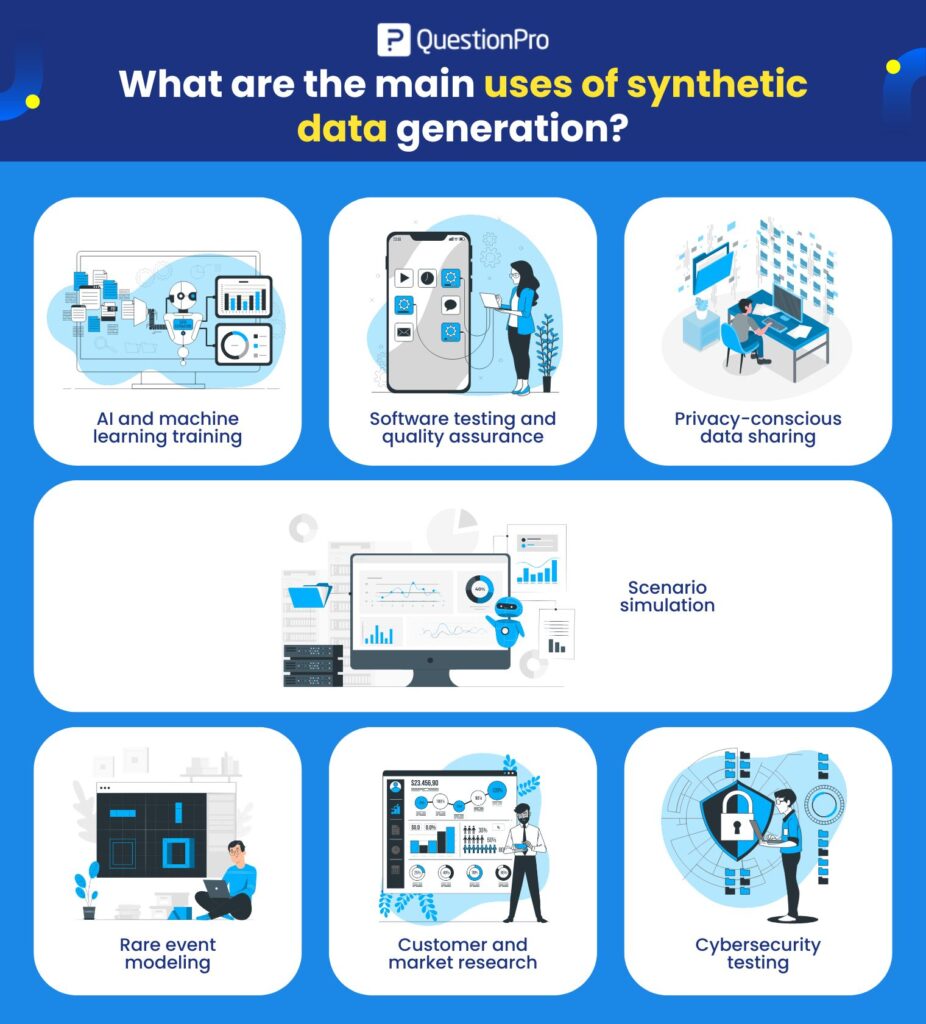
Common use cases include:
- AI and machine learning training: Synthetic datasets can help train or test models when real data is limited, sensitive, or imbalanced.
- Software testing and quality assurance: Development teams can test systems without exposing real customer or patient records.
- Privacy-conscious data sharing: Teams can share artificial datasets instead of raw sensitive data, when appropriate.
- Scenario simulation: Synthetic data can model future events, market changes, policy effects, or operational stress cases.
- Rare event modeling: Teams can create examples of fraud, equipment failure, rare diseases, or unusual customer behavior.
- Customer and market research: Researchers can model respondent behavior, test survey logic, or simulate segments.
- Cybersecurity testing: Security teams can train systems on artificial threat patterns without exposing production data.
The strongest use cases are usually early testing, controlled simulation, model preparation, and safe workflow development. High-impact decisions still need real-world validation.
How do you choose the right synthetic data generation technique?
To choose the right synthetic data generation technique, start with the use case, data type, privacy risk, required realism, available resources, and validation plan.
| Consideration | What to check |
|---|---|
| Privacy risk | Does the source data include sensitive, personal, or regulated information? |
| Data type | Is the data tabular, text, image, transaction, survey, or time-series data? |
| Use case | Is the data for testing, model training, sharing, forecasting, or simulation? |
| Fidelity | How close must the synthetic data be to real data patterns? |
| Resources | Do you have the technical skills and computing power required? |
| Validation | Can you test quality, bias, privacy risk, and task performance? |
A simple rule helps: choose the simplest method that safely meets the use case. Not every project needs a complex generative AI model. Sometimes clean rules, statistical modeling, or structured survey data are enough.
How do you validate synthetic data?
Synthetic data validation checks whether the generated data is realistic, useful, private, and fair enough for the intended use case. Validation should happen before the dataset is shared, modeled, or used for decisions.
A strong validation process checks:
- Statistical similarity: Does the synthetic data match key patterns in the source data?
- Data utility: Can the synthetic data support the intended task?
- Privacy risk: Could rare combinations or copied patterns expose individuals?
- Bias and fairness: Does the data repeat or increase source-data bias?
- Edge case coverage: Does the dataset include important rare or unusual cases?
- Use-case performance: Do models or systems perform well when tested against real-world data?
- Expert review: Have subject-matter, legal, privacy, or research stakeholders reviewed it?
Validation should be tied to the use case. A dataset for dashboard testing may need basic realism. A dataset for machine learning needs stronger task-performance testing.
What are the benefits of synthetic data generation?
Synthetic data generation helps teams work with useful data when real data is hard to access, risky to share, or too limited for testing and modeling.
Key benefits include:
- Reduces dependence on sensitive data: Teams can test and build without exposing raw records.
- Supports AI model training: Synthetic data can add examples when real data is scarce or imbalanced.
- Improves software testing: Developers can test workflows with realistic but artificial records.
- Supports safer collaboration: Teams can share synthetic datasets more easily than raw sensitive data.
- Enables scenario planning: Synthetic data can simulate future, rare, or difficult-to-observe events.
- Helps with research preparation: Researchers can test methods before using real data.
The value depends on quality. Bad synthetic data can lead teams in the wrong direction just as quickly as bad real data.
What are the risks and limitations of synthetic data generation?
Synthetic data generation has risks. It can reduce some privacy and access problems, but it can also create new problems when teams skip validation or use the data beyond its purpose.
Common limitations include:
- Source-data bias: Synthetic data can repeat or amplify bias from the original dataset.
- Poor realism: The dataset may miss real-world complexity, edge cases, or messy behavior.
- False confidence: A model may perform well on synthetic data and fail with real users or real systems.
- Privacy leakage: Poorly generated data may still reveal sensitive patterns.
- Weak task fit: Data that looks realistic may still fail for the intended analytical or modeling task.
- Maintenance needs: Synthetic datasets should be updated when source data, market behavior, or system rules change.
Synthetic data should be treated as a controlled tool, not a shortcut. The safest teams document how it was generated, what it was tested for, and what it should not be used for.
How can QuestionPro support synthetic data generation workflows?
QuestionPro can support synthetic data generation workflows by helping teams collect structured survey data and respondent-level research inputs. These datasets can support testing, forecasting, modeling, scenario analysis, or synthetic data workflows when handled with proper consent, privacy review, and validation.
QuestionPro also has a synthetic data capability for survey and panel-style use cases. Its help documentation describes synthetic data as artificially generated respondent-level data that mirrors real-world survey or panel data distributions. It can support survey testing, forecasting, modeling, and scenario analysis.
This makes QuestionPro especially relevant for research teams that need synthetic responses, respondent-level modeling, or simulated audience insights. It should not replace broader technical governance for regulated datasets, but it can support the research and survey data side of the workflow.
Final thoughts on synthetic data generation
Synthetic data generation is useful when teams need realistic data but cannot easily use real data. It can support AI training, software testing, research, simulation, and privacy-conscious data sharing.
The best results come from a clear use case, clean source data, the right generation method, and careful validation. The worst results happen when teams assume synthetic data is automatically private, accurate, or ready for high-stakes decisions.
Use synthetic data to reduce friction, not to avoid responsibility. It still needs privacy checks, bias review, documentation, and real-world testing when decisions matter.
Frequently Asked Questions
No. Anonymization modifies real data by removing or changing identifying details. Synthetic data generation creates artificial records that resemble real data patterns. Both approaches can still carry privacy risk if they are poorly designed or validated.
A synthetic data generator is software or a model that creates artificial datasets based on rules, source data, simulations, or learned patterns. It may generate tabular records, text, images, transactions, survey responses, or time-series data.
Yes. Synthetic data can support machine learning when real data is limited, sensitive, or imbalanced. It should be validated against real-world data because strong performance on synthetic examples does not always mean strong real-world performance.
Synthetic data generation costs vary based on data complexity, privacy requirements, generation method, validation needs, and tooling. Simple rule-based datasets may be low-cost, while high-fidelity datasets for AI training or regulated industries need more resources.
No. Synthetic data can reduce privacy risk, but it is not automatically safe. Poor generation methods may copy rare records or reveal sensitive patterns. Privacy testing and governance are still needed before sharing or using synthetic datasets.