Synthetic data in healthcare is artificially generated health data that mimics the patterns, structure, and relationships of real patient data without directly exposing real patient records. It can support medical research, AI model development, clinical trial planning, and safer data sharing.
The idea is simple, but the execution is not. Synthetic healthcare data needs to be realistic enough to be useful and private enough to reduce patient exposure. That balance matters in the USA because healthcare data often includes protected health information, or PHI, which is regulated under HIPAA.
Synthetic data can help teams work with realistic health information when real-world patient data is restricted, incomplete, expensive, or too sensitive to share. But it should not be treated as a perfect replacement for real clinical evidence.
What does synthetic data in healthcare mean?
Synthetic data in healthcare means artificial data created to resemble real clinical, operational, survey, imaging, or patient record data. It is designed to preserve useful statistical patterns while reducing exposure of identifiable patient information.
In simple terms, synthetic patient data looks and behaves like real healthcare data, but it should not represent actual individual patients.
For example, a synthetic dataset may include artificial patient profiles with age ranges, diagnoses, lab values, treatment paths, and outcomes. Researchers can use this kind of dataset to test an algorithm, plan a study, or simulate a healthcare workflow without directly using real patient records.
A PLOS Digital Health review explains that synthetic health data is gaining attention because it can make healthcare data more accessible for analysis, research, education, and technology development.
For a broader introduction to the parent topic, QuestionPro also explains synthetic data and how artificial datasets can support analysis, modeling, and privacy-conscious research workflows.
Why is synthetic data used in healthcare?
Synthetic data is used in healthcare because real patient data is sensitive, regulated, and difficult to share. It gives researchers and technology teams a safer way to test ideas, build models, and study patterns when real data access is limited.
Healthcare organizations may use synthetic health data to:
- Protect patient privacy during research and testing
- Reduce dependence on raw patient records
- Support AI and machine learning model development
- Simulate rare diseases or low-sample cases
- Test software workflows before live deployment
- Share realistic data across teams or institutions
- Plan clinical trials before using real participants
The main value is not that synthetic data is “fake.” The value is that it can copy useful patterns from real data while reducing direct exposure of patient identity.
How is synthetic healthcare data generated?
Synthetic healthcare data is generated using statistical methods, machine learning models, privacy techniques, or simulations. The right method depends on the use case, the source data, the privacy risk, and the level of realism required.
01. Statistical modeling
Statistical modeling creates synthetic data by learning patterns from existing datasets. It may copy distributions, relationships, and probabilities from real healthcare data without copying individual records.
For example, a model may learn the typical relationship between age, diagnosis, medication use, and hospital readmission risk. It can then generate artificial records that follow similar patterns.
02. Generative AI models
Generative AI models create new data based on patterns learned from training data. In healthcare, these models can generate synthetic tabular records, medical images, clinical notes, or patient journeys.
Generative adversarial networks, or GANs, are machine learning models that create new data by training two models against each other. Variational autoencoders, or VAEs, are models that learn compressed patterns in data and use them to generate new examples.
These models can be powerful, but they need careful testing. A realistic-looking dataset can still contain bias, privacy risk, or clinical errors.
03. Differential privacy
Differential privacy is a privacy technique that adds controlled noise to data or model outputs to reduce the chance of identifying a person.
In synthetic data generation, differential privacy can help lower re-identification risk. It can also reduce data accuracy if too much noise is added. Teams need to balance privacy protection with data utility.
04. Simulation-based data generation
Simulation-based generation creates synthetic data from rules, assumptions, or known clinical processes. It does not always require training directly on patient records.
For example, a public health team may simulate disease spread across a population. A hospital operations team may simulate appointment demand, staffing needs, or emergency department flow.
Simulation works well when teams understand the process they are modeling. It works poorly when assumptions are weak or incomplete.
Synthetic data vs anonymized data: what is the difference?
Synthetic data, anonymized data, and de-identified data are often confused, but they are not the same. The difference matters because each type carries different privacy and accuracy risks.
| Data type | What it means | Main risk |
| Synthetic data | Artificial data generated to resemble real data patterns | It may not reflect real-world clinical complexity |
| Anonymized data | Real data with identifying details removed or changed | Re-identification may still be possible |
| De-identified data | Real data stripped of direct identifiers | Indirect identifiers can still create privacy risk |
Synthetic data does not directly copy real patient records when generated properly. Anonymized and de-identified data still come from real people, even when names and direct identifiers are removed.
This is why synthetic data can reduce privacy risk, but it does not remove the need for governance, validation, and ethical review.
What are the main uses of synthetic data in healthcare?
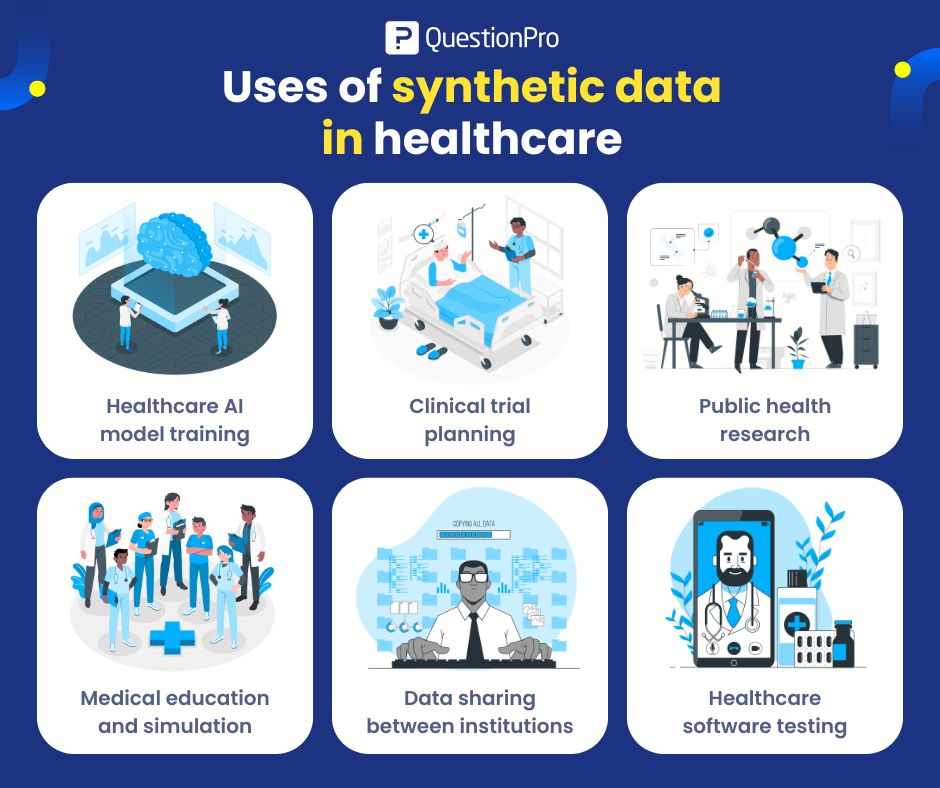
The main uses of synthetic data in healthcare include AI model training, clinical trial planning, public health research, medical education, data sharing, and healthcare software testing.
1. Healthcare AI model training
Synthetic data can help train and test healthcare AI models when real patient data is limited or difficult to access. It can also help expand datasets for rare conditions or underrepresented patient groups.
For example, an imaging team may use synthetic medical images to test whether a model can detect specific patterns before moving to real-world validation.
Synthetic data should not be the only testing source for high-risk medical AI. Models still need validation with real clinical data before they influence care.
2. Clinical trial planning
Synthetic data can support clinical trial planning by simulating patient cohorts, testing eligibility criteria, estimating recruitment needs, and stress-testing study designs.
For example, a research team may use synthetic patient profiles to explore whether trial inclusion criteria are too narrow or whether a sample size estimate seems realistic.
Synthetic data can help prepare a study. It should not replace real patient outcomes in regulatory-grade clinical evidence.
3. Public health research
Synthetic health data can support public health research by modeling disease spread, vaccination scenarios, healthcare resource needs, or population-level trends.
For example, a public health team may simulate outbreak scenarios to compare possible intervention strategies without exposing identifiable patient-level data.
This can be useful in the USA when agencies, universities, and healthcare systems need to collaborate while protecting sensitive data.
4. Medical education and simulation
Synthetic patient data can help medical students, clinicians, and staff practice diagnosis, treatment planning, and decision-making without using real patient records.
For example, educators can create realistic case studies with symptoms, lab values, medications, and outcomes. Students can practice clinical reasoning while avoiding privacy concerns.
5. Data sharing between institutions
Synthetic data can make healthcare collaboration easier when real patient data cannot be shared across hospitals, universities, research groups, or vendors.
For example, two research teams can test methods on a synthetic dataset before requesting access to real data through a formal review process.
This can speed up early research without weakening privacy standards.
6. Healthcare software testing
Healthcare software teams can use synthetic data to test EHR workflows, patient portals, billing systems, scheduling tools, dashboards, and analytics products.
Synthetic records can help teams test edge cases, system behavior, and data quality issues before using live patient data.
This is especially useful for development environments where real PHI should not be exposed.
What are the benefits of synthetic data in healthcare?
Synthetic data in healthcare can improve access to realistic data while reducing direct exposure of sensitive patient information. It is most useful when real data is restricted, incomplete, or too risky to use in early testing.
Key benefits include:
- Stronger privacy protection: Synthetic data can reduce the need to use raw patient records.
- Faster research preparation: Teams can test study designs, models, and workflows earlier.
- Better access for testing: Developers and researchers can work with realistic data without waiting for full data access.
- Support for rare scenarios: Synthetic data can simulate low-frequency conditions or unusual patient journeys.
- Safer collaboration: Institutions can share synthetic datasets more easily than raw patient data.
- More flexible training environments: Educators can create realistic patient cases without exposing real people.
The biggest benefit is controlled access. Synthetic data gives teams a way to learn, test, and prepare while keeping real patient information more protected.
What are the risks and limitations of synthetic healthcare data?
Synthetic healthcare data has real limits. It can support research and testing, but it can also create privacy, bias, and accuracy problems if teams treat it as risk-free.
Common risks include:
- Source-data bias: If the original data underrepresents certain groups, synthetic data can repeat or amplify that bias.
- Missing clinical complexity: Synthetic data may oversimplify real patient histories, comorbidities, or treatment pathways.
- False confidence: A model may perform well on synthetic data but fail with real-world patients.
- Privacy leakage: Poor generation methods can still expose patterns linked to real individuals.
- Weak generalization: Findings based on synthetic data may not transfer to real clinical settings.
- Ethical misuse: Synthetic data can still be used in misleading or harmful ways if governance is weak.
Synthetic data should be treated as a tool, not a shortcut. Healthcare teams need to know when it is appropriate and when real-world validation is required.
How should synthetic healthcare data be validated?
Synthetic healthcare data should be validated before it is used for research, AI training, public reporting, or operational decisions. Validation checks whether the dataset is realistic, useful, private, and fair.
A practical validation process should review:
- Statistical similarity: Does the synthetic data match the key patterns in the source data?
- Clinical plausibility: Do the records make medical sense to clinicians or domain experts?
- Privacy risk: Could individuals be re-identified through rare combinations or copied patterns?
- Bias and fairness: Are certain populations missing, distorted, or treated differently?
- Use-case performance: Does the data work for the specific research or testing goal?
- Expert review: Have clinical, legal, privacy, and research stakeholders reviewed the dataset?
Validation should match the use case. A dataset used for software testing may need different checks than a dataset used to train a healthcare AI model.
How can QuestionPro support healthcare research data collection?
QuestionPro can support healthcare research data collection by helping teams collect structured survey data, patient feedback, and research responses. These datasets can support analysis, segmentation, and synthetic data workflows when handled under proper privacy, consent, and ethics processes.
For example, healthcare businesses can use health care surveys to collect feedback from patients, medical professionals, or healthcare organizations. That survey data can help researchers understand patient experience, treatment barriers, care access, or service quality.
QuestionPro should not be treated as a replacement for clinical data governance or healthcare synthetic data validation. Its role is stronger at the data collection and research workflow stage, especially when teams need structured feedback before analysis or modeling.
Final thoughts on synthetic data in healthcare
Synthetic data in healthcare can help teams explore sensitive questions without immediately exposing real patient records. It can support AI development, research planning, software testing, medical education, and safer collaboration.
The strongest use cases are early testing, simulation, training, and privacy-conscious research preparation. The highest-risk use cases are clinical decision-making, regulatory evidence, and patient-level predictions without real-world validation.
The right approach is balanced. Use synthetic data to reduce friction and protect privacy, but validate it carefully, check for bias, and confirm important findings with real clinical evidence when needed.
Frequently Asked Questions (FAQs)
Synthetic data is not supposed to contain real patient records. It is artificial data generated to resemble real healthcare patterns. Still, teams should test privacy risk because poorly generated synthetic data may reveal sensitive patterns.
Synthetic data may reduce HIPAA-related privacy risk, but it does not automatically guarantee compliance. US healthcare teams should review how data is generated, validated, stored, shared, and governed before using it in research or development.
Synthetic patient data is used for AI model testing, clinical trial planning, software development, medical education, public health modeling, and early-stage research. It is useful when real patient records are restricted or too sensitive to share.
No. Synthetic data can support testing, simulation, and research preparation, but it should not fully replace real healthcare data. Clinical claims, AI performance, and patient outcome research still need real-world validation.
Synthetic healthcare data can be risky when it repeats source-data bias, misses clinical complexity, exposes privacy patterns, or creates false confidence. The risk is higher when teams skip validation or use it beyond its intended purpose.
If synthetic data isn’t validated properly, it might oversimplify clinical realities or inherit bias from the source data and lead to inaccurate conclusions or poorly trained algorithms.