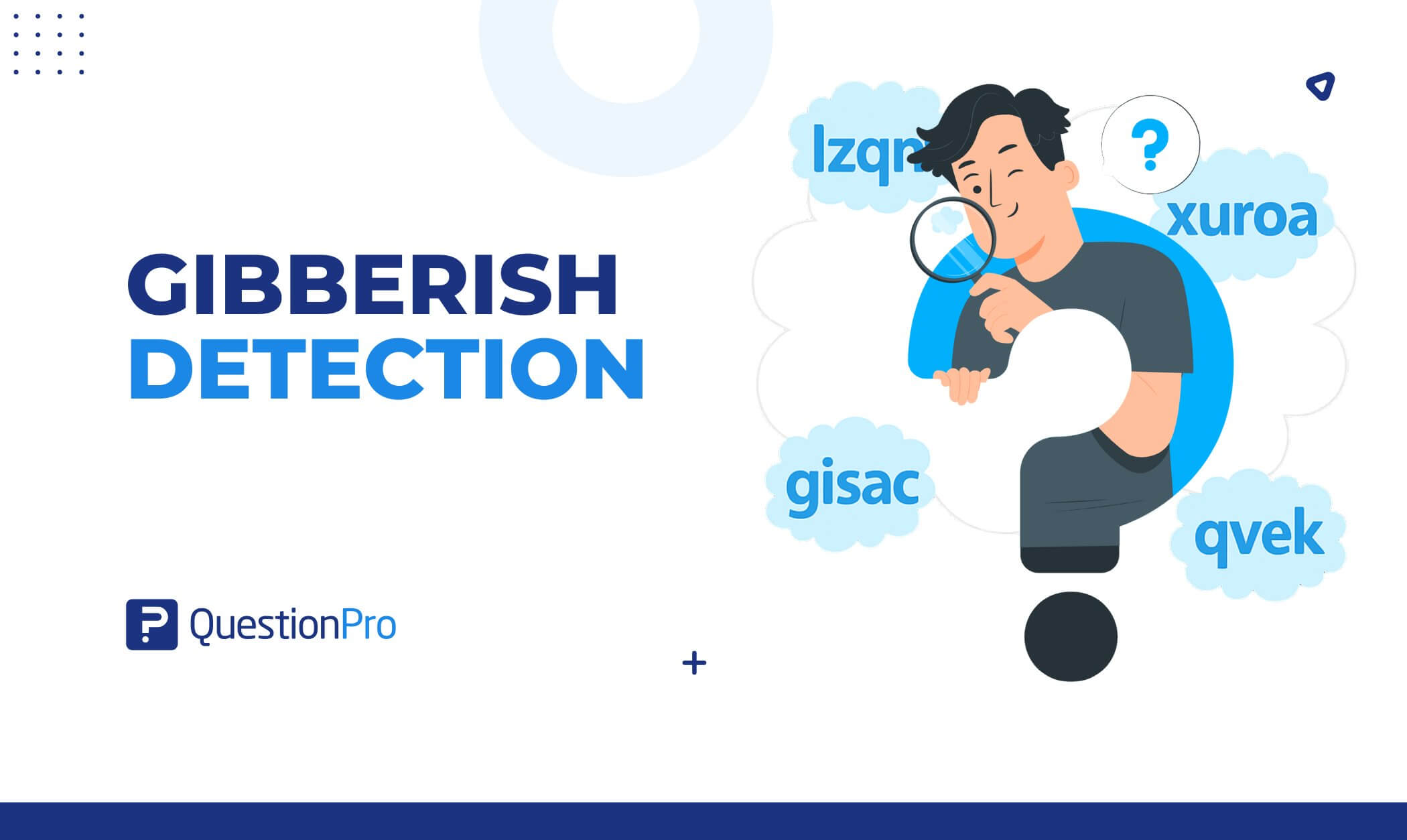
Every open-ended question invites a small risk. Somewhere in your dataset, a respondent may type random letters just to clear the field and collect an incentive. Gibberish detection is the safeguard built to catch that moment before it reaches your analysis.
It matters because a handful of nonsense answers can quietly distort a trend line, a persona, or a stakeholder decision. In this guide, we’ll explore how gibberish detection works, where it fits next to other data quality checks, and how to turn it on inside QuestionPro.
What is gibberish detection in surveys?
Gibberish detection is an AI-powered check that scans open-ended survey answers and flags text that has no real linguistic meaning. It looks for random keystrokes, repeated characters, or filler words typed only to skip past a required field.
Typical gibberish looks like “asdkjhasd,” “zxczxczxc,” or a single word mashed together with no grammatical structure. It is different from a genuine typo or a short but real answer like “good” or “yes.” A well-tuned detection system tells these apart instead of punishing respondents who simply write briefly.
This check matters most in open-ended survey questions, where respondents type their own words instead of picking from a list. QuestionPro’s gibberish module is part of its broader data quality tool, built to catch these responses in real time rather than during a manual post-survey cleanup.
How does AI detect gibberish in survey responses?
AI-based gibberish detection combines natural language processing, or NLP, the branch of AI that helps software interpret human language, with machine learning models trained on real response patterns. Together, they judge whether a string of text reads like organized language or like noise.
Here is what the system typically checks for:
- Consonant and vowel patterns that do not occur in natural language
- Answers with no discernible semantic meaning
- Repeated or randomized character strings, such as “qwqwqwqw”
- Overly short, low-effort text that fails to meet a minimum engagement threshold
When an answer matches these patterns, the platform can flag it for human review or remove it automatically, depending on how the survey is configured. That flexibility matters because academic, commercial, and panel-based research all tolerate different risk levels.
Why low-quality survey responses are becoming more common
Digital reach, mobile devices, and online panels have made surveys easier to distribute than ever. That same convenience has opened the door to inattentive respondents, incentive-driven cheating, and automated form fills.
Industry research groups have tracked this shift for years. ESOMAR and the Global Research Business Network list professional respondents and inattentive participants among the top threats to online sample quality, alongside duplicate entries and weak representativeness.
This is where survey data quality becomes a program, not a single setting. Gibberish detection catches one specific symptom, meaningless open-ended text, but it works best as part of a layered defense that also watches for speed, duplication, and bot activity, the same layered approach behind a modern survey management system.
Real-world example: Catching survey fraud with AI
QuestionPro’s data quality tools have been tested outside the lab. In a project with J4U, a U.S. panel provider, the platform helped uncover a wave of fraudulent survey responses that were not obvious at first glance.
The signals were scattered across the dataset instead of concentrated in one place:
- Repeated IP addresses tied to multiple “unique” respondents
- Bot-like completion patterns and timing
- Nonsensical open-ended answers that read like keyboard noise
Gibberish detection was one layer in that response, working alongside speed checks, duplicate tracking, and bot identification to confirm whether an open-ended answer was real, relevant, and human.
Gibberish detection vs. other survey data quality checks
Gibberish detection is often confused with the broader category of data cleaning, but it targets one narrow behavior. The table below separates it from the checks it usually runs alongside.
| Check | What it catches | Best signal for |
|---|---|---|
| Gibberish detection | Nonsensical or randomly typed open-ended text | Fake or rushed open-ended answers |
| Straightlining detection | Identical answers repeated down a rating grid | Disengaged multiple-choice respondents |
| Speed traps | Completion times far below the survey average | Respondents rushing through without reading |
| Duplicate response detection | Repeated submissions from the same person or device | Incentive fraud and panel abuse |
| Bot and AI detection | Automated, non-human submission patterns | Scripted or AI-generated survey fills |
No single check catches everything. A response can pass a speed trap and still contain gibberish, which is why most research teams run several of these checks together rather than relying on one.
Common mistakes to avoid with gibberish detection
Turning on gibberish detection is simple, but a few habits reduce how well it works. Watch for these before you assume your data is clean.
- Setting the module to auto-delete without ever reviewing a sample of flagged responses
- Treating short, genuine answers like “great” or “no complaints” as gibberish
- Ignoring non-English surveys, where language patterns need separate tuning
- Running gibberish detection alone instead of pairing it with speed, duplicate, and bot checks
- Never revisiting thresholds as a survey’s respondent pool or topic changes
Each of these turns a useful filter into either a false-positive problem or a false sense of security. Review flagged responses periodically, even after the system is running well.
How to measure the impact of gibberish detection on your data
Turning the feature on is not the finish line. Track a few simple metrics over time to know whether it is actually improving your dataset.
| Metric | What it tells you |
|---|---|
| Percentage of responses flagged as gibberish | How much noise your panel or audience is introducing |
| False-positive rate on manual review | Whether the module is too aggressive for your survey type |
| Change in verbatim response usability | Whether cleaned data is easier to code and theme |
| Time spent on manual data cleaning | Whether automation is actually reducing analyst workload |
If flagged volume climbs sharply between waves of the same survey, it is often a sign that a specific panel source or incentive structure needs a second look, not just a stricter filter.
How to turn on gibberish detection in QuestionPro
Enabling the feature takes a few steps inside your survey settings.
- Open your survey and go to Analytics, then Manage Data.
- Select the Data Quality option.
- Turn on the Gibberish Words toggle and choose which questions it applies to.
- Decide whether flagged responses should be marked for review or removed automatically.
Rules can be adjusted per survey, so a strict academic study and a fast commercial panel study do not have to share the same threshold. Full setup instructions are available in QuestionPro’s gibberish detection help documentation, and gibberish detection sits inside the same survey software toolkit as speed traps, duplicate checks, and bot detection.
A cleaner dataset is a more trustworthy one
Data quality checks like this one rarely make headlines, but they decide whether the conclusions built on top of a survey hold up under scrutiny. A single gibberish answer is a minor annoyance. A dataset full of them is a decision made on bad information.
The goal is not zero noise. It is knowing exactly how much noise exists and removing it before it reaches a stakeholder’s slide deck.
Frequently Asked Questions (FAQs)
Detection accuracy varies by language because natural language patterns differ. Most platforms, including QuestionPro, support major languages but recommend reviewing flagged results more closely for surveys fielded outside English-speaking markets.
Yes, short but genuine answers can occasionally trigger a flag. That is why most teams set the system to flag for review rather than auto-delete, especially early on, so a person can confirm the pattern before removing real data.
Gibberish detection judges the content of a written answer. Bot detection looks at behavioral signals like timing, IP patterns, and device fingerprints. A response can pass one check and still fail the other, which is why research teams usually run both.
Availability depends on your QuestionPro plan and the data quality features included with it. Check your account’s Data Quality settings under Analytics, or reach out to your account team to confirm access.
Yes. Even a five-minute customer feedback survey can pick up rushed or incentive-driven gibberish answers. The check adds value anywhere a survey uses open-ended text, whether the audience is a large panel or a short internal poll.