Customer experience management software is a category of tools that helps businesses collect customer feedback, track the customer journey, and act on insights across every touchpoint. Also called CEM or CXM software, these platforms range from feedback and survey tools to full omnichannel support suites.
In this blog, we compare the 10 best customer experience management software platforms for 2026, what each one does well, and how to think about choosing between them.
What is customer experience management software?
Customer experience management software is a platform that collects, analyzes, and acts on customer feedback and behavioral data across the entire customer journey.
Most platforms in this category handle some combination of:
- Survey and feedback collection
- Support ticketing and case management
- Sentiment and text analysis
- Journey mapping across touchpoints
Some tools specialize in one job, like feedback collection, while others bundle several functions into one suite.
That distinction matters when comparing tools. A platform built primarily for support ticketing solves a different problem than one built for survey-based feedback or journey mapping, even though both get marketed under the same “CX software” label. Reading past the marketing language to the actual core function is the single most useful filter when narrowing down a shortlist.
Why does customer experience management software matter?
Customer experience management software matters because retaining customers is measurably more profitable than constantly acquiring new ones.
Bain & Company’s own research found that increasing customer retention by just 5 percent can boost profits by 25 to 95 percent, depending on the industry. That gap is large enough that even a modest improvement in how a business tracks and responds to customer experience can meaningfully affect the bottom line.
A few concrete benefits show up consistently across businesses that use this kind of software well:
- Faster identification of recurring complaints before they cause churn
- Clearer visibility into which touchpoints actually drive customer loyalty
- Data-backed decisions instead of internal assumptions about what customers want
- A documented feedback loop that shows whether a fix actually worked
None of these benefits require the most expensive platform on the market. A small business using a basic feedback survey consistently often sees more value than a large enterprise that bought a comprehensive suite but never acts on what it collects.
How do you choose the right CEM software?
Choosing the right platform starts with identifying which specific job you need it to do, since no single tool covers every part of customer experience equally well.
A few questions worth answering before comparing vendors:
- Do you need feedback collection, support ticketing, journey mapping, or all three?
- How many channels does your team need to unify, email, chat, social, and phone?
- Does the platform need to integrate with your existing CRM or support stack?
- What’s the realistic budget, since pricing ranges from free tiers to enterprise custom quotes?
Answering these questions first narrows the list considerably before pricing or feature comparisons even start. Teams that skip this step often end up comparing customer satisfaction tools against ticketing platforms as if they solve the same problem, which makes the whole evaluation process harder than it needs to be.
Quick comparison of the best customer experience management software
Here’s a quick side-by-side look at the 10 tools covered in this guide, before the deeper breakdown of each one. Pricing shown reflects entry-level tiers where published, since most enterprise plans require a custom quote based on team size and usage.
| Software | Best for | Starting price |
|---|---|---|
| QuestionPro Customer Experience | Feedback surveys and experience analytics | Custom pricing |
| Zendesk | Omnichannel ticketing at scale | $19/agent/month |
| Qualtrics XM | Enterprise-wide experience management | Custom pricing |
| Medallia | Large-scale voice of customer programs | Custom pricing |
| HubSpot Service Hub | Teams already using HubSpot CRM | Free tier available |
| Intercom | AI-assisted chat and support | Custom pricing |
| Freshdesk | Simple, AI-powered support | Free tier available |
| Salesforce Service Cloud | Salesforce-native service teams | Custom pricing |
| Zoho Desk | SMBs already in the Zoho ecosystem | Free tier available |
| Birdeye | Multi-location reputation management | Custom pricing |
What are the best customer experience management software platforms?
Each of these 10 platforms leads in a different part of customer experience management, from feedback collection to omnichannel support. None of them are ranked against each other, since they solve different problems rather than competing head-to-head on the same job.
What does QuestionPro Customer Experience offer?
QuestionPro Customer Experience focuses on feedback collection through customer satisfaction surveys, Net Promoter Score tracking, and experience analytics. It’s built for teams that want to measure sentiment directly from customers rather than infer it from support tickets alone.
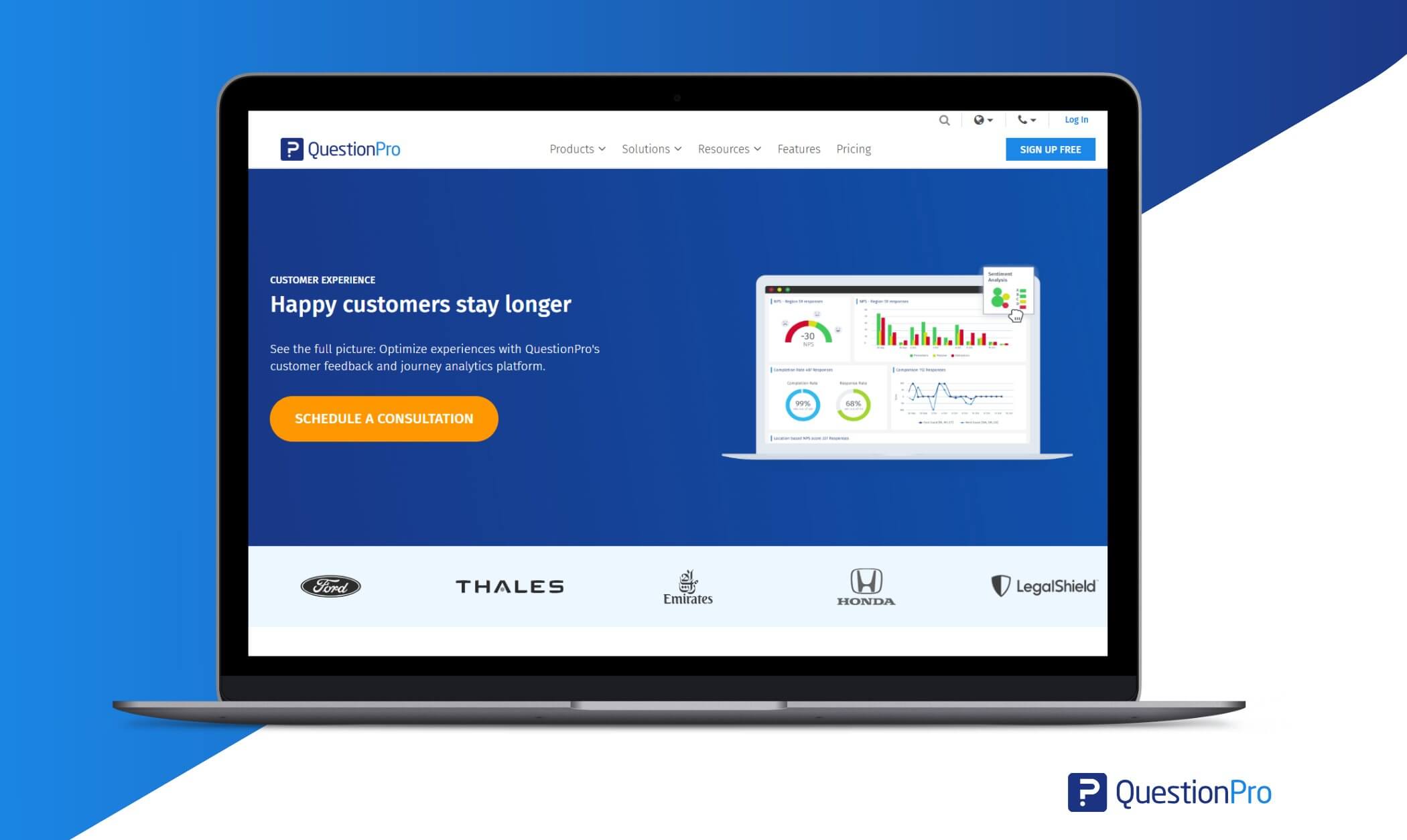
- Customer satisfaction, CSAT, and NPS survey templates
- Real-time dashboards for tracking sentiment trends
- Brand perception and experience analytics built into the same platform
How does Zendesk handle customer experience?
Zendesk centralizes support conversations across email, chat, voice, and social into one workspace. Its AI-assisted routing and automation make it a strong fit for teams handling high ticket volume across multiple channels.
Pricing starts around $19 per agent monthly for basic support, scaling up through higher tiers that add automation, analytics, and AI features as ticket volume grows.
What makes Qualtrics XM different?
Qualtrics XM is built for company-wide experience management, combining survey research with predictive analytics. It tends to suit larger organizations running structured, ongoing experience programs rather than a single feedback form.
- Enterprise-grade survey and research tools
- Predictive analytics layered on top of feedback data
- Designed for programs spanning multiple departments
What is Medallia best known for?
Medallia specializes in large-scale voice of customer programs, aggregating feedback across text, social, and traditional survey channels. Its sentiment and root-cause analysis tools help enterprise teams find patterns across huge volumes of feedback.
Larger organizations tend to choose Medallia specifically because it can process feedback volume that would overwhelm a simpler survey tool, at the cost of a steeper setup process.
Who should use HubSpot Service Hub?
HubSpot Service Hub fits teams already using HubSpot’s CRM, since it connects support tickets directly to existing customer records. It includes a free tier, making it accessible for smaller teams testing the category for the first time.
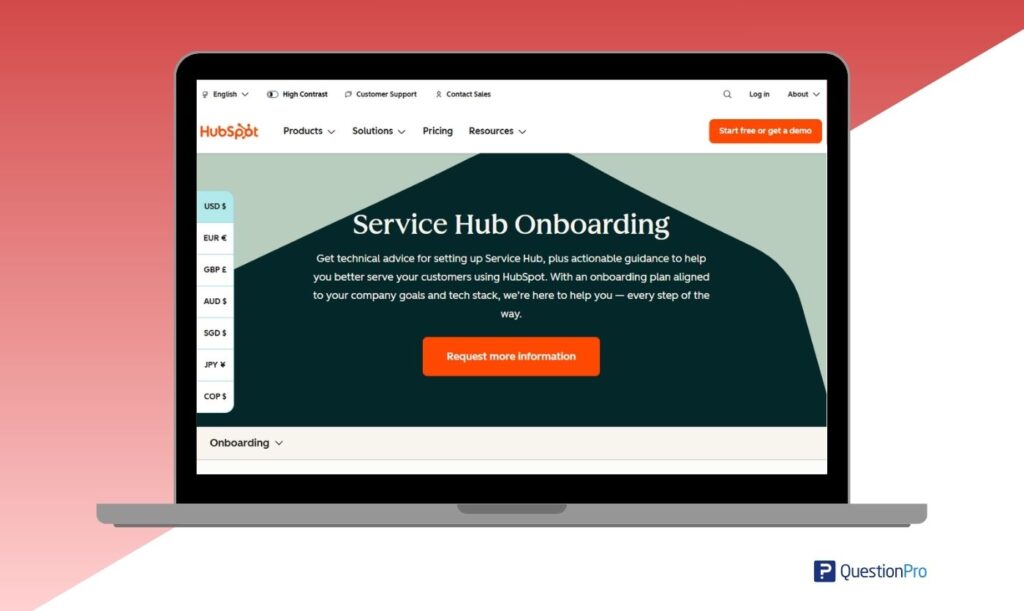
- Native integration with HubSpot CRM records
- Free tier for basic ticketing and live chat
- Shared inbox for support and sales conversations
What does Intercom bring to customer support?
Intercom pairs live chat with an AI agent that resolves common questions before escalating to a human. Teams that want to reduce ticket volume through automated first-response tend to gravitate toward Intercom.
The tradeoff is that Intercom’s pricing tends to run higher than comparable ticketing tools once a team adds its AI features, so it suits businesses where deflecting repetitive questions justifies the cost.
Why do teams choose Freshdesk?
Freshdesk offers straightforward ticket management with AI-powered suggestions built in. It works well for teams that want solid support functionality without a steep learning curve.
- Multi-channel ticketing across email, chat, and social
- Customizable workflows and service-level agreement tracking
- A free tier for smaller support teams
How does Salesforce Service Cloud fit into an existing stack?
Salesforce Service Cloud builds customer service directly onto the Salesforce CRM, unifying case history and real-time interactions in one screen. It’s the natural choice for teams already standardized on Salesforce.
Choosing it for the CRM integration alone makes sense. Choosing it without an existing Salesforce investment usually means paying for infrastructure a team doesn’t need yet.
What is Zoho Desk built for?
Zoho Desk serves small and mid-sized businesses that want help desk functionality integrated with the broader Zoho ecosystem, including Zoho CRM and Zoho Analytics. Multi-channel ticketing and SLA management come standard even on lower-tier plans.
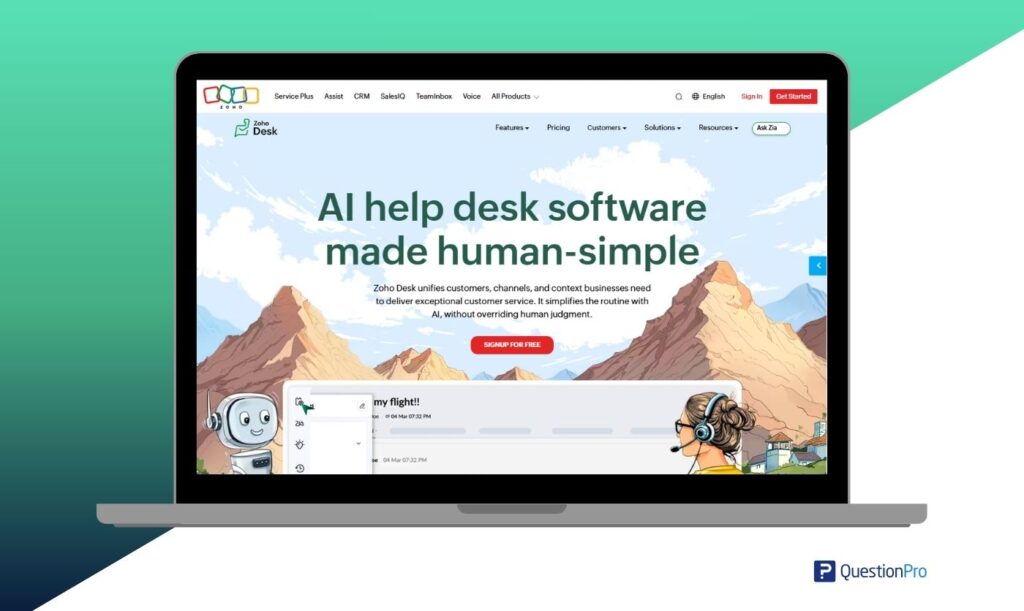
- Deep integration with Zoho CRM and Zoho Analytics
- Multi-channel ticketing across email, chat, and social
- SLA management available on lower-tier plans
How does Birdeye handle reputation management?
Birdeye focuses on reviews and reputation across multiple business locations, a different job than pure feedback or ticketing tools. Multi-location brands use it to monitor and respond to reviews at scale without checking dozens of platforms separately.
This makes Birdeye a poor substitute for a full support platform, but a strong addition alongside one for brands where public reviews directly affect foot traffic.
Common mistakes to avoid when choosing CEM software
The biggest mistake is choosing customer experience management software without a clear plan for acting on what it collects. Feedback collection is easy. Acting on it consistently is harder.
A few mistakes show up repeatedly:
- Choosing a tool based on feature count rather than the specific job it needs to do
- Tracking too many metrics without assigning clear ownership of each one
- Collecting feedback without a process for closing the loop with the customer
- Using the same survey for every stage of the customer journey
- Ignoring open-text feedback in favor of scores alone
- Failing to segment results by location, product line, or customer type
CEM software does not fix customer experience problems on its own. It gives a team the structure to find issues, assign action, and track whether things actually improve.
How does QuestionPro Customer Experience help businesses manage customer feedback?
QuestionPro Customer Experience connects feedback collection to the follow-up work most teams struggle with, routing responses to the right owner and tracking whether an issue actually gets resolved.
Most CX programs are strong at the collection side, sending surveys, gathering scores, building dashboards. Where they tend to break down is turning a low score into an actual fix a customer notices. Connecting survey responses directly to the team responsible for resolving them closes that gap without adding a separate process on top of the existing survey program.
This matters most for teams already running NPS or CSAT surveys who have volume but no consistent way to act on what comes back. The measurement was never the hard part. Acting on it, and being able to show that the score moved afterward, is.
Getting the most from your CEM software
Customer experience management software helps teams understand customers, measure key touchpoints, and improve experiences with more structure. No single platform on this list covers every job in customer experience management equally well, and that’s fine.
Most CX teams end up combining two or three tools rather than expecting one platform to do everything. Feedback collection, support ticketing, and reputation management are genuinely different jobs, and a tool built for one doesn’t automatically do the others well.
A practical way to start:
- Identify the single job causing the most pain right now
- Shortlist two or three platforms built specifically for that job
- Add journey monitoring or a second tool only once the first piece is working well
Buying a broad enterprise suite before knowing which specific problem needs solving is one of the most common ways teams waste budget on tools nobody ends up using.
The goal is not just to collect more feedback. The goal is to help the right teams act on it.
Frequently Asked Questions (FAQs)
CRM software manages customer data and sales pipelines. CEM software focuses on measuring and improving how customers actually experience a brand across support, feedback, and journey touchpoints.
Not always immediately, but even a simple feedback survey tool helps small businesses catch problems early. Many platforms on this list offer free tiers suited to smaller teams testing the category before committing to a paid plan.
Pricing varies widely. Some tools offer free tiers for basic use, while agent-based support platforms often start around $19 to $55 per agent monthly, and enterprise suites require custom quotes.
Some platforms cover both reasonably well, but most CX teams still combine a dedicated feedback tool with a separate support platform, since each is built around a different core job.
Prioritize the specific job you need solved first, whether that’s feedback collection, ticketing, or reputation management. Broad feature lists matter less than whether a tool excels at your actual primary use case, since most teams only use a fraction of a suite’s full feature set anyway.