Customer support teams don’t wake up thinking about SLAs.
They think about customers waiting for answers.
An enterprise customer reporting a production issue. A billing request that needs attention before month-end. A technical question that’s been sitting in the queue for hours.
Every ticket carries an expectation. The challenge is making sure those expectations are met consistently.
Many support platforms attempt to solve this with a simple concept: Overdue.
Once a ticket crosses a predefined threshold, it’s marked overdue.
On paper, that sounds reasonable.
In practice, it creates a reactive support process.
By the time a ticket becomes overdue, the commitment has already been missed.
The system tells you something went wrong, but it doesn’t help prevent it.
For growing support organizations managing hundreds or thousands of tickets every day, that’s no longer enough.
The Problem with “Overdue”
Support teams rarely operate under a single response target.
A critical production outage shouldn’t be treated the same as a low-priority feature request.
Different customers have different commitments.
Different ticket types require different urgency.
Different teams work in different time zones and business hours.
Yet many support systems reduce all of this complexity to a single overdue status.
This creates several operational challenges:
- No distinction between first response and final resolution commitments.
- No visibility into when an SLA is about to be missed.
- No automation to route or escalate high-risk tickets.
- No consideration for business hours, holidays, or regional workweeks.
- No consistent way to measure SLA performance across teams.
As ticket volumes increase, managers are forced to monitor queues manually, while agents constantly switch between priorities without knowing which commitments are most at risk.
The result isn’t just missed SLAs.
It’s a support organization that’s always reacting instead of planning.
Why Modern SLA Management Needs More Than Timers
Meeting service commitments isn’t simply about counting hours.
It’s about understanding which hours count.
Imagine a ticket is created on Friday evening after business hours.
Should the SLA timer begin immediately?
Or should it begin Monday morning when the support team actually starts work?
Now imagine that Monday is a public holiday.
Or the support team works Sunday through Thursday instead of Monday through Friday.
These aren’t edge cases.
They’re everyday scenarios for global support organizations.
Accurate SLA tracking depends on understanding how a business actually operates, not just how much time has passed.
That’s why effective SLA management needs to account for:
- Business hours
- Holiday calendars
- Regional workweeks
- Time zones
- Ticket priority
- Customer commitments
- Automated policy assignment
Without these, SLA reporting becomes misleading, and operational decisions become harder to trust.
Introducing Configurable SLA Management
Instead of relying on a single overdue indicator, Closedloop introduces a configurable SLA management framework that allows organizations to define, automate, and monitor service commitments across their entire support operation.
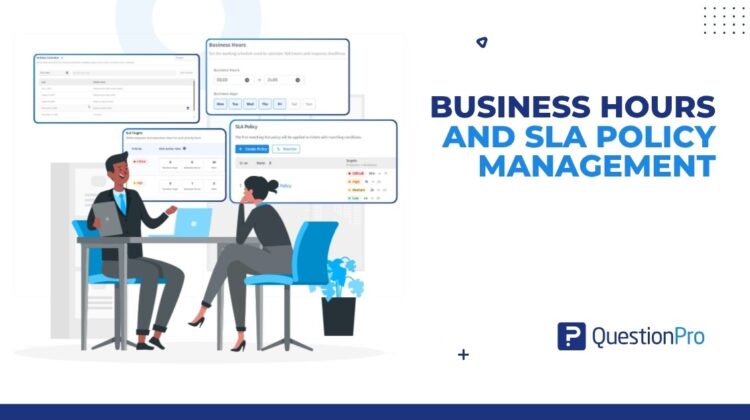
Administrators can create workspace-level SLA policies that define expected timelines for both customer response and issue resolution.
Rather than applying the same rules to every ticket, policies can be configured based on ticket priority and automatically assigned through qualification rules.
This ensures the right SLA is applied from the moment a ticket is created.
No manual intervention.
No inconsistent handling.
Just predictable service commitments.
Built Around How Support Teams Actually Work
Every organization operates differently.
Some support teams work standard business hours.
Others provide regional coverage across multiple time zones.
Some observe local holidays.
Others operate seven days a week.
The SLA engine adapts to these differences by calculating deadlines using configurable business hours and workspace holiday calendars.
If a ticket arrives outside working hours, the countdown begins when business resumes.
If a holiday interrupts the schedule, SLA calculations automatically exclude that period.
The result is an SLA clock that reflects real operational time rather than simply elapsed time.
Separate Response from Resolution
Not every support commitment ends with the first reply.
Customers often expect both a timely acknowledgement and a timely resolution.
Closedloop allows organizations to configure independent targets for:
- First Action SLA
- Resolution SLA
This provides better visibility into where delays occur.
A ticket may receive an immediate response while taking several days to resolve.
Another may miss its first response commitment despite being resolved quickly afterward.
Tracking these separately creates a much clearer picture of support performance.
Prioritize What Matters Most
A critical outage should never compete with a routine inquiry.
SLA policies can define different response and resolution targets for Critical, High, Medium, and Low priority tickets.
Combined with automatic qualification rules, every new ticket receives the appropriate service commitment based on its attributes.
Support agents no longer need to decide which timer applies.
The system handles that automatically.
Visibility Before a Breach Happens
The biggest limitation of traditional overdue tracking is timing.
You only discover the problem after it has already happened.
Modern SLA management shifts the focus earlier.
Support agents can see remaining SLA time directly on each ticket, while managers can monitor SLA status across the workspace.
When a breach occurs, it’s clearly identified, making prioritization straightforward and operational reporting more meaningful.
Rather than asking, “Which tickets are overdue?”
Teams can ask, “Which commitments are currently at risk?”
That’s a much more valuable operational question.
Preserving Historical Accuracy
Support operations evolve.
Business hours change.
Holiday calendars are updated.
SLA targets improve.
But historical tickets shouldn’t be recalculated every time a policy changes.
Closedloop versions SLA policies so that existing tickets continue using the configuration that was active when they were created.
Historical breach timestamps remain accurate, while new tickets automatically adopt the latest policies.
This preserves auditability and ensures reporting remains trustworthy over time.
Looking Ahead
Configurable SLA policies are only the beginning.
Future enhancements will expand visibility even further with live SLA countdowns, proactive breach notifications, automated escalations, and analytics that reveal long-term SLA performance trends across teams and ticket types.
Because effective support isn’t measured by how often teams recover from missed commitments.
It’s measured by how consistently they avoid missing them in the first place.