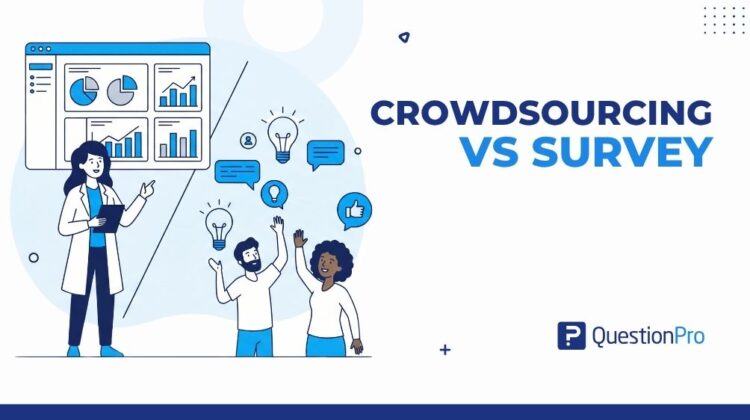
Should your next project use crowdsourcing vs survey methods? Both approaches pull in outside opinions, but only one gives you control over the exact questions being asked.
A survey works from a fixed set of questions and a defined group of respondents. Crowdsourcing opens the floor to a broader, often self-selected group and lets the conversation go wherever the crowd takes it. Both sit inside the wider practice of market research methods, but they solve different problems.
This guide breaks down what separates crowdsourcing from a survey, walks through a simple framework for choosing between them, and shows how QuestionPro customers combine both for sharper insight.
What is the difference between crowdsourcing and a survey?
A survey collects structured answers to a fixed set of questions from a chosen sample. Crowdsourcing collects open contributions, ideas, or opinions from a larger and often less defined public.
What is a survey?
A survey is a research tool that asks a defined group of people the same set of questions so their answers can be compared and measured. The researcher sets the direction. Participants respond within that structure, which keeps the resulting data easy to score, chart, and run through statistical analysis.
What is crowdsourcing?
Crowdsourcing is the practice of gathering ideas, feedback, or work from a large, open group of people, usually through an online platform, rather than from a single research team. The term covers a wide range of activities, from a distributed knowledge base like Wikipedia to an open innovation challenge that asks the public to solve a specific problem.
People often lump crowdsourcing, open innovation, and crowdfunding together, but they are not interchangeable. Open innovation platforms use crowdsourcing to generate new ideas, crowdfunding uses it to raise money, and a knowledge base like Wikipedia uses it to build and maintain content. Crowdsourcing has changed how many teams approach market research precisely because it adds an open, exploratory layer that a traditional survey was never built to provide.
A useful way to keep the terms straight: market research is the umbrella goal of understanding customers or a market, a survey is one tool under that umbrella built for structured answers, and crowdsourcing is a separate tool built for open, public input. Confusing the tool with the goal is where most teams go wrong when they scope a project.
Crowdsourcing vs survey: A side-by-side comparison
The two methods differ across control, data structure, and the kind of question each one answers best. Use this comparison before you write your next research brief.
| Factor | Survey | Crowdsourcing |
|---|---|---|
| Who sets the questions | The research team | The crowd, after a broad prompt |
| Data structure | Structured, closed-ended | Open-ended, mixed formats |
| Best for | Answering a specific, known question | Surfacing ideas you had not thought to ask about |
| Analysis speed | Fast, statistical | Slower, often qualitative coding |
| Participant pool | Defined, sometimes screened | Broad and self-selected |
| Typical use case | Customer satisfaction, product feedback | New product ideas, open innovation challenges |
Most research programs that use QuestionPro’s market research software start with a survey and add crowdsourced input only when the question genuinely calls for it.
Pros and cons of crowdsourcing vs surveys
Each method trades off control against reach. Weigh these before locking in a project plan.
Survey pros:
- Clean, structured data that is fast to analyze
- Full control over question wording and order
- Easier to project results onto a larger population
- Lower cost per response at scale
Survey cons:
- Limited to the questions you thought to ask
- Can miss ideas outside the researcher’s own assumptions
- Closed-ended formats can feel rigid to respondents
Crowdsourcing pros:
- Surfaces ideas and angles a survey would never prompt for
- Draws on a wider, more diverse pool of contributors
- Builds public engagement alongside the research itself
Crowdsourcing cons:
- Harder and slower to analyze at scale
- Participants are self-selected, not a controlled sample
- Needs a clear plan for evaluating and acting on submissions
Step-by-step guide to choosing between crowdsourcing and a survey
Four questions settle the choice for most teams.
- Do you already know the question you want answered?
If yes, a survey works well. Asking which ice cream flavor to launch next is a clean, closed question. If you are not even sure what the real question is, such as how to keep vegetables fresh on a long space mission, crowdsourcing helps surface the right question first.
- How structured does the data need to be?
Survey responses slot into rows and columns for fast statistical analysis. Crowdsourced input is richer but takes longer to sort and code by hand.
- How wide is your current reach?
A limited customer base benefits from crowdsourcing because the crowd steers the conversation toward what it actually cares about, which introduces topics a smaller sample would never raise.
- Do you need the “why” behind an answer without opening a full crowdsourcing project?
QuestionPro’s AskWhy open-ended survey questions capture some of that nuance inside a standard survey, without the time and moderation a crowdsourcing campaign requires.
Real-world examples of crowdsourcing and survey research
Seeing both methods in action makes the difference concrete.
Crowdsourcing examples:
- Wikipedia, built entirely from volunteer contributions to a shared knowledge base
- LEGO Ideas, where fans submit set designs and the company brings winning concepts to market
- NASA’s open science challenges, which invite the public to help solve engineering problems
Survey examples:
- A post-purchase satisfaction survey with a 1 to 5 rating scale
- An employee pulse survey with the same five questions sent every quarter
- A pricing study that asks a fixed sample how much they would pay for a new feature
How to measure success in crowdsourcing and survey research
Each method uses a different scorecard.
For a survey, track response rate, completion rate, and margin of error. These numbers tell you whether the sample is large and clean enough to trust.
For crowdsourcing, track participation rate, submission volume, and the diversity of ideas received. A community insights platform that logs ongoing engagement makes it easier to see which contributors keep coming back with useful input.
Common mistakes to avoid when choosing a research method
A few missteps show up again and again.
- Forcing a rigid survey onto a question you have not fully defined yet, which produces clean but shallow answers
- Launching a crowdsourcing campaign with no plan for evaluating or ranking submissions once they arrive
- Oversurveying a small, loyal customer base until response rates drop from fatigue
- Cutting a crowdsourcing budget too early. Mind the Bridge’s Open Innovation Outlook 2025 found that 86% of corporations planned to maintain or increase their open innovation budgets that year, up from 73% the year before
Combining crowdsourcing and surveys for richer insight
The two methods work best as a sequence rather than a choice.
A team can open a conversation in an online research community to see what customers raise on their own, with no prompt narrowing the topic. Once a handful of strong ideas or themes emerge, the same team can validate them at scale with a structured survey built in online survey software. The community surfaces what to ask. The survey confirms how many people agree.
This sequence keeps the creativity of an open crowd while still producing the clean, comparable data a statistical write-up needs. It also protects budget, since a short, focused survey to confirm a handful of finalist ideas costs far less than running a large crowdsourcing campaign with no upfront direction.
The right tool depends on the question, not the trend
Crowdsourcing and surveys are not competing methods fighting for the same job. A survey earns its place when the question is already clear and the answer needs to be counted. Crowdsourcing earns its place when the real question has not been found yet.
Most mature research programs end up using both, at different stages of the same project. The teams that get the most value are the ones that pick the method to fit the question, rather than defaulting to whichever tool they already know how to run.
Frequently Asked Questions (FAQs)
No. A survey asks a fixed set of questions to a defined group, while crowdsourcing gathers open contributions from a broader public. Crowdsourcing can include informal polls, but it also covers idea generation, crowdfunding, and volunteer knowledge projects that a survey format could never capture.
Yes, and many do. A common sequence opens an unstructured community discussion first, then follows up with a structured survey to test the strongest ideas against a larger, representative sample. This pairs open discovery with data that holds up to statistical review.
Costs vary by scale and platform, not by method alone. A simple survey sent through self-service software can cost very little, while a moderated crowdsourcing campaign with review and follow-up usually needs more staff time to manage submissions and evaluate ideas.
Self-selection is the main risk. People who choose to participate in an open crowd are not always representative of your full customer base, so conclusions drawn from crowdsourced input alone can skew toward the most vocal or motivated contributors.
Crowdsourcing often works better here because a small sample limits what a traditional survey can uncover statistically. An open discussion lets a small but engaged group raise topics the business had not considered asking about.